
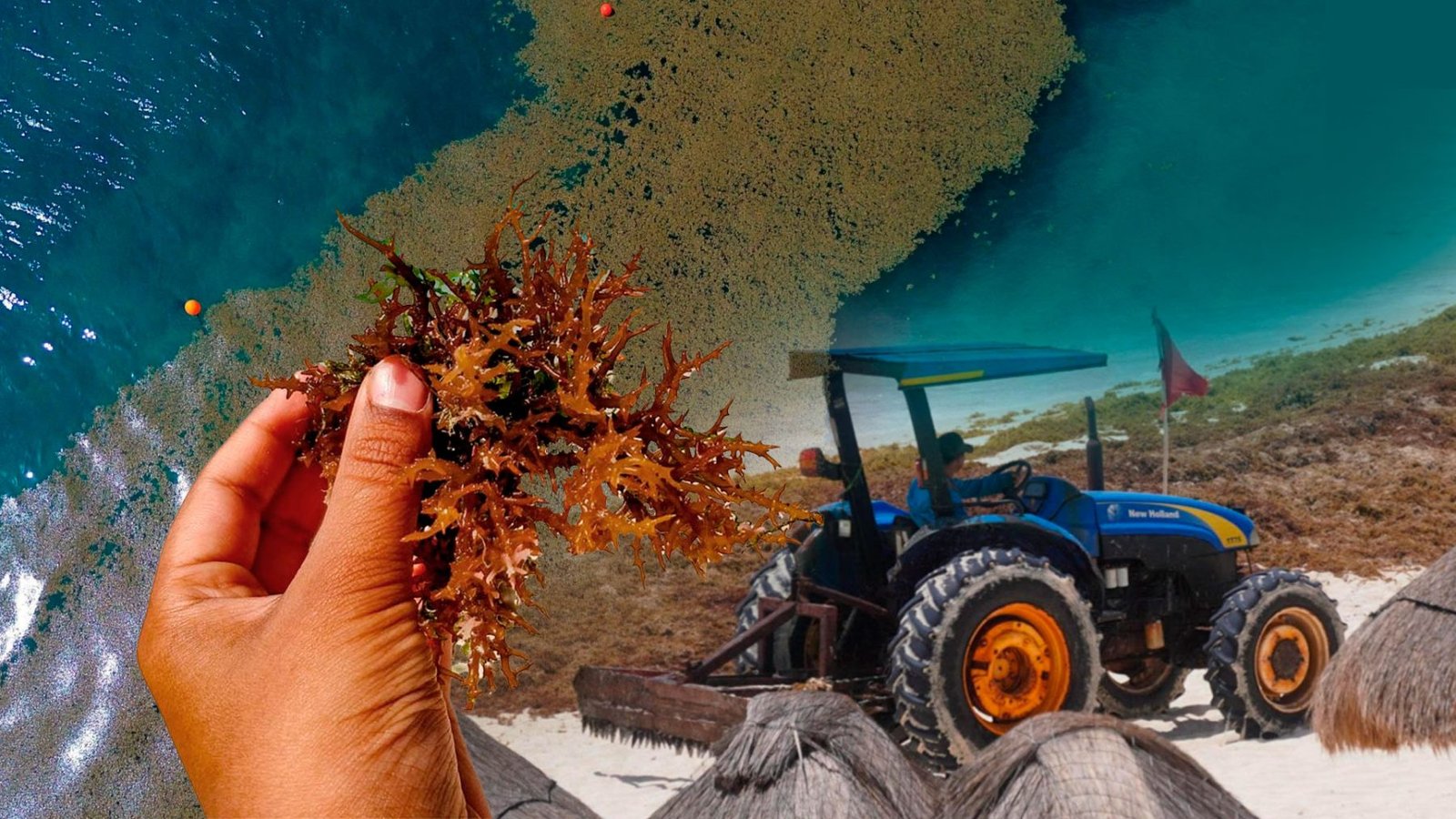
Cancún, Quintana Roo — The hotel, restaurant, and business sectors of the Mexican Caribbean have launched Caribe Circular, described as the world’s first multi-actor circular economy program applied to tourism at an industrial scale. The initiative aims to transform sargassum from a persistent environmental problem into a raw material for a new industry—one designed to protect the region, generate jobs, and position Mexico as a global leader in regenerative tourism.
The launch brings together some of the most influential players in the region. Founding members of the Grand Alliance for the Safeguarding of the Mexican Caribbean include the Hotel Council of the Mexican Caribbean, AMEXME Cancún, CANIRAC, INVEROTEL, and the Riviera Maya Hotel Association, along with the federal government’s Mexican Institute for Research in Sustainable Fisheries and Aquaculture (IMIPAS). All have signed a Manifesto of Adhesion and a Joint Declaration of Commitment, signaling coordinated action across both the private and public sectors.
The scale of the plan is ambitious. Caribe Circular aims to integrate 80% of hotels and 50% of restaurants in Quintana Roo by 2028. In its 2026 launch phase, more than 150 hotels and 600 restaurants are expected to participate, generating 250 direct jobs and processing 150,000 tons of sargassum. By 2028, the targets increase significantly: more than 1,180 hotels and 5,900 restaurants, 3,500 jobs, and the valorization of 2 million tons annually.
“Today, in Cancún, we stop talking about sargassum only as a problem and start talking about it as raw material,” said Ignacio Muñoz, CEO of The Seas We Love – SargaTech Platform. “Caribe Circular doesn’t clean beaches. It builds the market that makes it profitable to collect sargassum offshore, before it reaches the coast.”
That shift in approach is central to the project. Rather than focusing solely on cleanup after the seaweed arrives, Caribe Circular seeks to create industrial demand first—across six key sectors: bioplastics, biomaterials, bio-agricultural inputs, alginates, bioenergy, and biochar. Supply is then secured through a structured marketplace, the Sargassum Value Market (MVS), with financial incentives in place to support offshore collection before the algae reaches beaches.
The alliance is operated by The Seas We Love – SargaTech Platform and includes collaboration between tourism businesses, organized industry groups, federal and maritime authorities, and industrial partners.
“The tourism sector of the Mexican Caribbean goes from being a victim of sargassum to being an economic actor in the solution,” said David Ortiz Mena, President of the Hotel Council of the Mexican Caribbean.
At the center of the system is the SargaTech Circular Procurement Program (SCPP), which creates a closed-loop model. Beachfront hotels collect, dry, and sell sargassum, then purchase bioproducts made from that same material at equivalent value. Inland hotels, restaurants, and other businesses participate by purchasing circular products at prices comparable to conventional goods, without requiring operational changes and with full ESG traceability.
The economic case is clear. The hotel sector in the Mexican Caribbean currently spends more than $150 million annually managing sargassum, with most of it ultimately ending up in landfills. By contrast, the potential market for the SCPP in Quintana Roo alone is estimated at $2.46 billion per year.
“International hotel groups operating in the Mexican Caribbean support Caribe Circular because it combines what any tourist destination in the world needs: real environmental solutions, economic viability, and verifiable ESG traceability,” said Toni Chaves, President of the Riviera Maya Hotel Association and Executive Vice President of INVEROTEL. “This is destination competitiveness.”
The initiative is backed by a broader federal framework designed to support circular economy development. This includes the PODECIBI Decree (July 4, 2025), which establishes Circular Economy Development Poles for Well-being with tax incentives through 2030; the General Law of Circular Economy (January 19, 2026), which formally redefines waste as a resource within the Mexican economy; and the National Fisheries Charter Decree (August 6, 2025), which recognizes sargassum as a fishery resource rather than waste.
Caribe Circular also aligns with an active Expression of Interest submitted to SEMARNAT for the handling of 500,000 tons annually, along with Letters of Intent signed with CHCM, INVEROTEL/AHRM, and IMIPAS. The estimated capital investment required to build out the full industrial ecosystem ranges between $1.1 billion and $1.35 billion, with funding expected from private investment, multilateral banks such as IDB, CAF, IFC, and EIB, and European cooperation through the Global Gateway initiative.
For a region that has spent years reacting to sargassum influxes, the program represents a shift toward a more structured, long-term solution—one that attempts to turn a costly environmental challenge into a scalable economic opportunity.
More Business
- Cozumel to Get First Direct Flight From Europe With New Milan Route
- Cancún Airport Tops 400 Daily Flights for First Time Since August
- Quintana Roo Urges Homebuyers to Verify Property Records Before Buying
- Maya Ka’an Named Among National Geographic’s 25 Best Destinations for 2027
- Quintana Roo Eyes ‘Set-Jetting’ Boom as Expedia Report Links Film Exposure to Bookings
More Quintana Roo
- Call to Scrap Visitax Puts Quintana Roo’s Tourist Fee Under Scrutiny
- Caribbean Hoteliers Ask Mexico to Earmark 28% of Non-Resident Fee for Tourism Promotion
- Belize Tightens Río Hondo Border Patrols, Presses Mexico on Maya Train Extension
- Women’s Groups Demand Purge of Quintana Roo Police Forces Over Abuse and Criminal Ties
- Aquaponics Congress in Riviera Maya Takes Aim at Quintana Roo’s Food Dependence
