
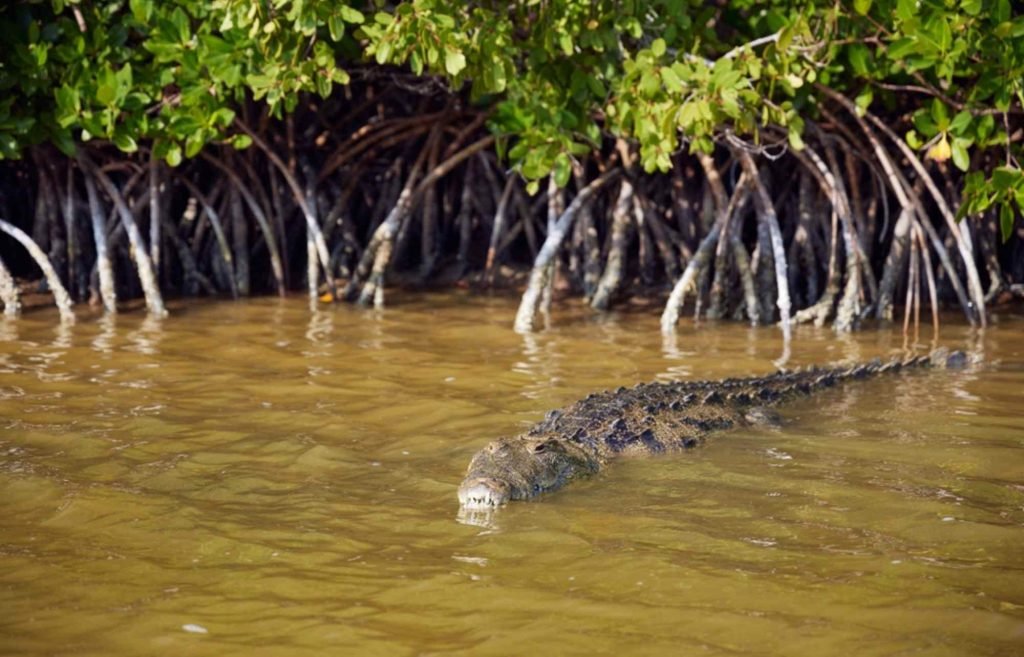
Tulum, Quintana Roo — The presence of crocodiles in Cobá Lagoon has decreased compared to previous years, when the reptiles were a far more visible—and sometimes unsettling—part of daily life, occasionally venturing into nearby streets and residential areas, according to local authorities.
Azcorra, the community delegate, said that in recent months there have been no reports of crocodiles moving toward inhabited zones, a noticeable change from past years when sightings near homes and tourist areas were more common. While crocodiles are still present in the lagoon, their behavior appears to have shifted. Some are believed to have relocated to the Macansho area, a nearby nature reserve with lower levels of human activity and less disturbance.
Cobá Lagoon sits just steps from the Cobá Archaeological Zone, making it a natural point of interest for visitors exploring the ancient site. In the past, that proximity created a unique, if unpredictable, interaction between wildlife and tourism.
Part of the reason for the earlier concentration of crocodiles near the lagoon’s edge may have been human behavior. Azcorra recalled that a local crafts vendor used to feed the animals chicken scraps, which conditioned them to gather near the tourist zone. Over time, the crocodiles became accustomed to human presence and food handouts, increasing the likelihood of close encounters. After the vendor’s death, the feeding stopped, and the crocodiles gradually dispersed, no longer congregating in the same visible numbers.
There were also reports in previous years of crocodiles dying under unclear circumstances, though no official cause was confirmed. These factors combined appear to have contributed to the current decline in sightings.
Even with fewer visible crocodiles, authorities stress that the animals have not disappeared. The lagoon remains their natural habitat, and the potential for encounters still exists. For that reason, local officials are now calling on environmental organizations, volunteers, and conservation-minded residents to assist with installing clear warning signage around the lagoon.
The goal is not to restrict access. Azcorra emphasized that Cobá Lagoon cannot be closed to the public, as it remains one of the community’s most important natural spaces and a key part of the visitor experience. Instead, the focus is on education and awareness—ensuring that both residents and tourists understand how to safely coexist with wildlife in the area.
Alongside these efforts, the community has taken steps to improve the surrounding environment. The delegation recently organized a cleanup along the main avenue and areas bordering the lagoon, drawing participation from local youth, students from the Colegio de Bachilleres, and residents. The initiative is part of an ongoing effort to reduce waste, protect water quality, and encourage shared responsibility for maintaining Cobá’s natural spaces.
For visitors, the change may be subtle. The crocodiles are still there, just less visible than before. For the community, however, it marks a shift back toward a more balanced coexistence—one where wildlife is less dependent on human interaction and more aligned with its natural patterns.
More Environment
- Mexican Caribbean Has Lost More Than 70% of Its Corals, UNAM Scientist Warns
- Sargassum Barrier Installation Begins in Puerto Aventuras
- Cancún to Open Glass Collection Center as Part of Circular Economy Push
- Cave Divers Push to Revive Jacinto Pat Museum in Tulum to Showcase Caves and Underground Rivers
- Snakes Account for Nearly Half of Cancún’s Wildlife Reports, Firefighters Say
More Tulum
- Gunmen Fire on Hotel Facade in Tulum’s La Veleta, No Injuries Reported
- Cancún Named World’s Most Active City in World Wellness Weekend 2026
- Tulum Drivers Push to Overhaul Traffic Rules Over Costly Towing
- Tulum Business Owners Say Police Still Extorting Tourists and Residents
- Tulum Airport Gets Three More Years of Full Airline Incentives
