
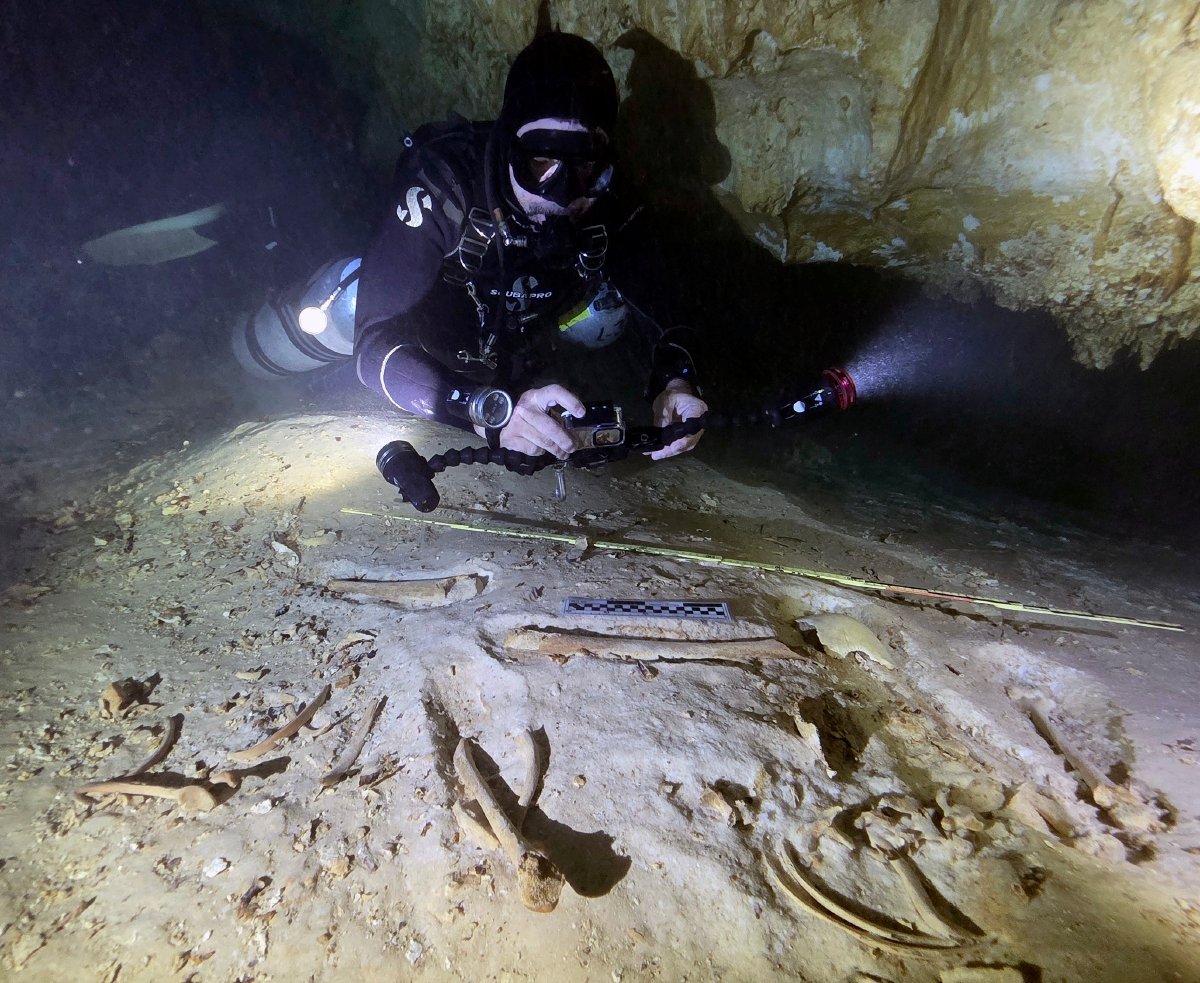
TULUM, Quintana Roo — An approximately 8,000-year-old human fossil has been discovered and recovered within the Sac Actún cave system beneath Tulum, adding to what is already one of the most important prehistoric corridors in the Americas.
The remains were located by Mexican underwater archaeologists inside the extensive Sac Actún system, a vast network of underground rivers and caverns that stretches approximately 380 kilometers beneath the Riviera Maya. Researchers believe the cave where the fossil was found once served as a funerary deposit when it was dry, thousands of years ago, before rising sea levels flooded the region at the end of the last Ice Age.
This new discovery brings the total number of prehistoric human remains documented in the area between Tulum and Playa del Carmen to eleven.
Among the previously recorded skeletons is the Woman of Naharón, dated at 13,721 years old and considered the oldest human fossil recorded in the Americas. Other significant discoveries in the region include the Grandfather of Muknal; Chan Hol 1, which was later stolen; the teenager Naia; the Lady of the Palms; El Pit 1; Ixchel; El Pit 2; and the Man of the Temple. These remains range in age from 8,000 to 13,721 years and have played a key role in reshaping scientific understanding of early human migration into the continent.
“To date, we have recorded fossil evidence of prehistoric humans from the Ice Age, dating back 10,000 to 13,000 years, in the area between Tulum and Playa del Carmen. So far, 10 human remains have been reported, including Naharón, which is currently the oldest, at 13,700 years old, on the entire continent. This new find adds to those 10,” said Octavio del Río Lara, director of the archaeology project in cenotes and caves in the region.
Reported Years Ago, Recovered in 2025
The existence of this fossil was first reported years ago to del Río Lara by underwater explorers Alejandro Reato and Peter Broger. In September 2022, its existence was publicly acknowledged without specific details as a form of public denunciation, intended to draw attention to the need to protect and preserve the region’s archaeological heritage amid large-scale development pressures, including infrastructure projects such as the Maya Train.
Following that public disclosure, a formal research project was developed in co-direction with archaeologist Gustavo García of INAH’s Subdirectorate of Underwater Archaeology. The project, focused on studying the first inhabitants of the Yucatán Peninsula and the broader American continent, received authorization from the INAH Archaeology Council in 2025, during the administration of President Claudia Sheinbaum.
The initiative is led by del Río Lara and his team, with collaboration from the Subdirectorate of Underwater Archaeology under the academic and scientific coordination of Luis Alberto Arenas Martos, director of Archaeological Studies.
Fieldwork Inside a Flooded Cave
Fieldwork took place in November 2025 over a 10-day period, including seven days of direct underwater intervention at the discovery site.
The remains were located approximately 200 meters inside the cave and about eight meters below the surface in a flooded section of the system.
“The only way the person could have reached that place was when the cave was dry, during the transition from the Pleistocene to the Holocene, at the end of the last ice age, about 10,000 years ago, when the sea level began to rise and gradually flooded the underground cavities,” del Río Lara explained.
Access to Sac Actún is through a large cenote formed by collapse, which leads into a cavern and eventually into the main network of underground rivers.
Researchers determined that roughly 8,000 years ago the body was deposited atop a dune of white calcareous sediment in a narrowing section of the cave where the walls converge with the floor. The remains were naturally protected by speleothems — mineral formations that grow from the cave floor and ceiling until they meet.
Based on anatomical position and context, the team believes the body was deliberately placed there when the cave was dry, likely as part of a ritual practice in what functioned as a mortuary deposit.
The skeleton was found articulated, though time and natural processes caused partial disarticulation. Approximately 45 percent of the skeleton has been recovered. Among the bones collected were femurs, tibias, fibulas, long bones of the upper limbs, vertebrae, and part of the skull with several teeth. The skull and some upper portions showed alterations that researchers believe may be the result of previous interventions.
The remains were extracted at the end of November and are currently undergoing stabilization after having remained underwater for at least 8,000 years.
Ongoing Scientific Analysis
The investigation is being conducted by a multidisciplinary team of Mexican specialists, including physical anthropologist Jorge Arturo Talavera; hydrogeologist Emiliano Monroy; molecular biology specialist Víctor Moreno; engineer Guillermo Dchristy, responsible for water quality analysis; and instructor Eugenio Acevez Núñez, who oversees direction and photographic documentation.
Once stabilized, the material will be transferred to INAH laboratories in Mexico, where Talavera González will conduct studies to determine sex, stature, possible pathologies, and, if possible, cause of death. Genetic analysis will seek to establish the individual’s ancestry and origin. In previous cases from the region, genetic studies have shown links to populations of Asian origin.
Development Pressures and Preservation
The Sac Actún cenote system was previously placed at risk by plans to construct the Tulum bypass road over sections of the area. A passage route was reportedly opened through illegal tree felling before the project was halted by the Federal Attorney for Environmental Protection (Profepa). Authorities later required route modifications to avoid impacting the cenotes within the system.
For residents of the Riviera Maya, the discovery is another reminder that beneath the beaches, resorts, and expanding infrastructure lies one of the most significant archaeological landscapes in the Americas — a submerged record of human presence dating back more than 13,000 years.
With this latest find, that record continues to grow.
More Lifestyle
- Tulum’s Mureco Museum Adds 53 Mesoamerican Pieces for Second Anniversary
- Chetumal Entrepreneur Develops Automatic Hammock Rocker for Mexico
- Cancún Prepares Janal Pixán 2026 at Puerto Juárez, Aims to Double Attendance
- Mental Health and Addiction Top Concerns Among Playa del Carmen Youth, Survey Finds
- Cancún Opens Registration for Janal Pixan 2026 Catrina and Altar Contests
More Tulum
- Zamna Tulum 2027: Dates, Lineup and Ticket Details
- Cancun Tourism Slumps 7% as Industry Leaders Urge Marketing Overhaul
- Quintana Roo Braces for Four Days of Heavy Rain and Flooding
- Tulum’s Mureco Museum Adds 53 Archaeological Pieces From Across Mesoamerica
- Tulum Fishing Cooperative Seeks Funding to Modernize Its Facilities
