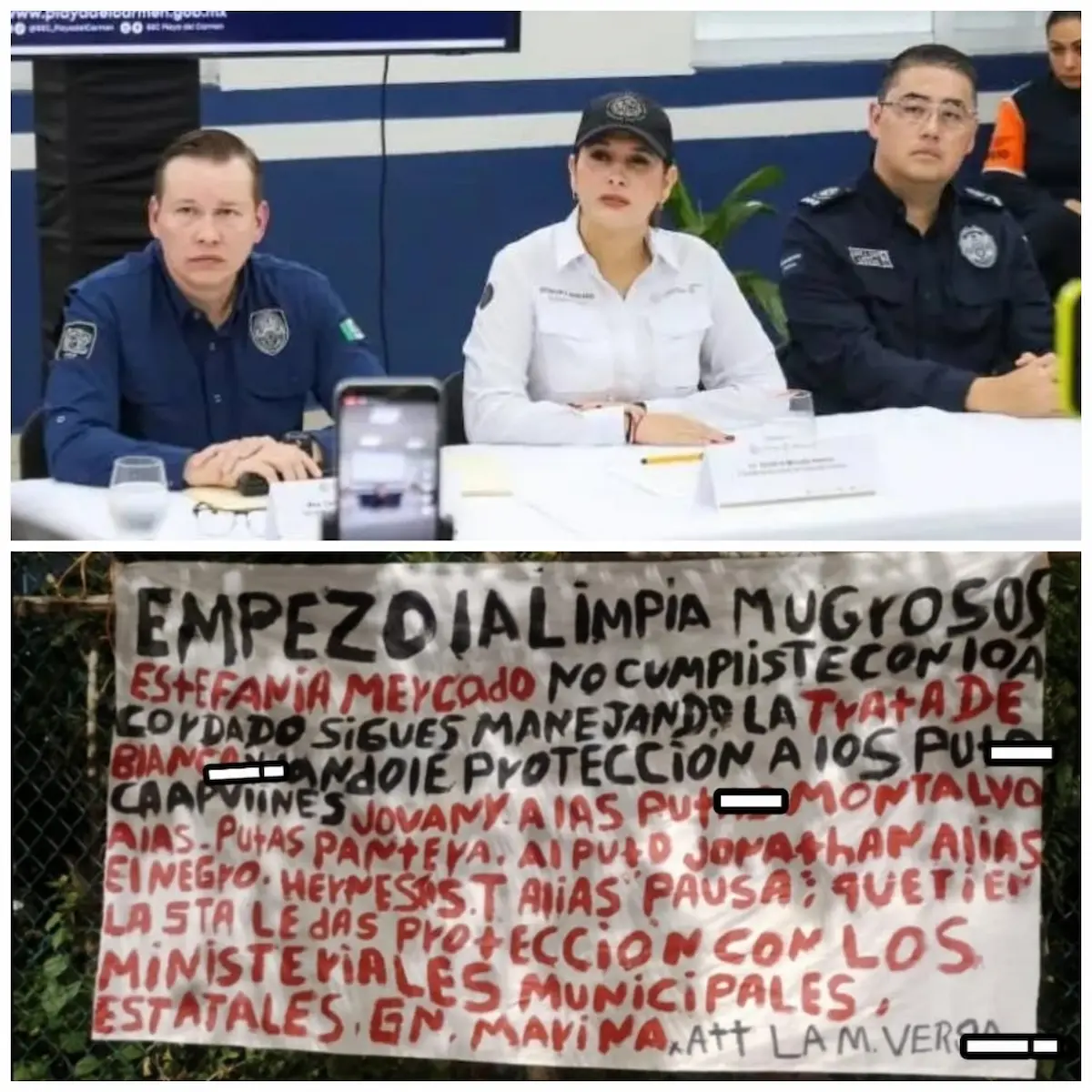
Playa del Carmen, Quintana Roo — A narco banner directly threatening Mayor Estefanía Mercado appeared this week at a strategic intersection in Playa del Carmen, signaling a potential escalation in organized crime violence. The message, written in red letters, read: “Estefanía Mercado, you did not keep your end of the deal.” In the language of organized crime, such a direct warning to a mayor is tantamount to a declaration of war, indicating that a fragile non-aggression pact has been broken.
Although initial reports suggested up to four banners were placed across the city, authorities confirmed only one. The discrepancy reflects the confusion that criminal groups often sow by dispersing cells in the early morning to maximize psychological impact.
The violent response came swiftly. That same night, a vehicle was set on fire at the intersection of Constituyentes and Alondra avenues. Hours later, a Molotov cocktail destroyed another car on Avenida 40 in the Gonzalo Guerrero neighborhood, both attacks occurring minutes from the tourist zone that the city touts as a showcase of security.
Under the current administration, Playa del Carmen has seen recurring narco banners, mainly in hotspots like Villas del Sol, Luis Donaldo Colosio, and Puerto Aventuras. Previous threats were limited to inter-cartel warfare among the Sinaloa Cartel, Jalisco New Generation Cartel (CJNG), and Caborca Cartel, or warnings to police commanders. The direct targeting of the mayor marks a new phase.
Official response has been silence. Neither the Municipal Public Security Department nor the State Prosecutor’s Office has issued a statement on arrests, investigations, or the banner’s origin. Critics say the government is trying to contain media fallout during peak tourist season, protecting the destination’s image while ignoring the reality on the streets.
“When organized crime tells a mayor ‘you did not keep your end of the deal,’ it is not talking about campaign promises,” the article notes. “It is denouncing that operational commitments, agreements over territory, and conditions of coexistence between the municipal administration and criminal groups have been broken.”
The Mercado administration has built its security narrative on four statistics: a 37% reduction in homicides, a 42% drop in reports of gunfire, a 45% decline in business robberies, and a 122% increase in drug seizures. However, extortion and protection rackets have risen 28% in 2026 compared to the previous period, and most victims do not report out of fear. Homicides with signs of organized crime — execution-style killings, torture, and bodies in bags — have spiked, occurring in broad daylight on major avenues like 115 and Juárez.
The article concludes that the government’s statistical reductions were not built on arrests or dismantling criminal structures, but on a fragile non-aggression pact that has now shattered. “What comes next does not appear in any official bulletin, but the experience of other cities with the same pattern anticipates it clearly.”
More Crime
- Playa del Carmen Mayor Responds to Puerto Aventuras Mayor’s Arrest on Extortion Charges
- Loose Horses on Reforma-Bacalar Highway Crash Leave Mare Dead, Second Horse Injured
- Former Gubernatorial Candidate Laura Fernández Piña Loses Appeal Against 20-Year Public Office Ban
- Three Men Sentenced in Quintana Roo for Sexual Abuse of Minors, One Receives 120 Years
- Cancún Authorities Identify 19-Year-Old Woman Found Dead Near Supermanzana 201
More Playa del Carmen
- Playa del Carmen to Review Legal Status of Chen Zubul Property
- Playa del Carmen Hosts Second National Firefighters Congress With 750-Plus Participants
- Quintana Roo Braces for Four Days of Heavy Rain and Flooding
- Mental Health and Addiction Top Concerns Among Playa del Carmen Youth, Survey Finds
- Structures Collapse at Abandoned Hotel in Playa del Carmen Tourist Zone