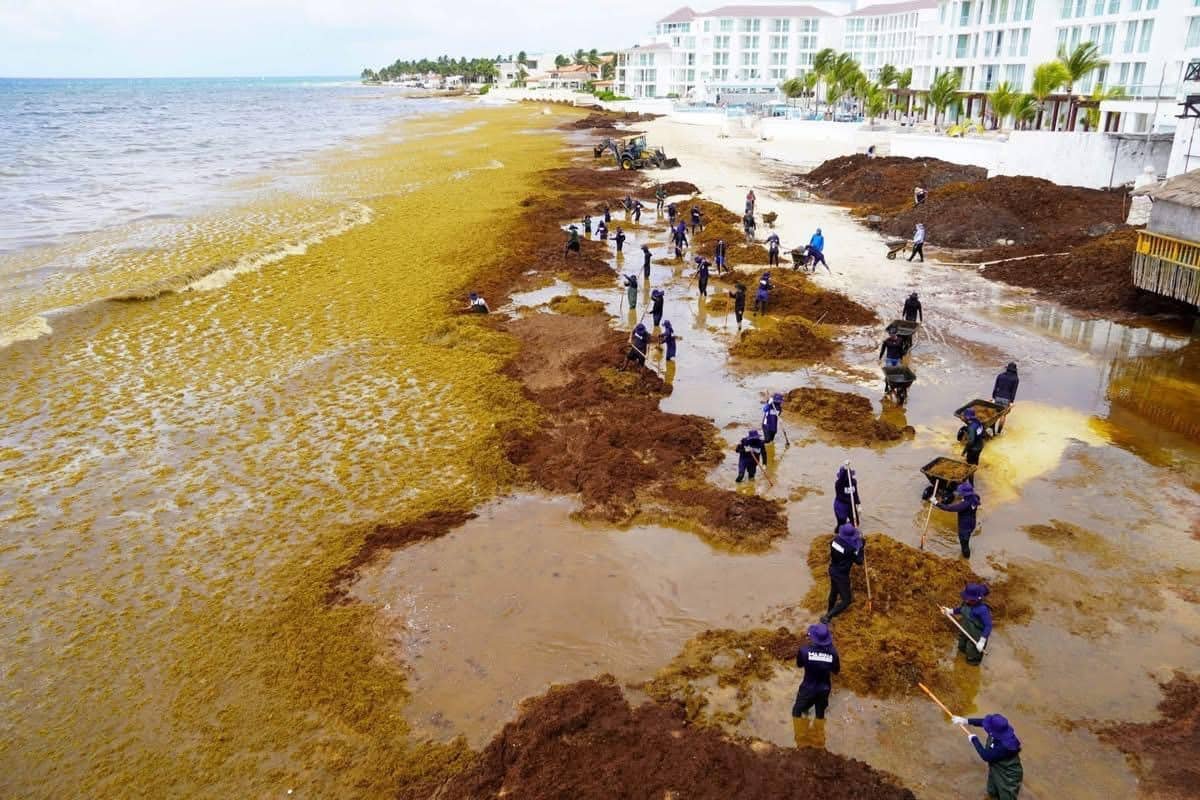
Playa del Carmen, Quintana Roo — Playa del Carmen is experiencing one of its worst sargasso seasons in recent years, with more than 14,000 metric tons of the brown macroalgae collected so far. Despite round-the-clock cleanup efforts, the daily influx continues to overwhelm response teams, raising concerns ahead of the 2026 FIFA World Cup.
The situation gained attention after Mayor Estefanía Mercado stated that sargasso “sooner or later turns into sand” and helps expand beaches affected by erosion. Scientists and research institutions, including the National Autonomous University of Mexico (UNAM), have rejected that claim, noting that sargasso does not transform into sand. Instead, its decomposition produces organic matter that can mix with sediment but does not create new sand or replace natural beach formation processes.
According to the latest Sargasso Arrival Traffic Light report from the Caribbean Sea Environmental and Climate Change Monitoring Network, 64 beaches across the Mexican Caribbean have excessive amounts of sargasso, with several located in Playa del Carmen.
Esteban Amaro, director of the Quintana Roo Sargasso Monitoring Center, warned that the worst is yet to come. “We expect an increase of 25 to 30 percent compared to last year. In 2025, about 95,000 tons were collected; this year could reach between 120,000 and 130,000 tons due to the early start of the season,” he said.
The season began in January, roughly three months earlier than usual, disrupting historical cycles. May, June, and July typically see the highest sargasso volumes, and the northern zone of the state is expected to be hit hardest.
The timing is particularly problematic as Playa del Carmen prepares to host thousands of visitors for the 2026 FIFA World Cup, with many expecting the turquoise waters the region is famous for. July’s summer vacation period also brings a surge of tourists who may encounter brown beaches instead of the iconic Caribbean blue.
The municipal government has allocated more than 40 million pesos ($2 million) for environmental sanitation and sargasso management, but experts say the extraordinary volume this year will likely require additional resources and closer coordination among federal, state, and local authorities.
More Environment
- Maya Frog and Toad Shell Pendants May Reveal Ancient Trade Routes
- Heavy Rains to Soak Quintana Roo as Unstable Weather Moves In
- Brain-Eating Amoeba Found in Six Artificial Lakes in Mérida; Water Contact Restricted
- Semarnat Approves Artificial Reefs and Sand Relocation for Akumal Hotel
- Chetumal Plans 836 Million Pesos in Stormwater Works to Curb Flooding
More Playa del Carmen
- Playa del Carmen Health Center in Villas del Sol to Close Two Days for Maintenance
- Mara Lezama Delivers 288 Infonavit Homes in Puerto Aventuras as Quintana Roo Targets 76,000
- Playa del Carmen Bars New Developments Without Electrical Investment, Mayor Says
- Student Hospitalized After Alleged Drug Intoxication at Playa del Carmen Middle School
- Selvame MX Calls HAZUL Project With Artificial Beach a ‘Fantasy’ in Playa del Carmen