Calakmul, Campeche — Archaeologists working in one of Mexico’s most remote protected forests have confirmed the discovery of a remarkably preserved Maya city hidden deep inside the Calakmul Biosphere Reserve, a vast tropical landscape long known for its concentration of ancient settlements and monumental architecture.
Mexico’s National Institute of Anthropology and History, INAH, announced that the site has been named Minanbé, from the Yucatec Maya words mina’an and be, meaning “there is no path.” The name reflects the conditions that helped protect the site for centuries. Unlike many areas of the jungle where old logging roads have made archaeological zones easier to reach, Minanbé had no clear access route. Researchers and workers from the nearby community of Constitución had to cut their way through kilometers of dense vegetation before reaching the ruins.
The site is located in the northern sector of the Calakmul Biosphere Reserve in Campeche, west of Chactún, another important Maya center documented by the same long-running research initiative. Although LiDAR scans first revealed the presence of structures in the area years ago, the recent field season allowed archaeologists to verify the site on the ground.
What they found was not a minor settlement. Minanbé covers roughly 15 hectares and contains a defined urban core with plazas, palatial and religious buildings, terraces, wetlands, and water-channeling features. One of the tallest structures is a pyramid temple more than 13 meters, or about 43 feet, high. Archaeologists have identified architectural features associated with the Río Bec style, including fine masonry, steep stairways, smooth facade panels, and upper moldings.
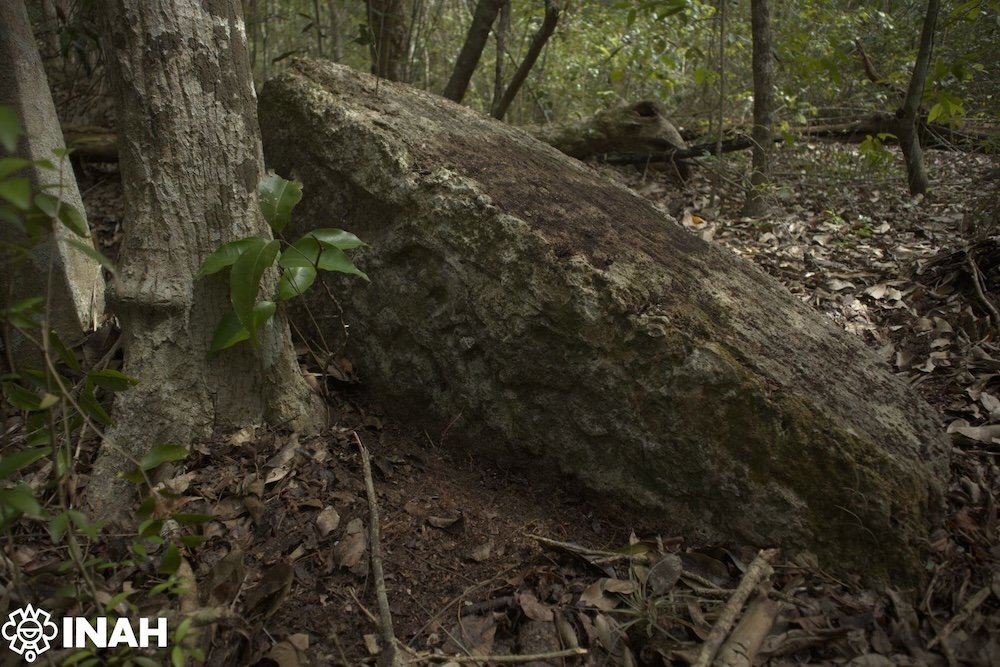
The most striking discovery may be the concentration of carved monuments. Researchers documented 14 stelae and altars, several with hieroglyphic inscriptions and iconographic elements. The monuments were found near a causeway linking the central and northeastern sectors of the city, a layout that suggests the area held ceremonial or political significance.
One monument, known as Stela 1, depicts what researchers describe as a decapitation scene. Despite erosion, epigraphic analysis identified a calendrical sign corresponding to 5 Ajaw, or A.D. 849. INAH researchers say that date places at least part of the monument group in the Terminal Classic period, shortly before many major Maya centers in the region were abandoned in the 10th century.
Another piece, referred to as Monument 6 in local reporting based on INAH’s findings, appears to show a ruler wearing elaborate elite ornaments. Some of the monuments show signs of intentional alteration or fragmentation, raising the possibility that later groups may have modified the city’s political symbols after its original period of use. Researchers have stressed that the decipherment and interpretation of the inscriptions are still ongoing.
The discovery is significant not only because of what Minanbé contains, but because of what it appears to lack: evidence of looting. Archaeologist Ivan Šprajc, who led the Mexican-Slovenian research team, said Minanbé is the first intact, apparently unlooted ancient city his team has found in three years of fieldwork in the region. That state of preservation gives researchers an unusually valuable opportunity to study a Maya center with its monuments and architectural context still largely in place.
Minanbé also adds another piece to the broader archaeological landscape of Calakmul. The UNESCO-listed Ancient Maya City and Protected Tropical Forests of Calakmul includes the remains of one of the most powerful capitals of the ancient Maya world and dozens of other settlements, roads, water-management systems, terraces, and sculpted monuments. UNESCO describes the region as an exceptional cultural landscape that helps researchers understand both the rise of Maya urban civilization and the dramatic abandonment of many settlements between the 9th and 10th centuries.
For archaeologists, the timing of Minanbé’s carved monuments may be especially important. If further study confirms that some were erected around A.D. 849, the city could offer new evidence about political authority, ritual life, and regional instability during the final generations of Classic Maya occupation in the central lowlands.
For now, Minanbé remains a research site, not a tourist destination. Its isolation is part of what preserved it. The same lack of roads that gave the city its modern name may also be what allows researchers to study it carefully, before the jungle’s silence is broken again.
More Culture
- Pre-Hispanic Frog Pendants From Tren Maya Route Shed Light on Ancient Maya Trade
- Mayatek Brings Technology and AI Talks to Mérida, Entirely in Maya
- Five Finalists Chosen for Xmatkuil Fair Ambassador Contest
- Yucatecan Filmmaker Wins Ariel Award for Cliff Divers Film
- Same-Sex Marriages Nearly Triple in Yucatán as 2025 Sets an Eight-Year Record
More Zona Maya
- Quintana Roo Opens 2026 Poetry Contest for Indigenous and Afro-Mexican Girls
- Drought Damages Farmland in Felipe Carrillo Puerto as Quintana Roo Assesses Losses
- Aluxes Endure in the Beliefs of Maya Communities in Quintana Roo
- Search Operation for Missing People Deployed in Felipe Carrillo Puerto
- Mothers of Missing Children Ask Quintana Roo to Display Their Faces on Public Transport