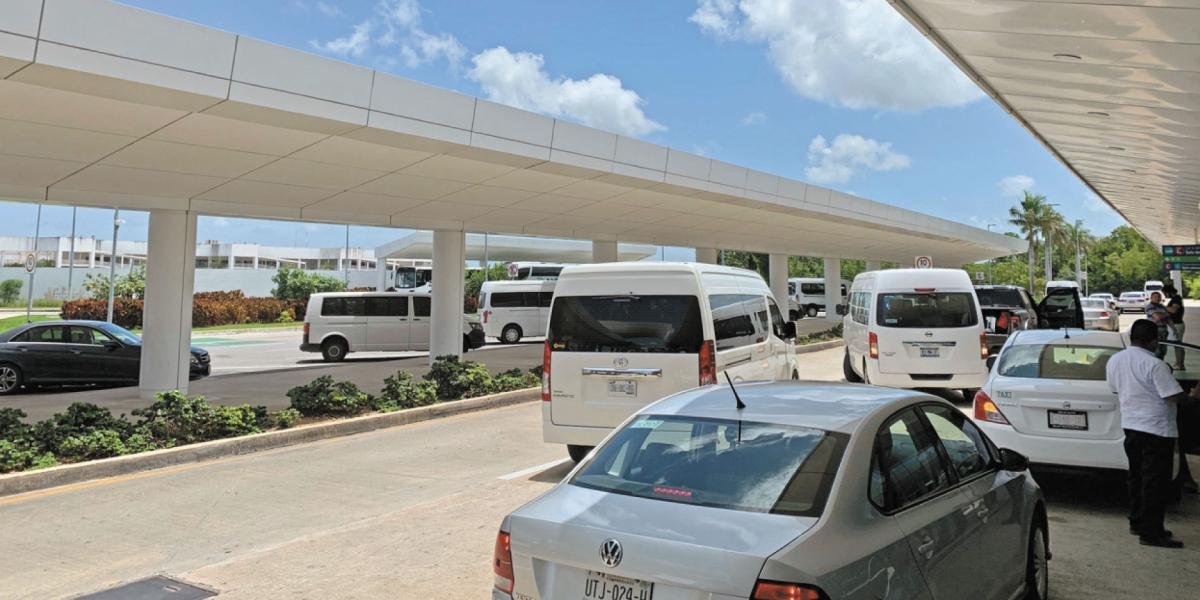
Cancún, Quintana Roo — For many travelers, the most stressful part of arriving at Cancún International Airport begins after they collect their luggage.
National Guard patrols and checkpoints remain in place around the terminals as authorities attempt to stop unauthorized taxis and ride-share drivers from collecting passengers. Meanwhile, complaints about the price and reliability of authorized transportation continue to circulate online.
The result is an airport where travelers can generally arrive in an Uber but cannot depend on one to take them home, to a hotel or south toward the Riviera Maya.
Uber’s own website currently tells passengers that pickups are available at Cancún International Airport and that the app will provide directions to a collection point. In practice, drivers entering the terminal area may still be questioned or prevented from collecting passengers. A ride accepted through the app can therefore be canceled or disrupted after a traveler has already left the terminal. Uber continues to advertise pickups at CUN, despite the unresolved regulatory dispute.
Why is this still happening?
The underlying legal issue is more complicated than whether Uber is permitted to operate in Quintana Roo.
Cancún’s airport property is under federal jurisdiction. Federal transport authorities maintain that any company collecting paying passengers there requires authorization from the Secretariat of Infrastructure, Communications and Transportation, known as SICT. Uber vehicles generally operate under state ride-share rules rather than federal airport transport permits.
Uber obtained a court suspension intended to prevent authorities from detaining or sanctioning its drivers while its broader legal challenge is resolved. The company has argued that the order allows its drivers to collect passengers at airports. SICT counters that the ruling protects drivers from arbitrary detention but does not grant the federal permits required to operate an airport transportation service.
That conflict has never been translated into a clear, dependable system for passengers. Enforcement has continued even as Uber accepts airport requests.
Complaints extend beyond Uber
Travelers interviewed at the airport said their frustration was not simply that ride-sharing pickups remain difficult. They also complained about inconsistent prices charged by authorized transportation providers.
“They charge whatever they want,” Cancún resident Roberto Colmeranes said. “You have to negotiate the price before getting in. That’s why I prefer Uber, but they keep going after them.”
Other passengers reported being quoted one amount and later asked to pay another. Although these accounts do not establish that every authorized operator is overcharging, they illustrate why travelers want a service that provides a price in writing before the journey begins.
Authorized airport transportation is typically more expensive than an ordinary city taxi because operators pay for federal permits, airport access and concession rights. That may explain part of the difference, but it does not excuse unclear pricing or a fare that changes after a passenger accepts it.
Travelers using an airport taxi or shuttle should obtain the complete price before boarding, confirm whether it is per person or per vehicle and keep the receipt or reservation confirmation.
Family pickups can also become uncomfortable
The enforcement effort has occasionally affected people collecting relatives or friends in private vehicles.
Adalberto Méndez said he was stopped after picking up his sister because people at the airport suspected that he was working for Uber. He said taxi drivers wanted to see their identification before National Guard officers intervened.
“If it’s my brother or my wife coming to get me, why do they have to prove they don’t work for Uber?” another passenger asked.
Taxi drivers and private security personnel do not have the same authority as federal officers to demand personal identification. However, drivers waiting at the curb, repeatedly circling terminals or accepting luggage in a way that resembles a commercial pickup may attract attention.
Anyone collecting a friend or relative should arrange a precise terminal and meeting point, avoid remaining at the curb longer than necessary and be prepared to explain the relationship if questioned by an authorized officer.
An airport experience that remains unnecessarily difficult
ASUR’s official transportation page lists ADO, authorized taxis and car rentals, but it does not present ride-sharing as an approved ground transportation option. Nor does the airport provide the kind of clearly marked app-based pickup zone now found at many major international airports.
This leaves passengers sorting through competing claims from Uber, federal authorities, drivers and airport transportation companies, often while standing outside a crowded terminal with luggage.
Cancún’s airport is the gateway not only to Cancún, but also to Puerto Morelos, Playa del Carmen, Cozumel, Puerto Aventuras, Akumal and Tulum. The question of how passengers leave it should not remain this confusing.
The National Guard can continue checking vehicles, and federal authorities can continue arguing about permits. But until travelers are given clearly marked pickup areas, transparent fares and transportation choices that work consistently, the dispute will remain more than a fight between Uber and authorized operators. It will remain the first bad experience many visitors have in the Mexican Caribbean.
More Business
- López Obrador Reappears With Video Message as Sheinbaum Marks Two Years
- Two Extortionists Sentenced to 22 and 15 Years in Cancún
- Tulum Hosts Nine US Universities and Team Mexico at NCAA Division II Golf Shootout
- Quintana Roo Warns Against Unchecked Hotel Growth as It Courts Brazil and Colombia
- Tren Maya Lost 5 Billion Pesos in Six Months as Operating Costs Soar
More Cancun
- Million-Dollar Robbery in Cancún Triggers Major Police Deployment
- Four Years After Decriminalization, Quintana Roo Feminists Say Abortion Access Still Falls Short
- Fake Priests Target Hotel Weddings in Cancún, Diocese Warns
- Cancun’s Night Bike Ride Returns to Avenida Bonampak on October 3
- Quintana Roo Ranks Third Nationally in Corruption of Minors With 182 Cases