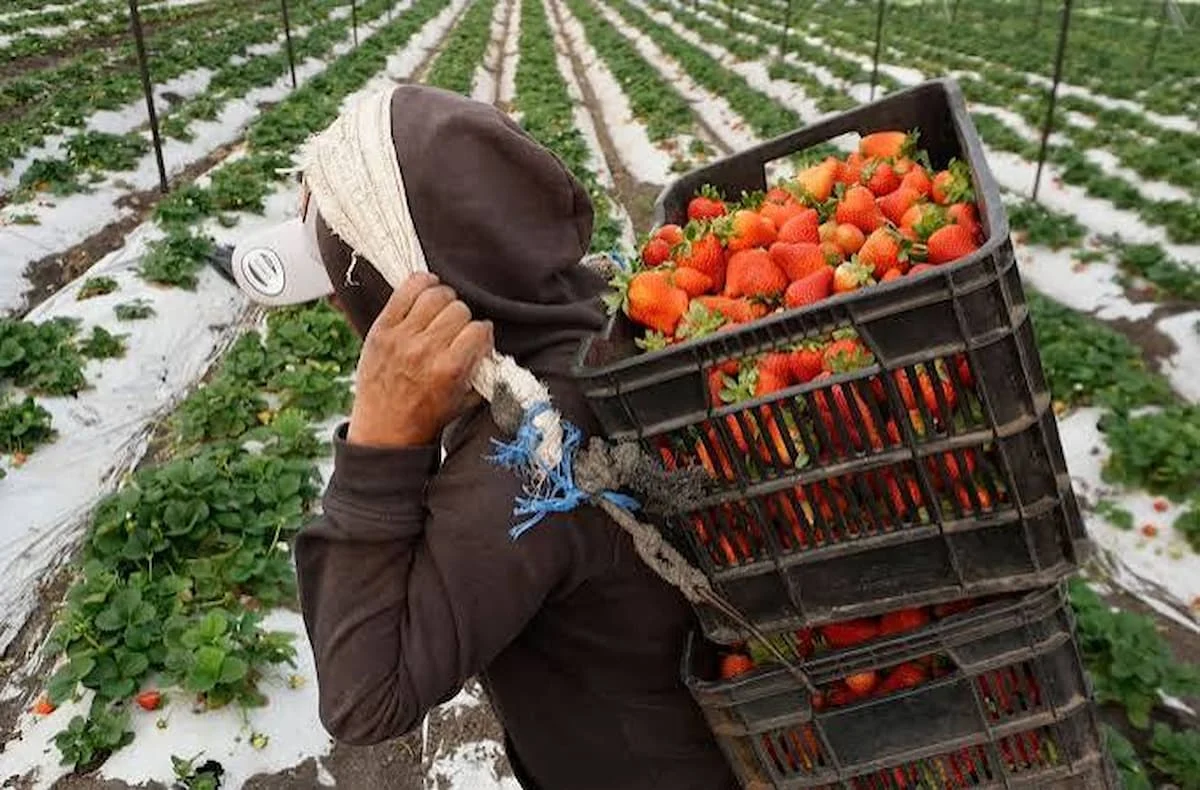
Mexico City — The Mexican government has expressed “grave concern” over a preliminary US ruling that found Mexican strawberry exporters sold fruit below fair market value, a decision that could affect nearly 5,000 domestic producers and 151,000 jobs.
In a statement released Tuesday night, the Economy Ministry said the US Department of Commerce had set preliminary anti-dumping margins of 3.37% to 5.28% on Mexican strawberry shipments, depending on the company, with an average dumping margin of 4.83%.
The investigation dates to Dec. 31, 2025, when Florida growers filed a petition with the Commerce Department and the US International Trade Commission (ITC) seeking anti-dumping duties.
The preliminary measure would affect nearly 5,000 Mexican strawberry producers, 97% of whom are small or medium growers with up to 10 hectares (about 25 acres), according to the government. It also endangers 151,000 jobs linked to strawberry cultivation.
Mexico exported 263,000 metric tons of strawberries to the United States in 2025, worth about $1 billion.
The government said it will monitor the case together with producers and exporters until the ITC issues its final decision, expected in early 2027. It argued that the Commerce Department’s criteria are incompatible with the WTO’s Anti-Dumping Agreement and with the terms of the US-Mexico-Canada Agreement (USMCA).
Mexican Farm Council Rejects US Ruling
The National Agricultural Council (CNA), a major Mexican agribusiness association, on Wednesday accused the United States of violating the USMCA and WTO rules.
“We express particular concern over the application of these criteria by US authorities, even though they are contrary to the provisions of the USMCA, the WTO’s Anti-Dumping Agreement and US law itself,” the council said in a statement.
The CNA said it categorically rejects the preliminary restrictions, arguing they distort US law and the principles of competitiveness and productive integration built over more than three decades between the two countries.
The group warned that the ruling sets a dangerous legal precedent that could extend to other perishable and seasonal agricultural products from Mexico.
It added that the “arbitrary parameters” create uncertainty for investors, exporters and producers in the cross-border supply chain. The CNA said the growth of Mexican fruits and vegetables in the US market is the result of legitimate factors, including productivity, quality, food safety and the agro-climatic advantages of Mexico’s growing regions.
The private sector warned that the protectionist measure not only puts substantial investments and millions of jobs on both sides of the border at risk, but could also fuel inflation by raising food prices for US consumers.
The council called on the Mexican government to maintain a firm stance with the White House and demand full compliance with the trade rules established in the USMCA. It also urged authorities to urgently modernize Mexico’s trade defense instruments so it can respond with reciprocity to unfair practices by foreign competitors.
The dispute adds to tensions between the two countries over agricultural trade, energy policy and labor issues, which have clouded the outlook for the USMCA.
More Economy
- Cancun’s Tourism Reset: Regenerative Travel Takes Center Stage
- Quintana Roo Moves to Power Public Buildings With Clean Energy
- Quintana Roo Education and Training Chiefs Resign to Seek Morena’s Chetumal Nod
- Sargassum Could Cost Mexican Caribbean $11.5 Billion a Year, IDB Estimates
- Mexico Extends Deadline for Electronic Customs Value Declaration to October 31