
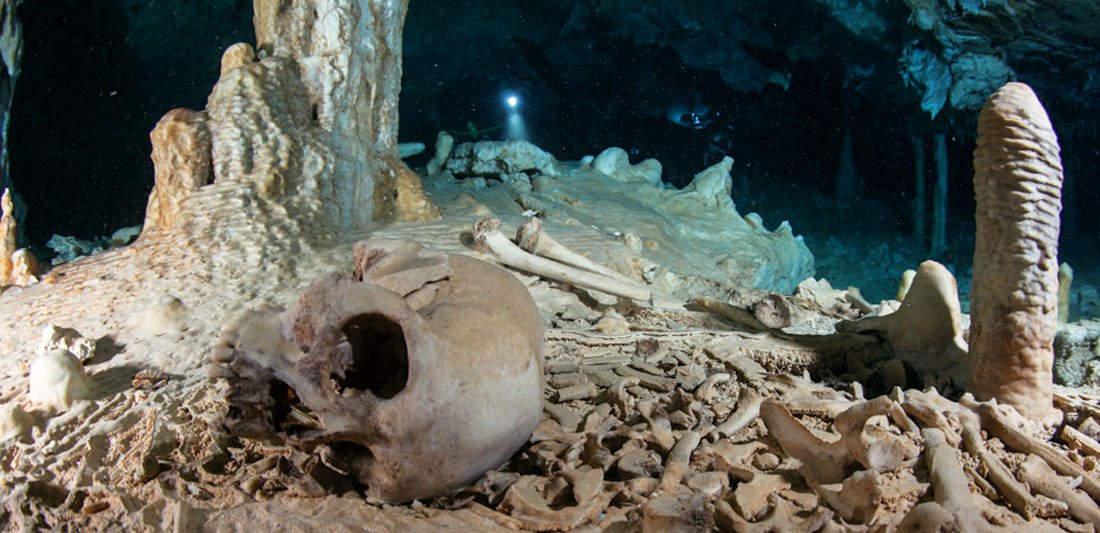
Tulum, Quintana Roo — Researchers have now identified at least 12 preceramic skeletons in the Yucatan Peninsula, with two new discoveries yet to be officially published, according to paleontologist and speleologist Jeronimo Avilés Olguín.
Avilés, affiliated with the Museo del Desierto, said that while a skeleton found a month ago in an underwater cave between Tulum and Playa del Carmen has been reported, a third skeleton discovered in the Palmas cave has not yet been published. That would bring the total to 12 individuals, all over 10,000 years old.
Among the most famous is “La Mujer de las Palmas,” found in 2004 in the Palmas cave in Tulum. She died at about age 50, 10,000 to 12,000 years ago. Two reconstructions exist: one at the Climate Change Museum in Guanajuato, the other part of a traveling exhibit.
Another well-known skeleton is “Naia,” a 12,900-year-old woman who was 18 when she died. “Both were gatherer-hunter women from a period not only prehistoric but before ceramic technology,” Avilés said.
The “Eva de Naharon,” remains dating back 13,700 years, were found in the Naharon cave in Tulum, where vandals have also disturbed the site. More recently, “Ixchel” or “Chan Hol 3” was discovered in the Chan Hol cave, also in Tulum.
Over the past 30 years, 10 preceramic skeletons have been located, but that number may soon increase. A skeleton found in a flooded cave less than a month ago may date from the end of the last ice age. “It hasn’t been dated, but the last time that cave was dry was 8,000 years ago, so we can assume it is at least that old,” Avilés said.
Additionally, a third skeleton in the Palmas cave is still under study and not yet published.
Vandalism Threatens Archaeological Sites
Avilés, former founder of the Institute of Prehistory of the Americas, lamented vandalism at the Hoyo Negro cenote and other sites. He said divers, often foreigners without ties to the area, frequently touch remains, causing damage or altering contexts and losing important information.
A notable case is the theft of the “Chan Hol 2” skeleton in 2012, which remains missing. It could only be dated because the vandal missed some remains, including a hip bone with a stalagmite growing over it. “The vandal is fully identified, but no one says anything or acts,” Avilés said.
“There are so many cenotes and caves that the National Institute of Anthropology and History (INAH), which has the authority to protect this heritage, cannot keep up,” he added. “I propose certifying underwater custodians from the speleodiving community, especially Mexicans interested in protecting national heritage.”
More Environment
- White Sea Turtle Rescued in Cancún’s Hotel Zone
- Quintana Roo Records 29,413 Sea Turtle Nests at Season’s Midpoint
- Quintana Roo Reports 1,200 Screwworm Cases as Officials Await Sterile Fly Release
- Semarnat Approves Floating Marina in Cancún’s Nichupté Lagoon
- Cancún’s Benito Juárez Recycling Drive Recovers 6.8 Tons of Waste
More Quintana Roo
- Sheinbaum Announces 187 Primary Care Clinics and Major Projects in Quintana Roo
- Sheinbaum Touts Billions in Quintana Roo Infrastructure Ahead of Cancún Accountability Event
- Delphinus Blue Planet Pulls Out of Deal to Buy The Dolphin Company, Leaving 101 Marine Animals in Limbo
- No Long Weekend for Quintana Roo Students: Classes Held Sept. 14-15, Suspended Only Sept. 16
- Quintana Roo Bill Would Jail Pet Owners Who Abandon or Neglect Animals
