Mahahual, Mexico — The cancellation of Royal Caribbean's Perfect Day theme park has revealed decades of state neglect in this Mexican Caribbean town, which is becoming increasingly polarized due to its absolute dependence on mass tourism.
With wheelbarrows and shovels, still in the pre-dawn darkness, dozens of men from the community work tirelessly removing as much sargassum as they can from the beach. This is the stretch of coastline where Mahahual's food stalls and craft shops are located, along a long, narrow street that prepares every day for 8:00 a.m., when a ship finally docks at Puerto Costa Maya, about 5 kilometers from the town center. By that time, the coast looks almost pristine; the sun loungers, placed close together, face directly out onto the Caribbean Sea with its turquoise and intense blue hues. Among the vendors, women dressed in white prepare their massage tables; the tables are set, and local products are displayed for all to see. Mahahual's day begins when the tourists arrive from the cruise ships.
Until just a few weeks ago, this town, located in the south of the Yucatán Peninsula, very close to the border with Belize and about 150 kilometers by road from Chetumal, the capital of Quintana Roo, in the municipality of Othón P. Blanco, remained largely out of the spotlight and was known mainly among travel agents and companies dedicated to cruise tourism. This niche market has experienced rapid growth in Mexico in 2025 and so far in 2026.
The cruise bubble burst when the debate over Royal Caribbean's Perfect Day water park spilled beyond the borders of the Mexican Caribbean and spread throughout the country. Mahahual's name and its landscapes began appearing on television screens and newspaper front pages, but the apparent national consensus against the megaproject is far removed from the reality within the community, where basic services are not guaranteed, waste management is a serious problem, and the town seems to have been forgotten by the government, far removed from the millions of dollars this industry brings to local coffers.
From Fishing Village to Cruise Port
The social fabric of Mahahual—which has an official population of just over 2,600, but whose transient population exceeds 10,000—has been fractured for decades, its identity adrift. The fate of this former fishing village, isolated by the great natural barriers that surround it, changed abruptly when the Costa Maya Port was built in the late 1990s. Inaugurated in 2001, it is managed by the Mexican business group ITM, owned by businessman Isaac Hamui Abadi and his family.
Mahahual began to grow at the pace required by the cruise ship infrastructure, driven by the concessions granted by the Quintana Roo government to facilitate this growth. ITM sold the port to Royal Caribbean in July 2025, and the company assumed administrative control. However, the streets, shops, and hotel infrastructure within the town and the surrounding development have not benefited from the port's prosperity. Access to the port is private and restricted, available only to cruise ship passengers and workers. According to local residents, neither company has addressed the needs that residents outside the port area have endured for decades.
Isabel Bulos lives in the Nuevo Mahahual subdivision, popularly known as Las Casitas, a place adjacent to the port that was also entirely acquired by the dock owners, and the nearby site where Perfect Day was going to be built. She remembers moving there in 2009, when only two cruise ships arrived each month—now between one and four cruise ships arrive daily. "This growth, which has also been quite irregular, without planning, without really consulting the community, has gone much faster than any of us here can sustain. There isn't a single basic service that works," she says.
Bulos, a member of the neighborhood committee, recalls when they first learned about the park's construction and the numerous times they requested a formal technical rehabilitation plan for their community. In February, the committee began discussions with Royal Caribbean, repeatedly pointing out the "non-compliance" by the Hamui Abadi family, the developers of the subdivision, regarding its handover to the municipality and the eventual restoration of the deteriorated streets, drainage, lighting, electrical grid, and water treatment plant. "Royal Caribbean announced it would undertake the subdivision's rehabilitation; however, the promised project was never delivered, leaving us with no alternative but to resort to public protest," they stated in a press release in February, when their protests began.
For Bulos, one of the mistakes of the Save Mahahual collective, which, along with Greenpeace and millions of signatures on Change.org, spearheaded the campaign to deny the park's permit, was its failure to engage with the community. "They did something historic; I think we should focus on the positive aspects, but regardless of whether we agreed with the project or not, dialogue was essential. We live in a special place because of the reef, and I think many people don't understand that, perhaps due to a lack of connection. The fact that this issue has become so significant in our community wasn't solely due to Perfect Day; it's the result of years of exhaustion, of infighting; everyone is looking out for their own interests. And I believe that if the community were consulted, they would probably vote in favor of building the park."
Expressing opinions in Mahahual about recent events is not easy for anyone. Many choose their words carefully, careful not to fully endorse Royal Caribbean and to avoid accepting that nature shouldn't pay the price for development. One phrase, however, is repeated ad nauseam: "Mahahual has been forgotten for decades." This is what residents, environmentalists, and neighbors say. But it has also resonated with the state governor, Mara Lezama, a member of the Morena party; the president of Royal Caribbean in Mexico, Ari Alder; local business owners; farmers; and fishermen.
A young man who works at one of the beachside restaurants, and who prefers not to reveal his name due to the current polarization and fear for his job, says that the cancellation of Perfect Day is bad news for them. He knows the town's economic dynamics well because he previously worked for several years at the Costa Maya port. He says that cruise ship passengers not only generate economic activity for the port by eating at restaurants and shopping in stores, but the approximately 3,000 dockworkers also spend their money in Mahahual.
He is one of the employees of beachfront businesses who, starting at five in the morning, remove the sargassum. "I've lived here for many years, and I know that people have always been used to the boats, because it's their source of income. But also, because they earn good money out there [at the port], they come here and spend, and that money circulates here," he says.
He also explains that the spending of cruise ship passengers from companies like Royal Caribbean, Carnival Cruise Lines, or Norwegian Cruise Line depends on whether it's the first or last stop. He mentions days when a table becomes available and is immediately filled again, and how during peak season—from October to January—these days can last for weeks. Cruise ships arrive Monday through Friday, and there can be up to four on a single day.
Mauricio owns another establishment, a beach club that offers its customers various complimentary services when they dine in. His business is one of those that have made agreements with taxi drivers and the company to bring tourists directly there. He arrived in the town 26 years ago; he says he was in favor of the park, but also against it because of the damage it would do to the ecosystem. He says that Royal Caribbean has provided the boats and nets to remove the sargassum and that they pay the boatmen to do the work. He also points out that the local government provides the fuel and machinery. "We are happy with them for their help in removing the sargassum. They haven't abandoned us."
Some other residents say they don't want to become the new Tulum, that the power goes out almost every day, and that they've had a "garbage problem" for years because the local landfill is overflowing. They recount how, during the pandemic, unable to leave their homes, they smelled the scent of burnt mangroves in the air, that no one said anything, and that many of the burned properties were subsequently invaded or bought by private individuals.
They say, lowering their voices, that disappearances have increased in recent years, fueled by the presence of organized crime. They say that, although it remains a safe place to live, there are problems that no one wants to talk about, much less address.
An independent tourism promoter, who preferred to remain anonymous, explained that domestic tourism in Mahahual is very limited, and that for years they have denounced the community's shortcomings: "Many of these needs have gone unanswered by the authorities. From our perspective, Royal Caribbean was one of the few companies that showed interest in engaging with the community. Many residents feel that the public discussion did not fully reflect the reality we experience every day. Mahahual needs authorities, environmentalists, business owners, civil organizations, and residents to work together to build a development model that protects our natural resources without condemning the community to economic stagnation."
"This Is What We Stand For"
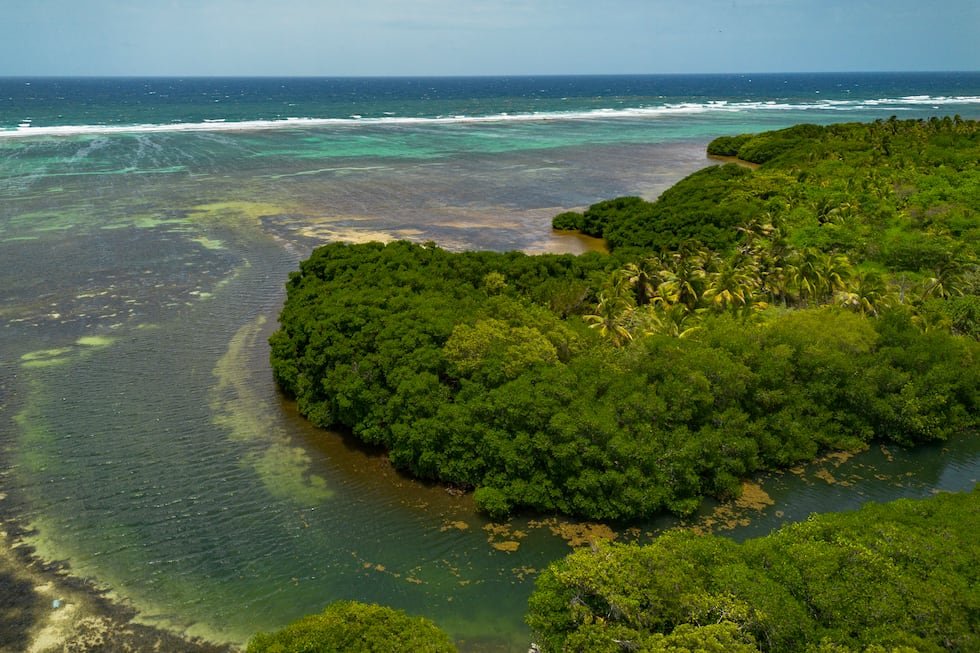
Luis Fernando Amezcua, from Salvemos Mahahual (Save Mahahual), navigates the Huach River, south of Mahahual. The mangrove forest shelters him as he paddles alongside his dog, Pach, on an inflatable paddleboard. He has dedicated himself to nature tourism, specializing in connecting with the ecosystem. Around him, the forest breathes; the saltwater river carries him along, while crabs and fish of different sizes and colors leap from one side to the other.
Amezcua calls this place "the cradle of life," where various species are born before venturing out into the surrounding environment. The roots of the forest float downstream, their vastness both immense and moving. The several-kilometer trail leading there reveals the plants, trees, and animals that inhabit this expansive area. "This is what we defend," he says. Manatees, turtles, dolphins—the species he lives with every day—inspire him and the group to keep going.
The Save Mahahual group demanded transparency from the government and analyzed Royal Caribbean's Environmental Impact Statement (EIS) with the help of María Luisa Villarreal Sonora, author of several books on the local situation, researcher, biologist, and specialist in political ecology. They are the collective that pushed for the cancellation of Perfect Day and achieved the unthinkable. "The people of Mahahual need jobs, they need to improve their quality of life, but not like this. Not at the cost that, unbeknownst to them, we were all going to pay. The region was going to pay the price," says Amezcua.
Discover more from Riviera Maya News & Events
Subscribe to get the latest posts sent to your email.