Playa del Carmen, Quintana Roo — A federal court challenge has added a new and complicated turn to the long-running fight over Chen Zubul, a large coastal property in the Luis Donaldo Colosio neighborhood that many residents and environmental groups have spent years trying to protect from development.
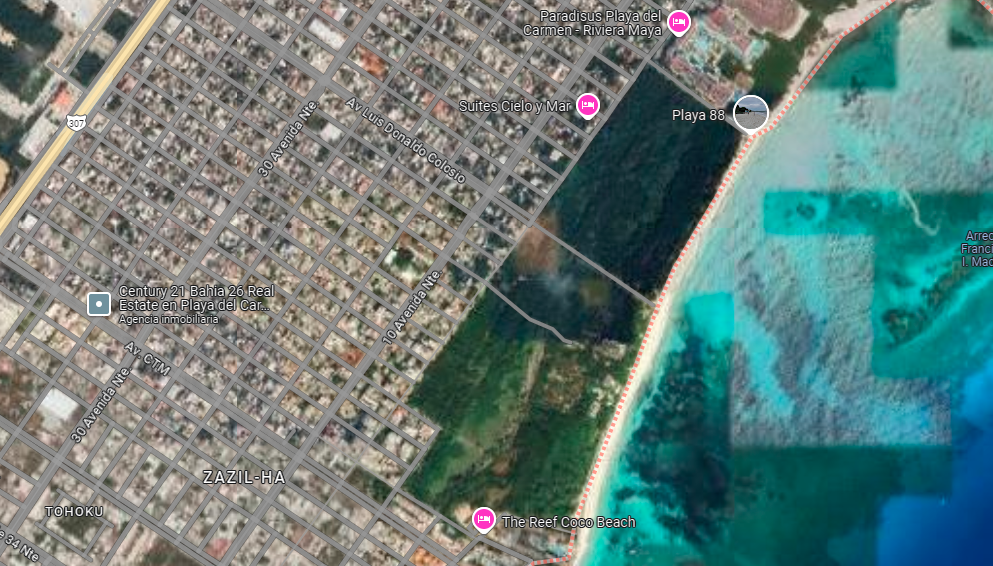
For readers who have not followed the case, Chen Zubul is often described locally as one of Playa del Carmen’s last remaining coastal “green lungs.” The property sits along the Colosio area between the city and the beach, in a zone that has seen intense real estate growth. Local reports have described the land as roughly 40 hectares, or about 398,505 square meters, with mangroves and wildlife that reportedly include coatis, mapaches, snakes and crocodiles.
The legal question is less simple than the environmental one. For years, the property’s ownership has been unclear. A 2025 report quoted the regional representative of Mexico’s National Institute of Sustainable Land, INSUS, saying federal authorities were still analyzing whether the land was public or private property. He said there was a presumption that private owners may exist, but that the legal situation had not been fully determined and was under review by SEDATU, the federal Secretariat of Agrarian, Territorial and Urban Development.
That uncertainty has made Chen Zubul a flashpoint. Environmental collectives and residents have repeatedly called for the land to be declared an ecological park, natural protected area, or zero-density conservation zone, meaning no construction would be allowed. In July 2024, the then-government of Solidaridad reportedly proposed in a Cabildo session that the 40-hectare property be given zero-density status, and the request was sent to the federal government.
The latest development involves Rodrigo Garcidueñas, a representative of the environmental collective Pulmón Verde, who has occupied and cared for the property for several years. According to reporting based on the court ruling, Garcidueñas filed a voluntary jurisdiction petition known as información ad perpetuam, seeking judicial recognition tied to his possession of the land. Judge Karina Ceballos Gómez of the First Instance Civil and Family Oral Court in Playa del Carmen declared the petition unfounded, rejecting his attempt to obtain title to the property.
In plain English, información ad perpetuam is a legal procedure often used to formally document facts, including possession of a property, through testimony and evidence. Mexican legal sources note that these proceedings are considered voluntary jurisdiction and do not necessarily resolve a dispute between competing parties. Legal analysis published by UNAM also warns that, in many contexts, such a proceeding is not enough by itself to prove ownership, but may only help establish possession.
According to the ruling cited by Noticaribe, the court acknowledged that Garcidueñas had been in public, peaceful, continuous and good-faith possession of the land, carrying out cleaning, maintenance, guarding and minor improvements. He also told the court that he initially received financial support from the person who entrusted him with guarding the property, but later continued living there with his partner and child at his own expense. The ruling also noted that the land is in an area of irregular properties and lacks formal documentation proving ownership.
Despite those findings and witness testimony presented in his favor, the judge found the petition unfounded. Garcidueñas is now challenging the decision through an amparo filed before the Ninth District Court, under case number 518/2026. The challenge targets a January 29, 2026 resolution that upheld an earlier October 22, 2025 decision rejecting the voluntary jurisdiction proceedings.
An amparo is a federal legal remedy in Mexico used to challenge acts by authorities that may violate constitutional or legal rights. The Supreme Court of Mexico describes it as a legal instrument designed to protect people from abuses of power and to strengthen rights protections.
The new court fight is controversial because it appears to shift part of the debate from conservation to ownership. Garcidueñas has publicly supported the idea of Chen Zubul becoming an eco-tourism park or zero-density green space. But the ruling and the amparo now place him in the position of seeking legal recognition that could award the property to him personally, rather than to the community or to a protected public-use project. Noticaribe framed the issue directly, reporting that the amparo seeks to reverse the adverse rulings and have the property granted in his favor.
At the same time, the broader citizen movement has continued pushing for conservation. In May 2026, residents resumed a signature campaign to preserve Chen Zubul as a zero-density area. The petition had reportedly been started years earlier and was relaunched after recent environmental battles in the state. Organizers said the property’s biodiversity and coastal location make it too important to lose to real estate development.
The land has also been tied to the now-defunct Desarrolladora de la Riviera Maya, known as DERIMAYA, which local reports say may have transferred or delivered the property to a private party. That history remains one of the reasons the ownership question is difficult to untangle. Reports have also noted previous attempts to develop the site, adding urgency for residents who fear that any legal opening could eventually lead to new construction.
For now, several questions remain unresolved. Who, if anyone, holds valid title to Chen Zubul? Is the property public, private, or subject to competing claims? Can it legally be declared a protected area or zero-density ecological park? And what would happen if a court eventually recognizes one person’s possession rights over land that many residents believe should be conserved for the public?
The amparo does not settle those questions. It simply moves the dispute into federal court, where judges will review whether the lower court rulings against Garcidueñas should stand.
What is clear is that Chen Zubul is no longer just a neighborhood environmental cause. It has become a test case for Playa del Carmen’s future: how the city handles irregular land, coastal conservation, private claims, public pressure and the last large undeveloped spaces in one of Mexico’s fastest-growing urban tourism corridors.
More Courts
- Power Outage in Chetumal Forces Closure of Quintana Roo Labor Courts
- Five Men Sentenced To Up To 50 Years For Killings In Cancún And Felipe Carrillo Puerto
- Mexico’s Senate Votes 96-0 to Curb Telemarketing Harassment With New Do-Not-Call Registry
- Mexico’s Senate Unanimously Approves Tourism Law Reform to Combat Child Sexual Exploitation
- Federal Court Voids State Permit for Coastal Condo Project in Quintana Roo
More Playa del Carmen
- Quintana Roo Riders Resume ‘Vest Law’ Talks, No Protests
- Quintana Roo Plans Two Wastewater Plants and Two Aqueducts for Cancún and Playa del Carmen
- Playa del Carmen Ranks Second in HIV Cases in Quintana Roo, Official Says
- Playa del Carmen Recognized as International Bull Shark Zone
- Five Zones in Playa del Carmen Lose Urban Jungle to Construction Boom