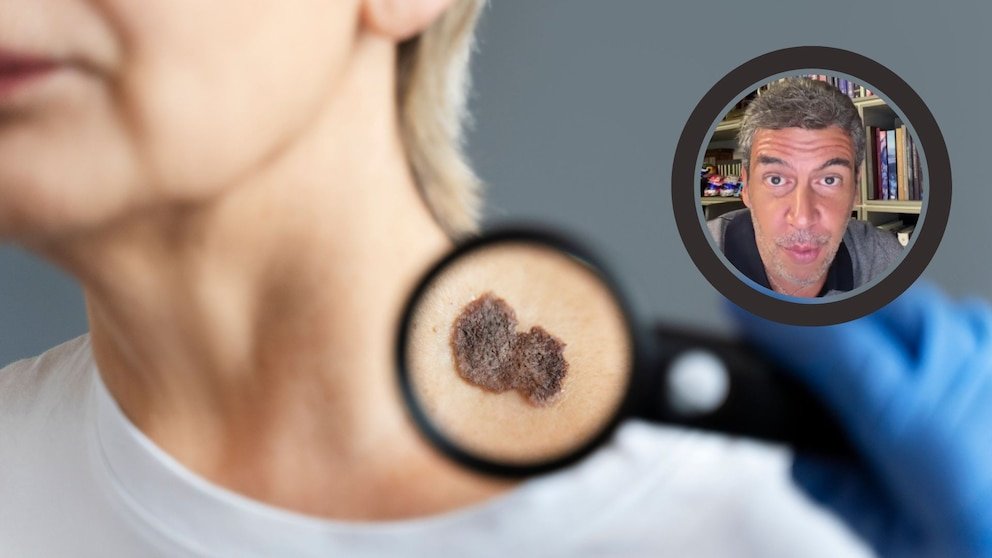
Mexico City — Moderna and Merck announced positive Phase 3 results for intismeran autogene, a personalized mRNA-based therapy that, when combined with Keytruda (pembrolizumab), improved outcomes for patients with high-risk melanoma after surgical removal of the tumor.
The news sparked excitement in financial markets and among specialists, but the companies have not yet publicly presented all the trial data.
The INTerpath-001 study included 1,137 patients with stage IIB to IV melanoma who had undergone surgery, according to information available so far.
A Personalized Vaccine
Arturo Elías Ayub, a Mexican businessman and son-in-law of Carlos Slim, shared his enthusiasm for the results and explained in simple terms how the technology works.
“Today something happened that should make everyone happy, not just in Mexico but around the world,” he said of the advances announced by Moderna.
He stressed that this is not a conventional vaccine but a treatment designed specifically around each patient’s tumor characteristics.
“What this vaccine does, and this is what’s so interesting, is that it’s personalized — each person gets a different vaccine,” he explained.
The technology uses information from the patient’s tumor to identify specific mutations and design an immune response targeting those features. The immune system receives instructions to recognize cancer cells better.
“A Photo of the Thief’
To explain the mechanism, Elías Ayub used a simple comparison.
“Imagine you have a thief robbing your house every day, but you don’t know who he is, when he comes, or how he steals,” he said. “What this vaccine does is give your immune system instructions, like showing it a photo of the thief who comes to your house.”
The analogy illustrates how the personalized therapy uses tumor mutations to help the immune system identify and attack cancer cells more precisely.
The vaccine is administered alongside Keytruda, Merck’s immunotherapy. The goal is for the two therapies to work together: the vaccine identifies tumor features, while pembrolizumab boosts the immune system’s ability to fight cancer cells.
Phase 3 Results and a Key Clarification
Moderna and Merck reported that the trial met its primary endpoint of recurrence-free survival and a secondary endpoint related to distant metastasis-free survival. The companies called the results statistically significant and clinically relevant.
One clarification: the 96% figure Elías Ayub cited is not from the Phase 3 trial. That number comes from earlier overall survival data in the Phase 2b study, where survival at 2.5 years was 96.0% with the combination versus 90.2% with Keytruda alone. It should not be interpreted as 96% of Phase 3 participants being free of metastasis. Full Phase 3 data will be critical to understanding how much the therapy reduced recurrence and spread, and its impact on survival.
Expanding to Other Cancers
The enthusiasm is not limited to melanoma. Moderna and Merck have other studies evaluating this personalized vaccine platform in different cancer types, including lung, bladder, and others.
Elías Ayub highlighted this too, saying, “If this one already worked, it seems the chances that the others will work are significant.” If the platform proves effective across different tumors, the impact could be far larger than a single melanoma treatment.
Markets React
The announcement also triggered an extraordinary move in financial markets. Moderna’s shares rose about 177% in a single session, nearly tripling in value, after the trial results were announced.
Elías Ayub said he owns Moderna stock and held onto it despite the company’s post-pandemic decline. “I bought shares during COVID, and since a lot of people stopped getting vaccinated, the shares went to hell and I did terribly. But I said, okay, I’ll hold on to them,” he recounted.
The stock movement reflects the enormous expectations around mRNA-based oncology, though the trial’s success does not yet mean the vaccine is available to patients. The companies still need to present the full data and move through regulatory processes before the treatment can be authorized for broader use.
For now, the result is a significant scientific advance for personalized cancer vaccines, but it does not mean a universal cancer vaccine exists. Research continues, and upcoming results will be decisive in showing how far this technology can go.
More Lifestyle
- Yucatán Suspends Classes in 27 Municipalities as Tropical Storm Isaías Nears
- Playa del Carmen Traffic Police Run No Operations Targeting Bike Lane Violations
- Scooter Users Demand Say in Playa del Carmen Micromobility Rules
- PGA Riviera Maya Renovates Executive Course, Lifting Tulum’s Golf Offer
- Isla Mujeres Day of the Dead 2026: Pandora, Catrinas & More