
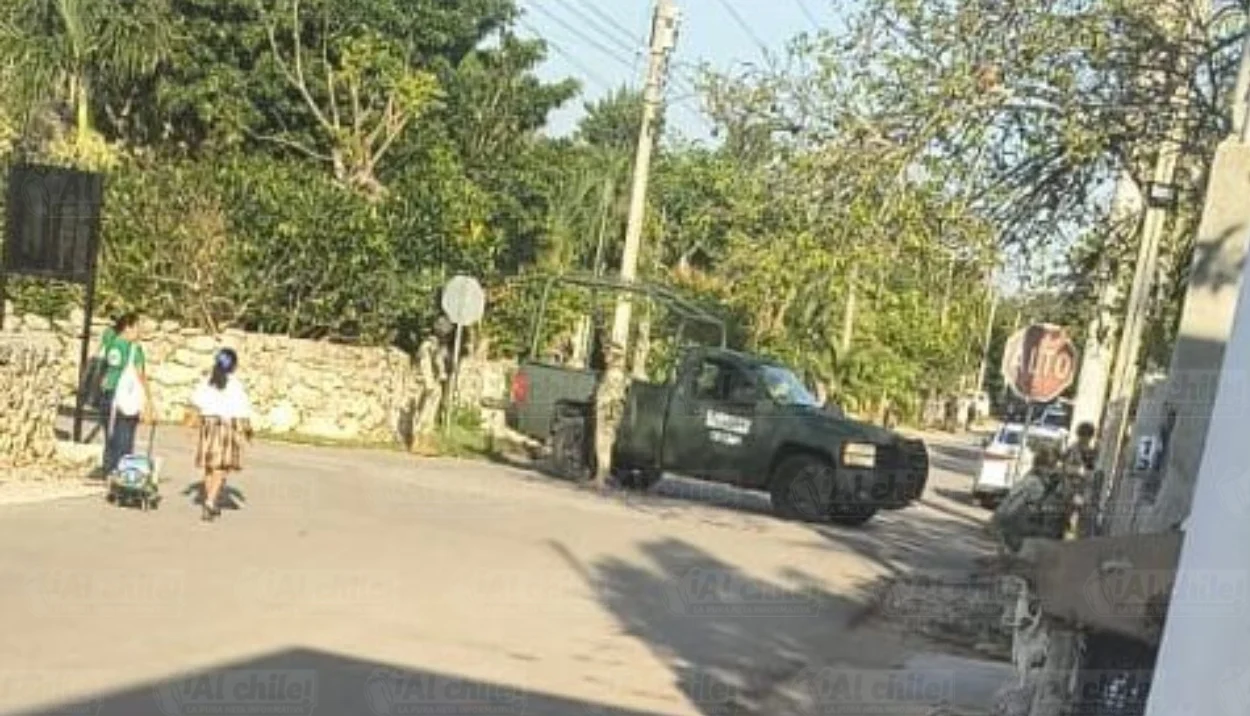
Tizimín, Yucatán — A series of federal and state raids in recent months has exposed the presence and possible consolidation of organized crime cells linked to Michoacán in eastern Yucatán, a region long considered one of Mexico’s safest. Ranches in municipalities such as Tizimín, Buctzotz, and Sucilá are allegedly being used as operational hubs for illicit activities.
Operations by the Mexican Army, National Guard, Navy, State Prosecutor’s Office, and Public Security Department have resulted in the seizure of drugs, exclusive-use weapons, and evidence pointing to ranches as strategic points for criminal operations.
The most significant evidence dates to June 2025, when at the ranch known as “El Cedro” or “Los Potrillos” on the road to Tizimín, three people were arrested and high-powered weapons and narcotics were found. Among those detained were individuals directly linked to the Cartel del Milenio, a criminal structure historically associated with the Valencia family: María Briseida V.S., alias “María la Michoacana”; her brother Jesús Alejandro V.S.; and Alfonso R.G., a native of Buctzotz.
Unofficial sources indicated that an alleged criminal leader tied to La Familia Michoacana and with suspected close ties to Servando Gómez Martínez, “La Tuta,” managed to escape the operation.
Activity continued on February 8, 2026, when authorities returned to the same property in Buctzotz under official bulletin SSP/046 as part of an ongoing investigation, seizing marijuana, methamphetamine, and relevant documentation. That same day, bulletin SSP/047 confirmed another raid near Tizimín, reinforcing the hypothesis of an operational network already established in the region.
The most recent episode occurred on April 16 in Sucilá, where federal forces raided a property linked to a group identified as “Los Michoacanos.” This operation comes amid an unusual escalation of violence in the area: on March 18, a rancher survived a shooting attack, and the following day armed individuals fired at a pickup truck on the Buctzotz–Sucilá highway, leaving visible bullet impacts and a clear message of intimidation.
The situation reached a critical level after direct threats against Sucilá Mayor Gabriela Pool Camelo. An intimidating message reading “We’re coming for you” was found on the outskirts of town, prompting the mayor to file a formal complaint with the State Prosecutor’s Office. This attack on municipal authority not only breaks the historic peace of the municipality but confirms that criminal cells have moved from silent ranch operations to open confrontation with local authorities.
Investigations point to the operation of cells linked to both La Familia Michoacana and the Cartel del Milenio. The former has been classified as a terrorist organization by U.S. authorities, while the latter maintains a historical structure that evolved from agricultural business to drug trafficking, consolidating as one of the oldest organized crime networks.
The pattern detected by federal intelligence indicates that organized crime groups, particularly cells from Michoacán, are behind the systematic acquisition of ranches in the Tizimín–Buctzotz–Sucilá triangle, using secondary routes and intermittent operation schemes to evade state pressure. This dynamic reveals organized criminal presence advancing discreetly but with structure and planning.
According to data from the Executive Secretariat, although Yucatán maintains low violence levels compared to the national average, recent seizures show an increase in synthetic drugs, particularly in the eastern part of the state, displacing traditional substances. Federal intelligence sources note that the acquisition of ranches in the livestock territory of Tizimín, Buctzotz, Sucilá, and Panabá by individuals outside the local ranching tradition is the most telling sign of a silent colonization by Michoacán cells.
In eastern Yucatán, fear has already taken hold in municipalities such as Buctzotz, Sucilá, Panabá, and Tizimín, where reports of raids, shootings, chases, and the alleged operation of Michoacán groups on ranches have raised alarms in the livestock region. Social and productive sectors are increasingly questioning Governor Joaquín “Huacho” Díaz Mena’s response, which they consider insufficient given a situation that already impacts security and threatens to escalate into extortion and protection rackets in one of Yucatán’s key agricultural zones.
More Crime
- Cancún Airport Transporters Blame ASUR for Steep Fees
- Five to Face Trial in Tulum Funeral Home Equipment Theft
- Quintana Roo Civil Protection Warns Against Fireworks Ahead of Independence Day
- Rising Crime Reports in Quintana Roo Signal Greater Trust, Official Says
- Armed Men Try to Abduct Woman on Cozumel; She Escapes on Her Motorcycle
