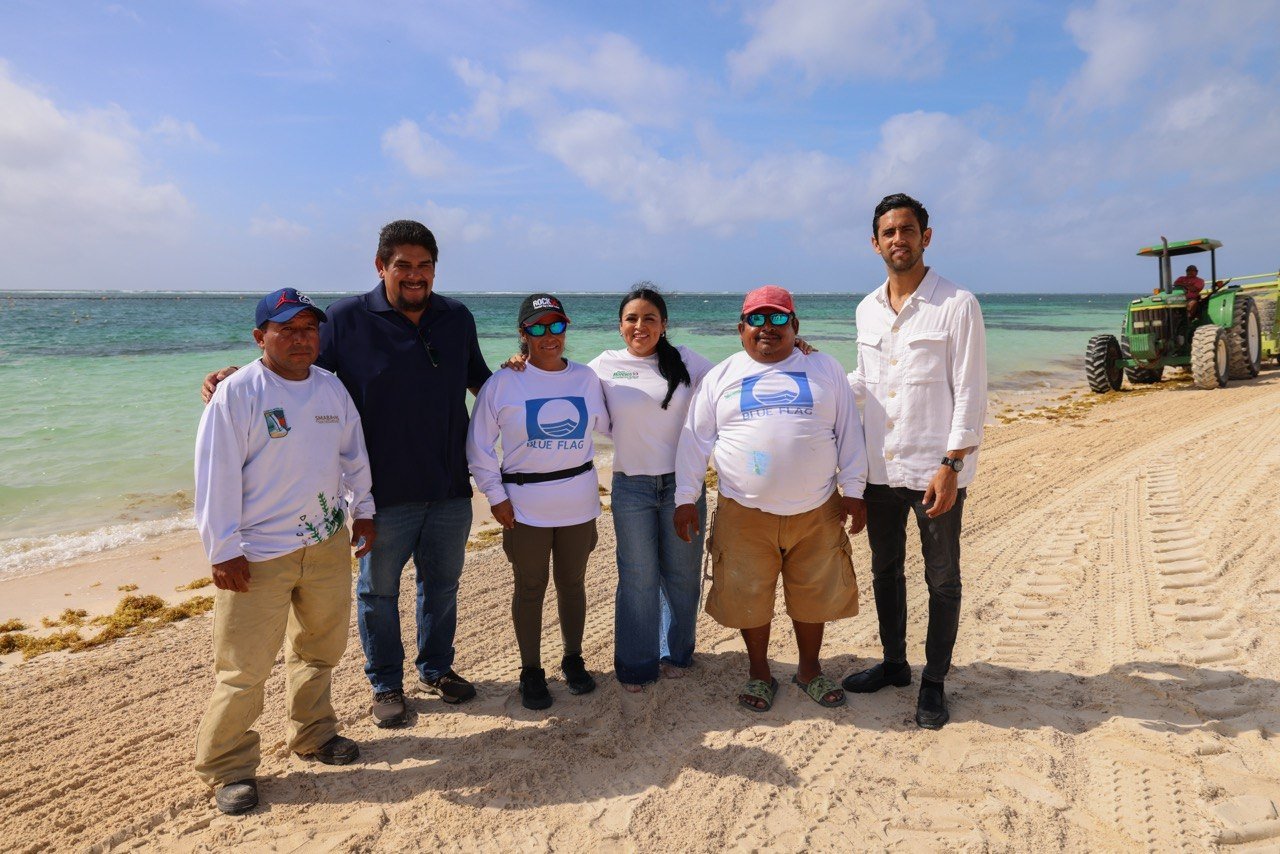
Puerto Morelos, Quintana Roo — Mayor Blanca Merari Tziu Muñoz has reaffirmed her administration’s commitment to keeping public beaches in optimal condition for residents and the thousands of tourists visiting this Caribbean destination, as the town continues its battle against sargassum seaweed.
Speaking about the ongoing efforts to manage sargassum influx, the mayor noted that while the seaweed is a natural phenomenon affecting much of the Caribbean coast, Puerto Morelos has key tools to significantly reduce its impact.
“We know sargassum is a natural phenomenon that affects much of the Caribbean coast. However, in Puerto Morelos we have important allies, such as our 2.3 kilometers of anti-sargassum barrier and the protection provided by our reef, which help us significantly reduce its arrival on the beaches,” she said.
According to the mayor, permanent monitoring, containment, and cleaning operations are carried out in coordination with various agencies, using specialized brigades that promptly address any seaweed landfall on the coastline.
Gerardo Rosas García, Secretary of Environment, Animal Welfare and Sustainable Mobility, explained that the municipality’s operational capacity — through the Federal Maritime Terrestrial Zone (Zofemat) — combined with support from the Mexican Navy, has helped Puerto Morelos advance in this fight.
“We have 40 Zofemat personnel, two sweepers, two backhoes, one handler for the final disposal site of the macroalgae, and a roll-off truck. The Navy supports us with the Natans vessel, three pontoon boats that clean the barrier, and 52 Navy personnel who help collect sargassum on the beaches,” he detailed.
Emmanuel Tuz Betancour, director of Zofemat, reported that from January to May 2026, the municipality collected 4,017 tons of sargassum. Monthly totals were: January 542.43 tons, February 604.17 tons, March 1,164.24 tons, April 912.28 tons, and May 793.80 tons.
He highlighted that these efforts are strengthened by the participation of the hotel sector, whose work complements municipal operations to keep the coastline free of seaweed and preserve the image of one of the top tourist destinations in the Mexican Caribbean.
Mayor Blanca Merari reiterated that there is a joint effort among the three levels of government, the Navy, and the state government of Quintana Roo through the Ministry of Environment (SEMA) to find ways to reduce the impact of sargassum on beaches, while also seeking its use through a circular economy program.
Puerto Morelos reaffirms its commitment to environmental protection, beach conservation, and the strengthening of tourism, the municipality’s main economic driver.
More Environment
- Two Atlantic Low-Pressure Areas Watched; One Shows 40% Cyclone Chance
- Tren Maya Freight Complex in Chetumal to Break Ground in 2027
- Lawmakers Propose One Tree Every 15 Meters in New Quintana Roo Developments
- Bacalar Aims to Show the World Its Appeal Goes Beyond the Lagoon
- Quintana Roo Weighs Permanent Revocation of Permits for Legacy by Awa Playacar After Closure Seals Broken
More Puerto Morelos
- Explosion and Fire at OXXO Store in Puerto Morelos Leaves Worker Shaken
- Puerto Morelos Pursues New Maritime Trade Route to Central America
- Holbox, Felipe Carrillo Puerto and Puerto Morelos Eyed for Mexico’s Pueblos Mágicos Program
- Puerto Morelos Announces Fifth Caribbean Grill Festival, Expects 4,000 Visitors
- Puerto Morelos Approves Funds to Protect Beaches and Strengthen Sargassum Response