
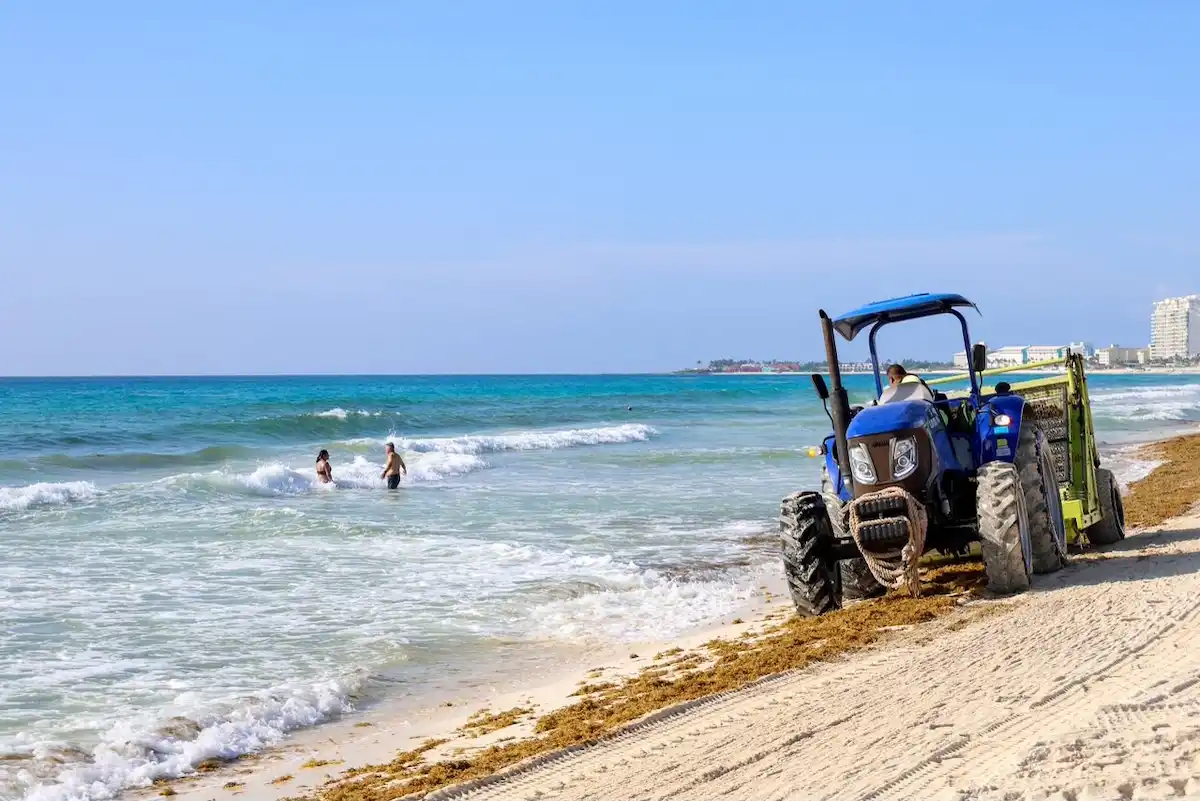
Cancún, Quintana Roo — The Mexican government is pushing to turn the sargassum that piles up on Caribbean beaches from a tourism problem into the base of a new industrial sector.
Under a circular-economy strategy announced Friday at the Expansión ESG Summit, the seaweed could be processed into biofuels, fertilizers and construction materials.
José Luis Samaniego Leyva, deputy secretary for sustainable development and circular economy at Mexico’s Environment Secretariat (Semarnat), said sargassum can no longer be treated as a seasonal nuisance, but rather as a permanent challenge linked to climate change that requires long-term solutions.
“From a problem to an opportunity — that has to be the future of sargassum,” Samaniego said. “If we develop technology, investment and a circular economy, we can harness a resource that will keep arriving on our coasts and turn it into development for the country.”
As part of the plan, the government has launched the PODECIBI circular economy hub in Puerto Morelos, a coastal town south of Cancún. The project is designed to coordinate efforts among authorities, the private sector and the tourism industry while producing higher-value goods from sargassum.
The strategy calls for:
- Strengthening beach collection with support from hotels
- Expanding the state government’s sanitation efforts
- Increasing offshore sargassum collection by the Mexican Navy
- Promoting technology development
- Offering tax incentives to attract investment
The Navy currently collects sargassum at sea and plans to gradually raise its capacity to 3,000 metric tons per day, aiming to intercept the seaweed before it reaches the shoreline and ease its processing.
Semarnat said nearly 190 technologies with potential to make use of sargassum have been identified, and 11 are ready to be scaled up for industrial use. The Puerto Morelos hub is expected to process between 600 and 4,000 metric tons per day, depending on the availability of material.
More Environment
- Texas’ Big Bend Becomes Border Wall Battleground
- Contemporary Maya Sculpture Installed in Sacalaca Cenote to Draw Community Tourism
- Mexico to Review Private Events Held Inside Tulum National Park
- Cancún Sargassum Arrivals Ease in September, but Officials Watch the Winds
- Mexico Holds Second National Earthquake Drill; Alerts to Sound at Noon
More Puerto Morelos
- Pickup Truck Rolls Over on Federal Highway 307 Between Cancún and Puerto Morelos; Driver Walks Away Unharmed
- Audio Reveals Pressure Tactics in Leona Vicario Land Regularization Scheme
- Puerto Morelos Mayor Accuses Predecessor Laura Fernández Piña of 1.26 Billion-Peso Embezzlement
- Puerto Morelos Announces Mar de Almas Janal Pixan 2026 Day of the Dead Festival
- Cancún Hoteliers Plan Rate Hikes of Up to 35% for Winter Season