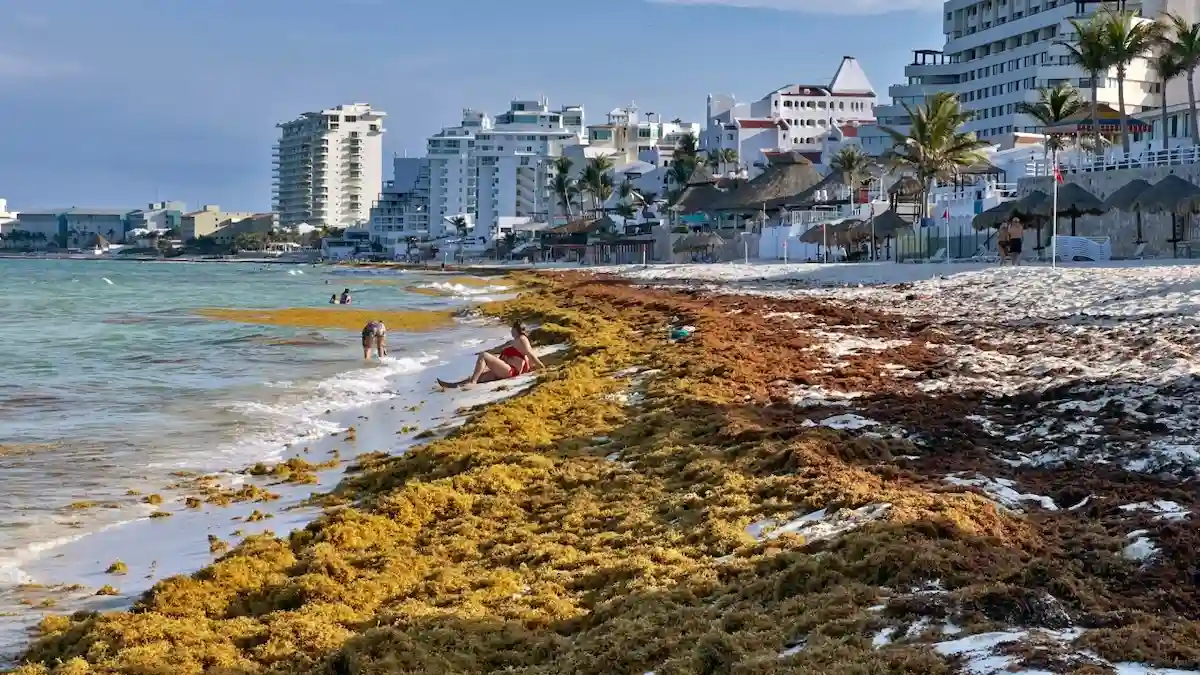
Playa del Carmen, Quintana Roo — A thick, reeking blanket of sargassum has taken over the Mexican Caribbean this summer, turning once crystal-clear turquoise waters into a brown, rotting mash and dragging hotel occupancy down across Quintana Roo.
Cleanup crews have deployed specialized sargassum boats, floating barriers and manual beach raking, but the seaweed keeps coming. An AFP team toured the Riviera Maya and Tulum aboard one of 27 vessels the Mexican Navy has operated since 2019 to try to contain the algae, which first appeared in 2011.
The small ship moved through the dense seaweed like something out of a video game, scanning for heavy concentrations and then sucking them up. A mechanical belt on a ramp in the bow lifted the sargassum off the surface and dumped it into an onboard hopper. Each vessel can hold up to 300 tons. The effort is backed by smaller boats, amphibious vehicles and, as a last step, crews picking seaweed by hand on the beaches.
“It’s an intense season that has required a lot more effort,” said Rear Adm. Topiltzin Flores, the officer in charge of the operation. The goal, he said, is to collect as much seaweed as possible offshore and keep it away from the beaches.
In the first half of the year, Navy personnel and local governments gathered roughly 100,000 metric tons of sargassum, already exceeding the 92,782 tons collected in all of 2025. Yet the algae remain ubiquitous along the coast, and only a handful of tourists are willing to brave the beach, where the air smells like rotten eggs.
Local businesses are feeling the pinch. A waitress in Playa del Carmen, 26-year-old Argentine Azul Lucero, said her restaurant now serves fewer than 50 customers a day — down from as many as 400 when the water is clean. “My main income is tips,” she said.
The federal government insists the problem is under control. President Claudia Sheinbaum said Thursday that Mexico is breaking records for foreign tourist arrivals and that any impact on international tourism is the fault of jet fuel prices, not sargassum. “There have been no big losses,” she said.
Industry data, though, show hotel occupancy this summer running between 55% and 70%, depending on the destination. Fifteen years ago, high-season occupancy reached up to 90%.
At a hotel in Playa del Carmen, cook Tere May, 47, stood near a pile of sargassum and complained of an “unbearable smell” that had scared off guests. All 24 rooms were empty. “There’s nothing right now,” she said. “Sargassum has hurt us in every way.”
Bianca Ibanez, 33, who was vacationing with her family, said she was shocked by the amount of seaweed. “You just can’t enjoy yourself,” she said.
More Tourism
- Cancún Airport ‘Pirate’ Transporters Accused of Intimidating Tourists Over Uber and Didi
- Hurricane Polo Hits Category 5; Five Mexican States Brace for Heavy Rain
- Playa del Carmen Beach Restoration Clears Environmental Hurdle, Mayor Says
- Cozumel Lifeguards Keep Watch Over Playa Caleta After Crocodile Sighting
- Community Tourism Brings Income to Sacalaca With Small Groups and Cenote Protection
More Tulum
- Tulum Adds Artisan Market and Caribbean Culture Festival to Its Tourism Lineup
- Culture Ministry to Inspect Ceremonial Pole Ahead of Voladores de Papantla Return to Tulum
- Tulum Beach Cleanup Pulls 32 Kilos of Marine Debris From Playa del Pueblo
- Coastal Dune Loss Weakens Natural Defenses in Quintana Roo
- Felipe Carrillo Puerto Weighs Access Fee for Puerta al Mar