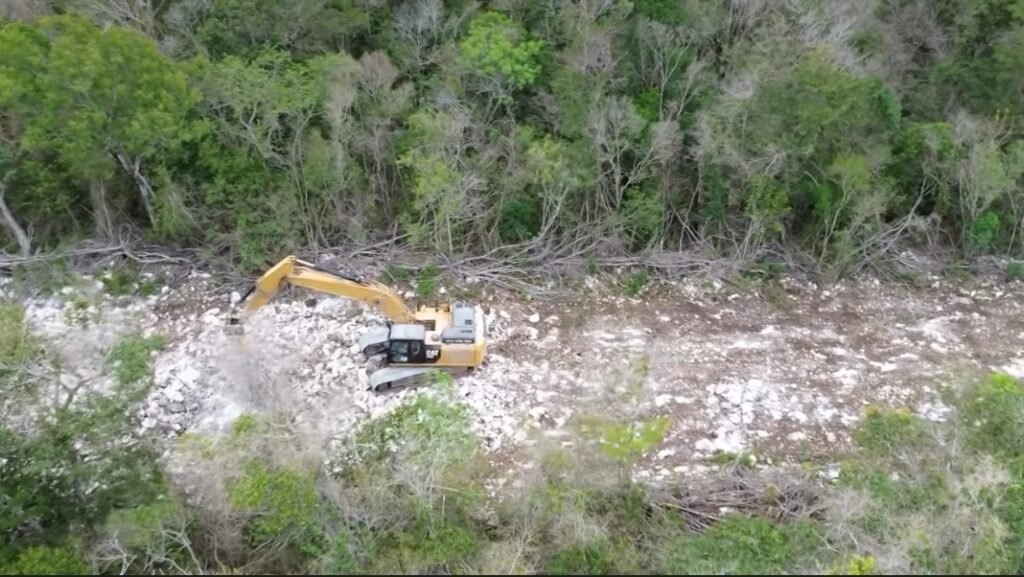
Tulum, Quintana Roo — A cave explorer and environmental activist has renewed his opposition to a road being built over the Sac Actún cave system near Tulum, warning that the project could damage the jungle, the region’s underground water supply and archaeological heritage.
José Urbina, known as “Pepe Tiburón,” a member of the Sélvame del Tren collective, said work is advancing in an area where there are no crops, despite the road having been previously described as a bypass for Tulum.
In a message directed at President Claudia Sheinbaum, Urbina said construction is taking place over the Sac Actún system even though, he claimed, there is an active legal process related to the project.
He recalled that last year a road in the same area was halted after the unauthorized clearing of vegetation was documented and Profepa, Mexico’s environmental enforcement agency, intervened. Now, he said, construction has resumed, and he questioned that the project was authorized through an exemption from an environmental impact assessment.
During a tour of the site, Urbina disputed that the road qualifies as a farm access road, given its size.
“A farm access road should not be more than six meters wide. This one easily exceeds ten meters,” he said.
He also rejected the idea that the infrastructure is meant to serve a local community, noting that it does not connect towns to schools or health centers.
According to Urbina, the road will be roughly 16 kilometers (10 miles) long and will connect federal Highway 307 with Highway 109, toward the town of Cobá.
His main concern, he said, is that the road will later open the door to real estate development in an environmentally fragile area. Sac Actún is one of the region’s most important underground cave systems, and the aquifer that flows through it supplies water to Tulum and other parts of the Mexican Caribbean, he said. Urbanization could contaminate the groundwater.
“Tulum is going to run out of water,” he said, insisting on the need to protect the aquifer.
Urbina also stressed the cultural and archaeological significance of Sac Actún. He said the National Institute of Anthropology and History (INAH) has documented human remains in the area dating back more than 8,000 years and up to 13,500 years. He called the zone a heritage that transcends the local and national level.
Finally, he questioned the use of public funds for a road that, in his view, will ultimately benefit private landowners.
“This is being paid for with everyone’s taxes so that the Mexican Army builds this road for the owners of these lands,” he said.
Urbina called on Sheinbaum to visit the area and see the jungle and the Sac Actún system firsthand.
“Madam President, please come tour the jungle, come see what we want to protect and help us defend our home,” he said.
More Environment
- Mexican Navy Opens Youth Photography Contest on Ocean Conservation
- WHO Warns El Niño Poses Major Global Health Threat
- Hurricane Polo Hits Category 5; Five Mexican States Brace for Heavy Rain
- Isla Mujeres Fishermen Face Grouper Shortage as Catch Barely Covers Local Demand
- Cancún Officials Urge Residents to Protect Pets After Reported Puma Sighting in Cuna Maya
More Tulum
- Tulum Adds Artisan Market and Caribbean Culture Festival to Its Tourism Lineup
- Culture Ministry to Inspect Ceremonial Pole Ahead of Voladores de Papantla Return to Tulum
- Tulum Beach Cleanup Pulls 32 Kilos of Marine Debris From Playa del Pueblo
- Coastal Dune Loss Weakens Natural Defenses in Quintana Roo
- Felipe Carrillo Puerto Weighs Access Fee for Puerta al Mar