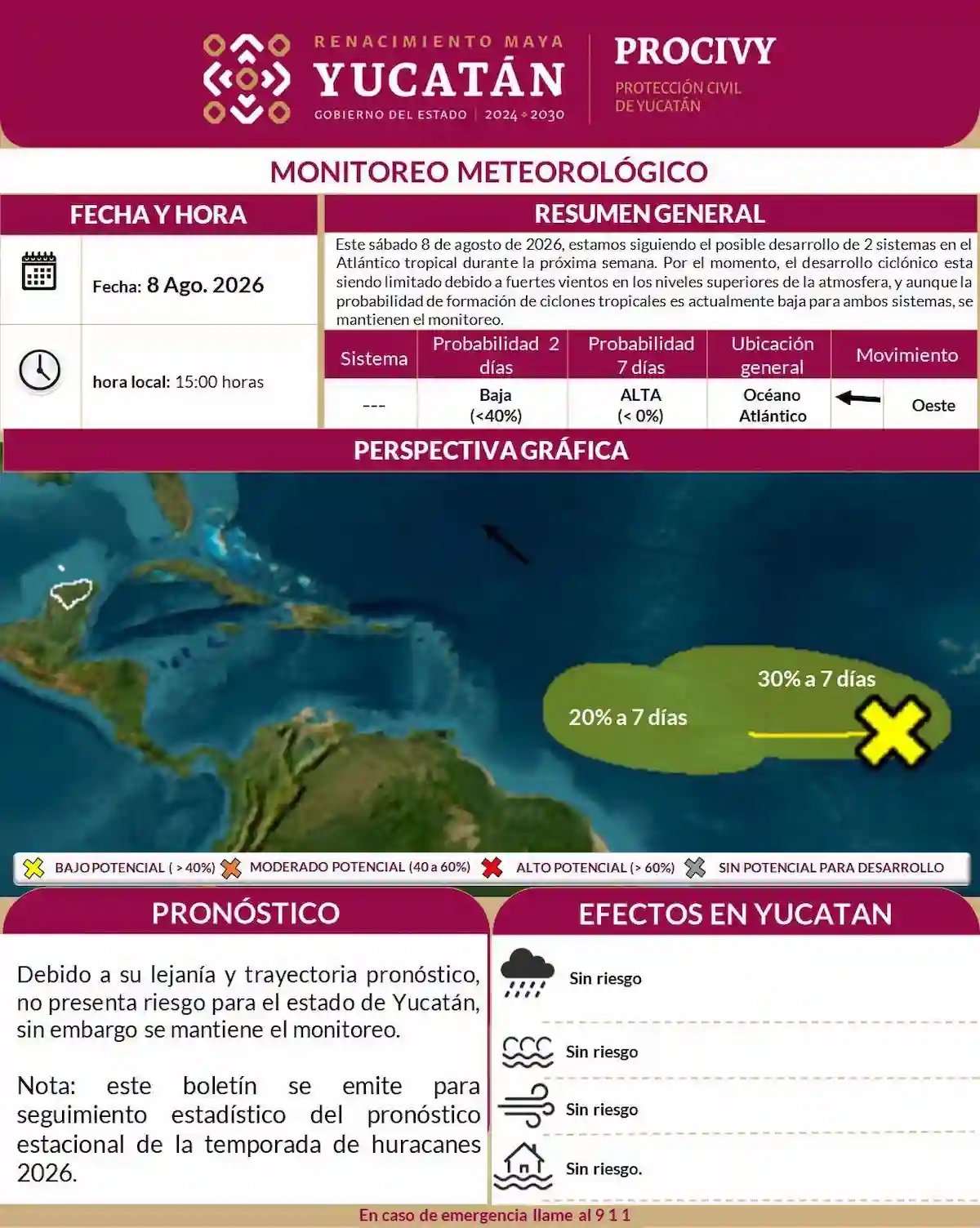
Merida, Yucatan — Civil protection authorities are keeping watch on two systems in the tropical Atlantic that could become better organized during the coming week, but as of Saturday neither poses a threat to Yucatan.
According to the latest meteorological monitoring from the Yucatan State Civil Protection Coordination (Procivy), current atmospheric conditions do not favor rapid organization of these systems, largely because of strong winds in the upper levels of the atmosphere. That pattern is limiting cyclonic development and keeping the chances low that either system will evolve into a tropical cyclone.
The report, updated at 3 p.m. Saturday, says both systems are still a considerable distance from the Yucatan Peninsula and remain over open Atlantic waters.
Development Odds Could Rise in Coming Days
Although the immediate odds of formation are low, the meteorological picture could shift as the systems track westward and move into different conditions across the tropical Atlantic.
The outlook released by Procivy identifies two areas of interest east of the Caribbean, with still-low probabilities of organization in the next few days, which is why authorities are keeping close tabs on them.
The monitoring matters because August marks the beginning of the statistically most active stretch of the Atlantic hurricane season, usually peaking between August and September. Still, an area with development potential does not necessarily mean it will become a tropical storm or hurricane, nor that it will head toward the Yucatan Peninsula.
For a system to achieve cyclonic organization, several factors have to come together, including favorable ocean temperatures, enough atmospheric moisture and low wind shear. That last element is currently acting as a brake on strengthening.
No Threat to Yucatan for Now
Procivy said that because of the systems’ distance and their forecast tracks, there is currently no risk to the state.
The official outlook also does not foresee any direct impacts from these systems in terms of rain, waves, wind or flooding across Yucatan.
Nevertheless, authorities will continue tracking their evolution, as scenarios can change in the coming days once more is known about their organization and movement.
The state agency noted that these advisories are part of the statistical and preventive monitoring for the 2026 hurricane season. It urged residents to stay informed through official channels and avoid alarm based on long-term projections.
For now, Yucatan remains free of any cyclonic threat linked to these two systems, while permanent surveillance of the tropical Atlantic continues.
More Environment
- Mexican Navy Opens Youth Photography Contest on Ocean Conservation
- WHO Warns El Niño Poses Major Global Health Threat
- Hurricane Polo Hits Category 5; Five Mexican States Brace for Heavy Rain
- Isla Mujeres Fishermen Face Grouper Shortage as Catch Barely Covers Local Demand
- Cancún Officials Urge Residents to Protect Pets After Reported Puma Sighting in Cuna Maya
More Quintana Roo
- Quintana Roo Congress Ranks Among Mexico’s Least Transparent
- Riviera Maya Business Groups Push to Block 35.8% Hike in Mexico’s Tourist Entry Fee
- Quintana Roo Climbs 12 Spots to 9th in Competitiveness Index
- Sargassum Collection in Quintana Roo Tops 133,000 Tons, Setting New Record
- Quintana Roo Courts European Airlines to Boost Winter Flights to Cancún