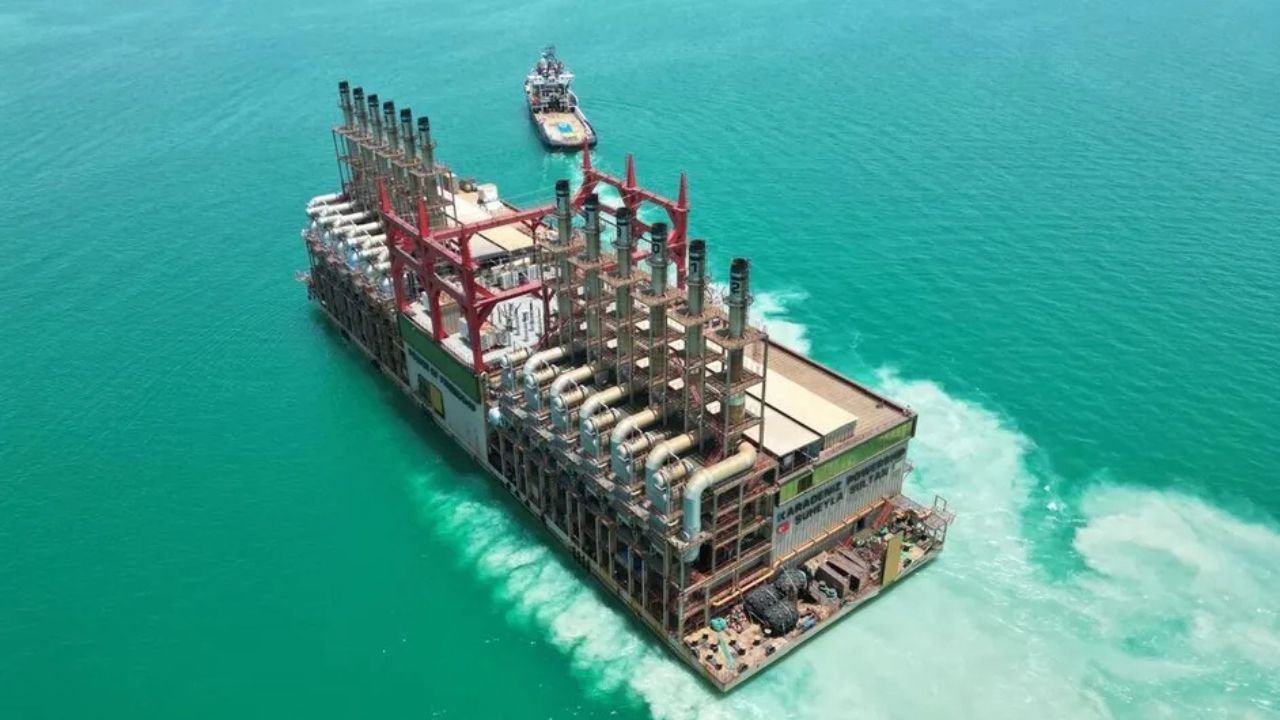
Playa del Carmen, Quintana Roo — Facing mounting pressure on its electrical grid, the state government is evaluating an unconventional but increasingly common solution: a floating power plant anchored off the coast at Calica.
Artemio Santos Santos, head of the Public Policy Cabinet, confirmed that officials are exploring the installation of a Turkish-operated power vessel capable of generating up to 250 megawatts. The ship would run on natural gas and serve as a rapid-response backup to support rising electricity demand across the northern Riviera Maya.
The proposal comes at a critical moment. Quintana Roo’s population growth, tourism expansion, and ongoing real estate development have placed sustained strain on the grid managed by Comisión Federal de Electricidad (CFE). In recent years, residents and businesses have experienced rolling outages, voltage fluctuations, and service interruptions—issues that have become more visible during peak demand periods and extreme heat.
Why a Floating Plant?
Floating power plants, often referred to as “powerships,” are not a new concept globally. Turkish energy company Karpowership has deployed similar units in countries across Africa, Asia, and Latin America to provide temporary or supplemental electricity.
The appeal is speed. Unlike traditional power plants, which can take years to build, a floating unit can be deployed in a matter of months once permits and infrastructure connections are in place. For a fast-growing region like Quintana Roo, that timeline matters.
At an estimated capacity of 250 megawatts, the proposed unit could supply a meaningful portion of local demand, particularly during high-consumption periods driven by air conditioning, tourism occupancy, and commercial activity.
Why Calica?
The port of Calica—a deep-water industrial site south of Playa del Carmen—has been identified as a suitable location due to its depth, existing infrastructure, and distance from dense residential zones.
Originally developed for limestone extraction and shipping, the port has the physical characteristics needed to support a vessel of this size, including docking capacity and access to fuel supply logistics.
Environmental and Regulatory Questions
Officials have suggested that a natural gas-powered floating plant would have a lower environmental impact compared to diesel-based emergency generation. Combined-cycle systems are generally more efficient and produce fewer emissions per unit of electricity generated.
Still, the proposal is likely to face scrutiny. Environmental groups in the region have become increasingly vocal about industrial projects along the coast, particularly those near sensitive marine ecosystems. Any installation would require federal environmental approval and detailed impact assessments.
There are also broader questions about whether a temporary solution risks becoming a long-term dependency if underlying infrastructure gaps are not addressed.
A Stopgap for a Bigger Problem
The floating plant is being framed as a bridge solution while more permanent upgrades are developed. Mexico has announced investments in transmission lines and generation capacity for the Yucatán Peninsula, but these projects take time to materialize.
In the meantime, demand continues to climb. The Riviera Maya remains one of the fastest-growing tourism regions in the country, with new hotels, residential developments, and commercial projects coming online each year.
Looking Beyond Electricity
The state is also exploring alternative energy strategies tied to one of its most persistent environmental challenges: sargassum.
Researchers and officials are studying ways to convert the seaweed into biogas and even ethanol suitable for aviation fuel. If viable at scale, this approach could serve a dual purpose—reducing the environmental and economic impact of sargassum while contributing to local energy production.
What Comes Next
For now, the floating power plant remains in the evaluation phase. Key questions around permitting, environmental impact, financing, and integration with the existing grid still need to be resolved.
But the fact that it is being considered at all speaks to the urgency of the situation. Quintana Roo’s energy demand is no longer theoretical—it’s immediate. And solutions, temporary or not, are moving from discussion to planning.
More Business
- 40-Hour Workweek in 2027 Will Speed Up Robots and AI in Hotels, IMEF Says
- Mexico’s Supreme Court Blocks Telmex Bid for Automatic Pay TV Access
- Mexico and EU Bring Modernized Global Agreement to Congress as Senate Ratification Looms
- Lawmakers Propose One Tree Every 15 Meters in New Quintana Roo Developments
- Moody’s Warns Mexico Faces Negative Fiscal Trend on Rising Debt and Weak Growth
More Playa del Carmen
- Man Gunned Down in Playa del Carmen; No Arrests Made
- Playa del Carmen Set to Host Pro Padel League International Stop
- Quintana Roo Weighs Permanent Revocation of Permits for Legacy by Awa Playacar After Closure Seals Broken
- Playa del Carmen Beach Restoration Clears Environmental Hurdle, Mayor Says
- Bidding Process to Define Renovation of More Than 10 Parks in Playa del Carmen