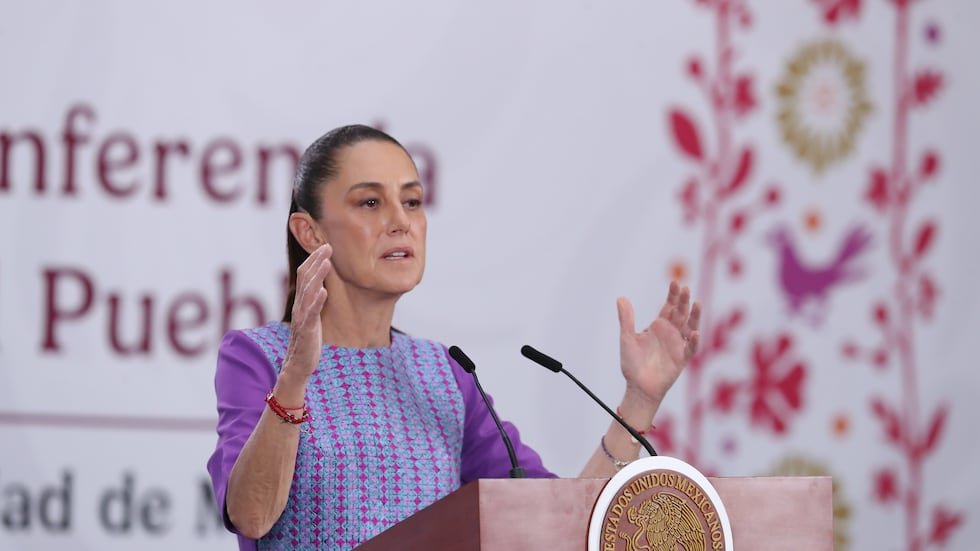
Mexico City — Mexican President Claudia Sheinbaum has responded to Washington's latest warning by asking the United States to improve its cooperation and do its part in the fight against drug trafficking, in the prevention of addiction and arms trafficking.
Sheinbaum has turned the tables on the United States in response to new threats of interference from President Donald Trump, who warned on Wednesday that if Mexico does not "do the job" to curb drug trafficking, the U.S. will intervene by land. "We are taking action," the president declared, listing the actions her government has taken to combat the cartels, including seizures, arrests, the dismantling of drug labs, and a reduction in homicides. However, she highlighted the lack of measures by her northern neighbor to prevent drug use and reduce the arms trafficking that fuels Mexican organized crime.
"For the first time, they are acknowledging that they have a problem with drug use," Sheinbaum remarked regarding the document published by Washington outlining the National Drug Control Strategy 2026. "There needs to be some recognition of the problem from the United States," she added.
Sheinbaum also responded to Acting U.S. Attorney General Todd Blanche, who yesterday announced—without providing details—that there will be more indictments against Mexican politicians allegedly linked to drug trafficking. Sheinbaum promised they would continue "doing that" when a reporter asked if there would be more arrest warrants in Mexico after he announced charges against the governor of Sinaloa, Rubén Rocha, and nine other high-ranking officials from that state for conspiring with the Sinaloa Cartel and offering them protection and security information in exchange for substantial bribes. Terrace Cole, the director of the U.S. Drug Enforcement Administration (DEA), maintains that Rocha won the 2021 state elections with the help of Los Chapitos, the faction of Joaquín "El Chapo" Guzmán's sons, who assisted him by "kidnapping and intimidating his rivals." High-ranking officials in the Sinaloa police apparatus, as well as a prosecutor, a senator, and security officials, participated in the corruption and drug trafficking network.
The formal indictment, which has rocked Mexican politics and strained diplomatic relations with the United States, comes less than a year after Ovidio Guzmán, El Chapo's son, pleaded guilty after spending two years in an Illinois prison in Chicago. The younger Guzmán was the first in the family to reach an agreement with the U.S. government in exchange for information, and his older brother, Joaquín Guzmán López, also a member of Los Chapitos, followed suit. A month later, the leader of the group's rival faction, Ismael El Mayo, also known as Zambada, agreed to plead guilty to avoid the death penalty. "One consequence of bringing many leaders of some of these cartels here over the past year, in cooperation with the Mexican government, is that some will likely want to cooperate, and that could lead to additional charges," Blanche argued regarding the possibility of further investigating the links between the Mexican government and organized crime.
Despite this, the Mexican government has clung to the claim that the evidence presented by the U.S. Department of Justice to justify the arrest warrants is insufficient. "Let them send proof," Sheinbaum reiterated, a mantra echoed by her entire party, Morena. However, she defended the security coordination relationship with the United States, while also denouncing the imbalance in reciprocity. "We want them to cooperate as well. Mexico has extradited more than 90 people wanted by the United States who were in Mexican prisons. We have asked them to extradite four people linked to the huachicol [fuel smuggling] issue. They haven't extradited anyone. We have asked them to extradite two people linked to the Ayotzinapa case. They haven't extradited anyone," she stated.
The Mexican government has been requesting the extradition of two individuals from U.S. Secretary of State Marco Rubio since last year, in connection with the 2014 disappearance of 43 students from the Ayotzinapa Rural Teachers' College in Guerrero. President Sheinbaum even made the request personally when the Secretary visited last September. To this list of requests, they have added four members of a fuel smuggling network operating between Mexico and the United States. This multi-million dollar scheme, which came to light last year and undermined confidence in the Mexican Army's handling of customs, allowed shipments of crude oil to enter the country illegally without paying the corresponding taxes at the border. The asymmetry in cooperation regarding the transfer of fugitives is another point of contention eroding the security cooperation relationship between Sheinbaum and Trump.
This is not the first time—nor does it seem likely to be the last—that Trump has threatened to send ground troops to Mexico to combat drug trafficking, as Sheinbaum pointed out. The president stated that in her first call with the U.S. president, he asked her about her strategy for controlling drug use in Mexico, and she spoke to him about "family values" and prevention campaigns. "We can continue to cooperate out of humanitarian concern. We don't want fentanyl to reach young people in the United States, nor young people in Mexico, nor anywhere else in the world, nor any other drug. But there has to be a degree of recognition of the problem from the United States," she noted.
She also emphasized that weapons arriving from across the border are a key factor in strengthening the cartels and that smuggling must be stopped to weaken their attack capabilities. "The joint dialogue has yielded results within a framework of mutual respect because we have worked together on several issues. What we don't want is for trust to be broken," she added, at a time of extreme tension in diplomatic relations due to accusations of narco-politics, the presence of CIA agents in Chihuahua, and the pressure surrounding the World Cup, which both countries are co-hosting.
More National News
- Mexico’s Lower House Approves Single-Nationality Requirement for Presidency and Governorships
- US Expands Visa Restrictions Targeting Birth Tourism
- Mexico’s Supreme Court Blocks Telmex Bid for Automatic Pay TV Access
- Mexico and EU Bring Modernized Global Agreement to Congress as Senate Ratification Looms
- Quintana Roo Reports 282 Dengue Cases, Eight of Them Severe