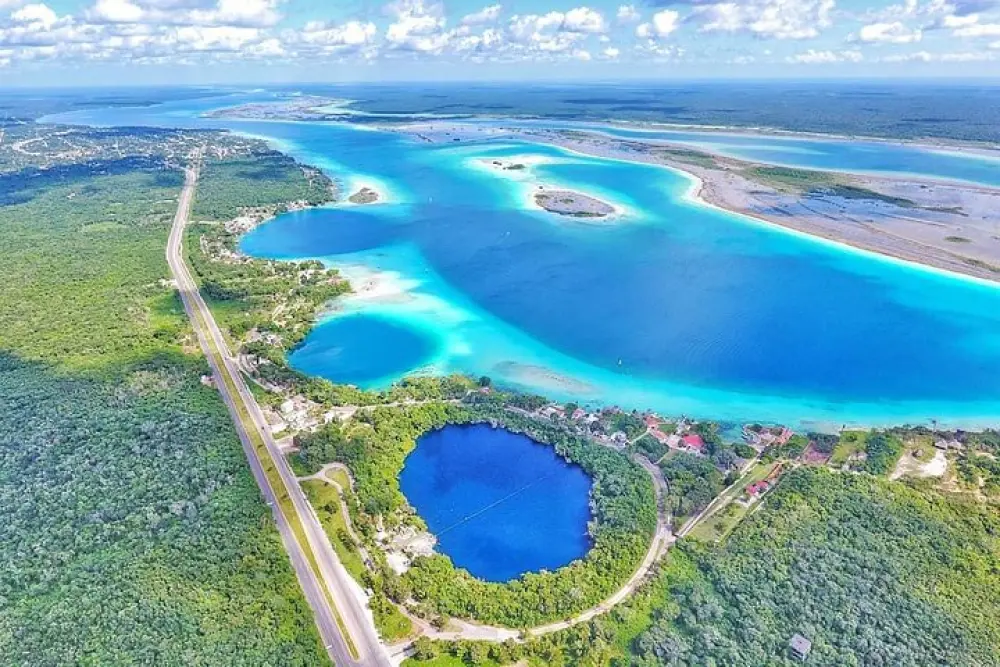
Bacalar, Quintana Roo — The Laguna de los Siete Colores, one of Mexico’s most iconic natural attractions, has lost 277 hectares of mangroves and wetlands between 1999 and 2021, according to a study by the Colegio de la Frontera Sur (Ecosur). The environmental degradation is causing economic losses exceeding $10.5 million annually.
The research, led by investigator Erika Palafox Juárez, quantifies the value of ecosystem services that have been irreversibly lost. Mangroves and wetlands provided natural water filtration, flood prevention, carbon capture, and resource supply — benefits that now require costly artificial replacements.
The study, titled “The Value of Conservation: Environmental and Economic Impacts on the Wetlands of Bacalar, Quintana Roo,” links the deterioration to rapid tourism growth following Bacalar’s designation as a Pueblo Mágico (Magical Town) in 2006, as well as an influx of visitors displaced from northern Quintana Roo by sargassum seaweed. Infrastructure development often proceeded without regard for the lagoon basin’s fragility.
Biologist María Luisa Villareal Sonora, author of two books on the lagoon, warned that urgent cleaning, maintenance, and dredging are needed in the southern zone to prevent irreversible damage. She said a mistaken belief that stromatolites dominate the entire lagoon has blocked necessary technical interventions.
“Focusing the discussion solely on protecting these organisms has limited attention to other critical ecological processes, such as accelerated sedimentation and nutrient buildup, which could trigger eutrophication in the short term,” Villareal said.
She called for informed dialogue and cooperation between environmental and productive sectors, stressing that conservation must be approached with a comprehensive vision that balances ecological protection and sustainable development.
The study’s economic valuation aims to highlight the social cost of environmental loss, estimating what society would need to invest to replace the natural processes that mangroves provided for free. Researchers urge stronger conservation policies in the region.