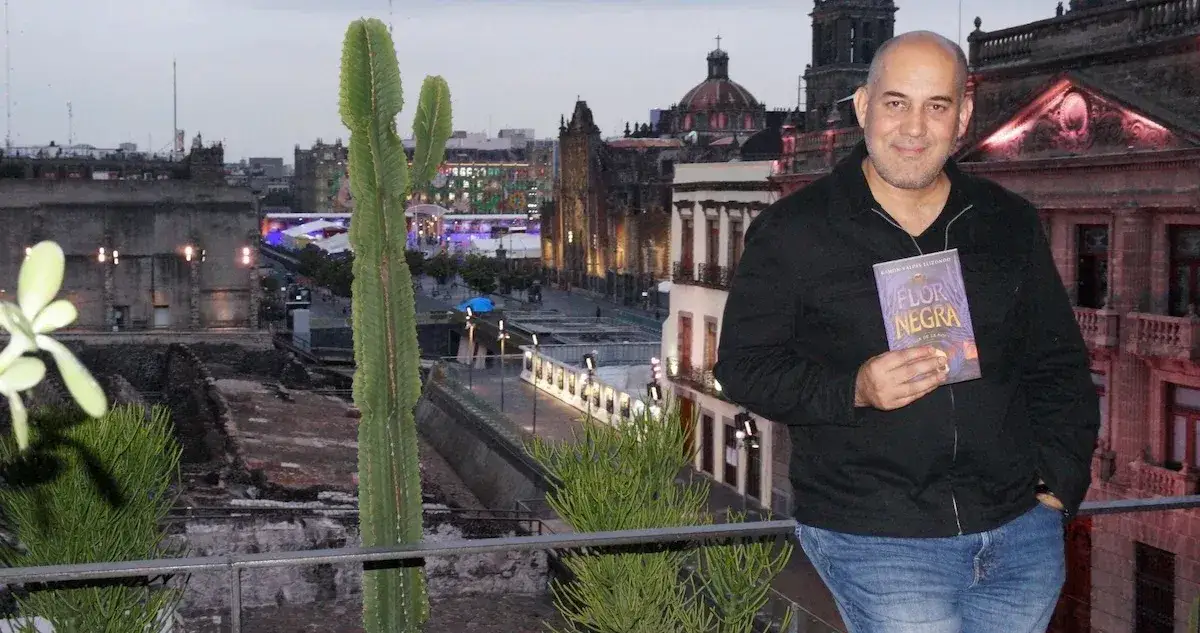
Mérida, Yucatán — Epic fantasy often conjures images of medieval castles, European dragons, and worlds rooted in Anglo-Saxon traditions. But the Flor Negra trilogy by Mexican writer Ramón Valdés Elizondo proves that Maya myths and legends can sustain grand adventures, memorable heroes, and complex fantasy universes. With the publication of La hija de la noche (Daughter of the Night), the author concludes a story that began with a simple question: Why had no one turned the Maya worldview into a major fantasy saga?
The answer lies in an anecdote that sparked the project. Valdés recalls it all started when he heard about the aluxes — mischievous forest spirits in Maya folklore — and decided to research them at a library in Mérida.
“I had all the richness of any mythological narrative, any mythology. It was brutal. I was blown away and said, ‘Hey, is there more about this?’ And there wasn’t. So I thought, ‘Someone must have written a novel about this.’ And when I discovered it didn’t exist, I said, ‘If no one has written it, then someone has to write it,’” Valdés said.
From that search, the author delved into the legends, fantastic beings, and beliefs of the Maya people. What he found was a universe as vast as it was unexplored by Mexican fantasy literature.
“I started feeding on the Maya worldview, its legends, its mythology, its fantastic beings, creatures, demons, and more. And I truly found a spectacular world, a world I didn’t expect to find. The world is so vast that I decided to write a novel that tries to portray these fantastic beings to introduce them to people, so they can get to know them, because they are in no way inferior to the fantasy we know based on other mythologies,” he said.
The result was Flor Negra (Black Flower), a trilogy starring Boox Nikté, a young woman found on the brink of death in the jungle, with no memory of her past and marked by strange tattoos. Over three novels, the character embarks on a journey that transforms her from victim into the most powerful sorceress in her world.
“She is a girl who doesn’t remember who she is or what happened to her. Little by little, she discovers her abilities for Maya magic and, along with the readers, gets to know all this mythology, all these fantastic beings, creatures, challenges, and rituals. Obviously, in the three books we see her evolution until she becomes the most powerful sorceress in the entire story,” Valdés explained.
The culmination of that journey occurs in La hija de la noche, where Boox Nikté returns to Xibalbá, the Maya underworld. Turning that mythical space into a narrative setting was one of the project’s greatest challenges.
“I went into dark, deep caves to feel the anxiety of total darkness, claustrophobia, humidity. Also to experience how the imagination goes wild in those places and you start confronting your own fears. Precisely, the first book is a journey into oneself, transported in a young woman who has to descend into the underworld,” he said.
Beyond the adventure, the trilogy explores themes such as destiny, memory, death, and power. But also a love story sown from the first pages that only reveals its full dimension in the finale.
“For me, it was very beautiful to be sowing that love story from the first paragraph of the first book. It’s there from the beginning, but you don’t have enough clues to understand it. As the story progresses, you discover who she is, what the tattoos mean, who attacked her, and why there is a very particular connection with a figure that has been present all along,” Valdés said.
With La hija de la noche, Ramón Valdés concludes a work conceived from the start as a closed trilogy. The ending leaves him, he admits, with a feeling of emptiness similar to saying goodbye to someone close.
“It leaves me with empty nest syndrome. When the third book is published, the novel is no longer mine. It belongs to whoever reads it. But it also leaves me with a very nice satisfaction. If I could fulfill two goals with Flor Negra, they would be to show that you can build epic fantasy from our own culture and that people enjoy the journey,” he said.
More Culture
- Cueva Popotitos: New Underwater Cave System Found South of Cozumel
- Tren Maya Archaeological Finds Won’t Be Displayed in Chetumal, INAH Says
- Cumbia, Rock and Pop Headline Plaza de Toros Cancún Concert Series
- Cabaret Show Brings 1920s Glamour to Cancún’s Teatro de la Ciudad
- Cancún Music Festival Opens Second International Classical Guitar Competition
More Zona Maya
- Tulum Tourism Slump Spreads to Inland Maya Communities as Businesses Close Along Cobá Route
- Mahahual Groups Build Reinforced Dog Shelters to Shield Pets From Jaguar Attacks
- Man Hospitalized After Apparent Crocodile Attack at Noh Bec Lagoon
- Girl Dies in Cobá Motorcycle Crash; Ambulance Fails to Arrive
- Melipona Honey Output Falls 50% in Quintana Roo