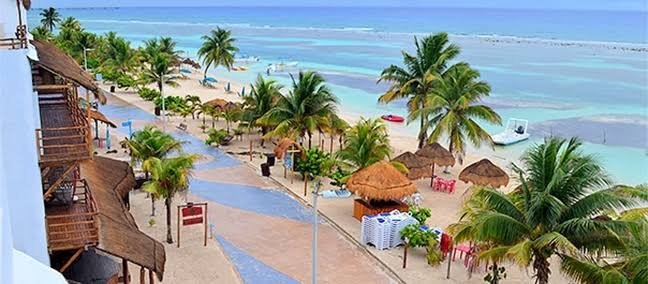
Mahahual, Quintana Roo — Quintana Roo is preparing a 197.5 million-peso improvement program for Mahahual, including work on the community’s waterfront boardwalk, tourist streets and Plaza del Faro, as state and federal officials develop a new model for tourism growth along the Costa Maya.
The confirmed investment is slightly below the more than 200 million pesos cited in initial reports. Governor Mara Lezama announced the 197.5 million-peso package during a June 5 federal presentation, saying it would finance road infrastructure, rehabilitation of Plaza del Faro and improvements to the malecón. At current exchange rates, the allocation is worth roughly US$11 million.
State Tourism Secretary Bernardo Cueto Riestra has since said construction is expected to begin in the coming weeks. The work is intended to improve Mahahual’s public spaces and urban appearance while addressing infrastructure needs in a community whose economy depends heavily on cruise passengers, diving and other coastal tourism.
The improvements are public projects and are not dependent on Royal Caribbean’s proposed Perfect Day Mexico development. That distinction is important because the original Perfect Day plan is no longer awaiting a routine approval decision.
Mexico’s Secretariat of Environment and Natural Resources (SEMERNAT), formally concluded the environmental review in May and said the project as submitted would not be approved. Royal Caribbean subsequently withdrew its environmental application.
The proposal covered approximately 82.6 hectares and included artificial beaches and waterways, a water park, service areas, a wastewater-treatment plant and a reverse-osmosis facility. Separate applications concerned a beach club and the construction or modification of a private cruise pier.
Semarnat determined that the different components needed to be evaluated together because of their connected operations and potential cumulative effects. The agency said Royal Caribbean’s submissions did not adequately answer requests for additional information or clearly establish how significant environmental impacts would be prevented.
The environmental review generated 14,411 public comments. Concerns included the presence of mangrove vegetation, possible effects on reefs and aquatic ecosystems, wastewater and solid-waste generation, disposal of brine from desalination, noise, vegetation removal and changes to local hydrology. Semarnat also declined to authorize the proposed modification of the cruise pier. The agency’s May 21 decision stated that protecting the Mesoamerican Reef System, mangroves, aquifers and coastal ecosystems was a federal priority.
Environmental organizations had warned that the volume of visitors envisioned for the resort could place additional pressure on Mahahual’s water, sewage and waste-disposal systems. Some groups published estimates of the human waste that could be generated by thousands of daily visitors. Those figures were projections used in opposition campaigns, not measurements of contamination caused by the project, which was never constructed.
The company’s proposal included its own wastewater-treatment and water-production systems. However, federal reviewers said the information submitted was insufficient to establish clearly how the combined environmental risks would be managed.
President Claudia Sheinbaum said in May that the Perfect Day project would not proceed at the Mahahual location. She added that the government could discuss a different development with Royal Caribbean in a location or form that did not produce the same environmental concerns.
That leaves open the possibility of a substantially redesigned Royal Caribbean investment, but not the automatic revival of the rejected Perfect Day application. Any new proposal would require its own plans, environmental studies and federal authorizations.
Cueto’s recent comments appear to refer to that possibility. He said the state hopes significant private investment can eventually be reactivated “possibly in a different way than originally planned,” with greater economic benefits for Mahahual and stronger environmental protections.
Meanwhile, the federal government is preparing a special instrument intended to limit large-scale tourism in Mahahual and promote community-based ecotourism. Semarnat, the federal Tourism Secretariat, Fonatur, the Quintana Roo government and community representatives are expected to participate.
When announcing the initiative, federal officials said residents were not opposed to investment but wanted projects that produced direct benefits for local hotels, restaurants, tour operators and small businesses. The proposed framework is intended to combine employment and economic development with protection of Mahahual’s reefs, mangroves and coastal landscape. The federal announcement described the measure as a way to steer the destination away from mass tourism and toward a more locally integrated model.
Officials have not yet released complete construction schedules, street-by-street plans or information about possible traffic restrictions during the boardwalk project. Further details are expected as contracts and work phases are announced.
For Mahahual, the immediate change will therefore come from the state-funded public works. The larger question is no longer whether the original Perfect Day Mexico project will be approved, but whether Royal Caribbean or another investor eventually presents a smaller, redesigned proposal compatible with the federal government’s emerging environmental and tourism rules.
More Development
- Profepa Shuts Down Work Damaging Coastal Dune in Yucatán
- Cancún Urban Development Plan Reaches 50% as Officials Weigh Where City Can Grow
- Isla Mujeres Residents Demand Land for Cemetery, Market and Slaughterhouse
- Cozumel Residents March Against Malecón Rehabilitation Project
- Playa del Carmen Draws Over $1.6 Billion in New Tourism and Real Estate Projects