
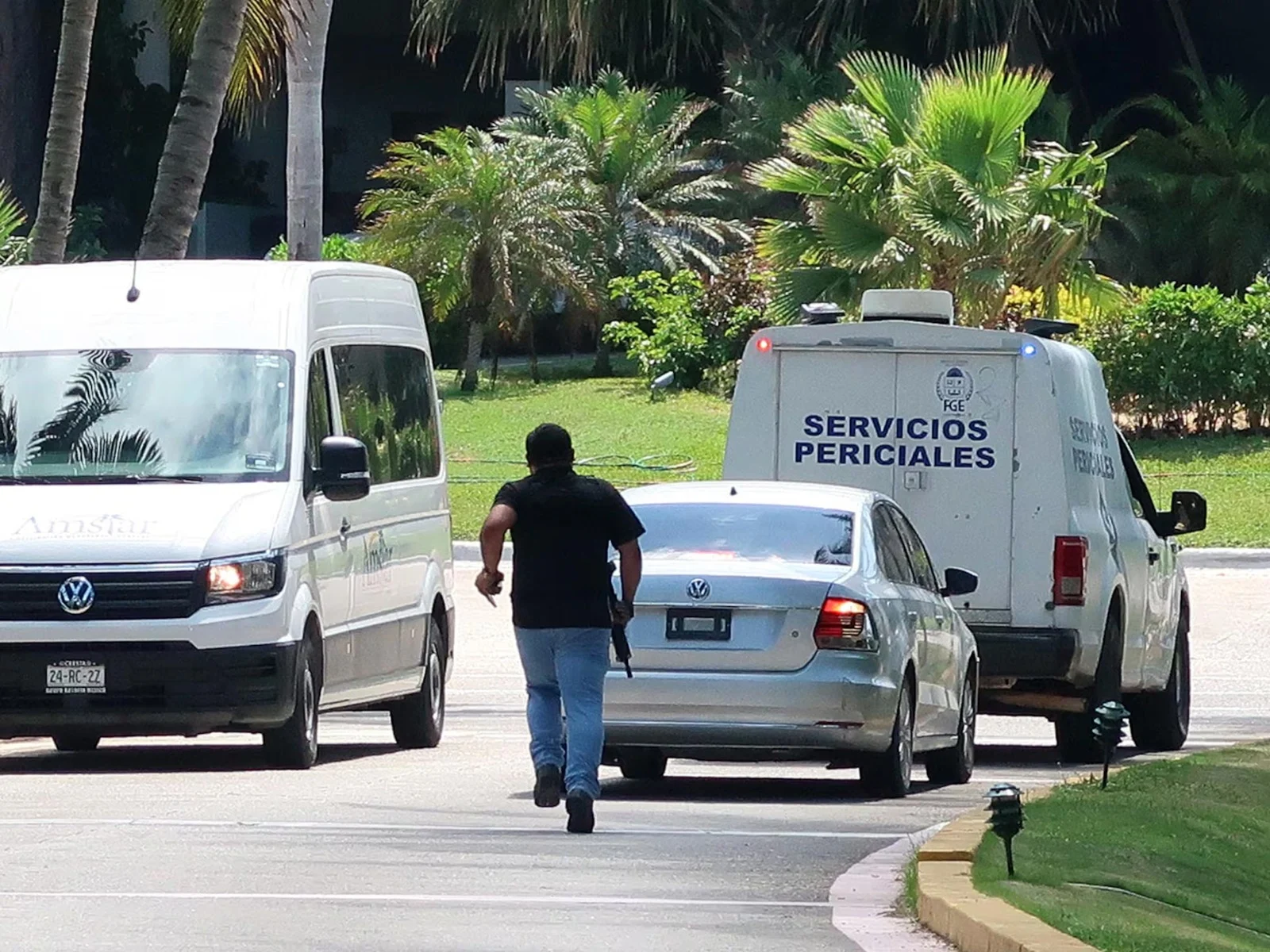
Quintana Roo, Mexico — Despite official claims of a 74% drop in intentional homicides in Quintana Roo compared to 2024, a detailed analysis of crime statistics reveals systematic manipulation of data that masks the true scale of violence in the state.
In mid-April 2026, Marcela Figueroa Franco, head of the Executive Secretariat of the National Public Security System, announced the reduction. The administration of President Claudia Sheinbaum has repeatedly touted the success of security strategies led by Omar García Harfuch, focusing on arresting “generators of violence.”
In Quintana Roo, authorities have used the state’s Crime Atlas as an intelligence tool, leading to the arrest of 36 priority targets in 2025, according to the State Prosecutor’s Office. However, violence and fear persist across the state.
Since the 2022 execution of Francisco Alberto López Galván, alias “Paco” or “El Huachi,” a Sinaloa Cartel leader in Cancún, and the 2023 arrest of his rival Héctor Elias Flores Aceves, alias “El 15,” leader of Los Chapitos in Cancún, the government has intensified arrests of hitmen, drug dealers, and criminal leaders. This policy accelerated under García Harfuch’s national push.
Notable arrests include Alejandro de Jesús “N,” alias “Fiscalito,” a hitman in Tulum linked to 14 murders (August 2024); María José “N,” alias “Lorena,” a Los Chapitos plaza boss in Tulum (May 2025); José Benjamín “N,” alias “Cuervo,” a drug trafficking leader in Tulum (June 2025); and Zacarías “N,” alias “El Skinny,” a drug gang leader in Cancún’s hotel zone (June 2025). In August 2025, 13 members of the Pacific Cartel were arrested in Cancún. In November 2025, Ernesto Guadalupe “N,” alias “Rayo,” a CJNG leader in Playa del Carmen, was captured. In December 2025, Emilio Alejandro “N,” alias “El Danone,” and Miguel Alexander “N,” alias “El Dumbo,” CJNG leaders in northern Quintana Roo and Cozumel, were detained, along with Matías “N,” a former marine who served as head of C2 in Puerto Morelos and accepted bribes. José Rafael “N,” alias “El Dóber,” son of Doña Lety, leader of the Cancún Cartel, was arrested for a second time.
In February 2026, the Quintana Roo Prosecutor’s Office reported that 248 CJNG members had been arrested since 2025 in municipalities including Playa del Carmen, Benito Juárez, Tulum, Puerto Morelos, and Isla Mujeres.
In southern Quintana Roo, violence escalated in 2024 as rival factions fought for control of airstrips and territory. The conflict between the Montero Valencia and Coronel Medina families (nephews of Ignacio Coronel Villarreal, linked to Los Chapitos) and the Caborca Cartel, led by José Gil Caro Quintero, alias “El Pelo Chino,” resulted in an undetermined number of homicides, disappearances, and forced displacements in Bacalar municipality.
In response, authorities arrested Jacobo Rodríguez Interian, a Caborca leader in Bacalar, on December 7, 2025, in Mérida. On January 15, 2026, Dalia Martínez Sarmiento, sister of Jesús Martínez Sarmiento, alias “La Pelusa” (killed in a 2023 clash with the Navy), was arrested in Huay-Pix. A week later, Shadani Lorena “N,” a Caborca leader in Carrillo Puerto, was detained, sparking roadblocks and vehicle burnings on the Chetumal-Mérida highway by residents of Chunhuhub and Polyuc.
On February 2, 2026, Adrián “N,” alias “El Borrachín de Bacalar,” died in a clash with the Navy in Limones. On February 8, the Navy and state police entered Limones to end new roadblocks and vehicle fires, arresting eight people, including Heydi Esperanza “N,” alias “La Quintero,” a relative of “La Pelusa” who organized the blockades. Fifteen homes were searched.
Despite these arrests, questions remain about whether the government will dismantle the airstrips used by organized crime in rural areas of Othón P. Blanco, Bacalar, Carrillo Puerto, and José María Morelos.
Violence Numbers in Quintana Roo
Quintana Roo is one of Mexico’s most violent states. Over the past decade, homicide rates have exceeded 40 per 100,000 inhabitants, and in some years 70 per 100,000, according to INEGI and the Executive Secretariat. In northern municipalities, rates surpass 80 per 100,000.
Benito Juárez (Cancún), Playa del Carmen, and Tulum lead in crime statistics. The northern zone is disputed by about ten criminal organizations, including factions of the Sinaloa Cartel, Jalisco New Generation Cartel (CJNG), Cancún Cartel, and Caborca.
According to INEGI, Quintana Roo recorded 5,630 homicides between 2015 and 2024. However, when subtracting traffic fatalities and adding feminicides from the Executive Secretariat’s data, the number of intentional violent deaths between 2015 and 2025 reaches 10,422 (with 1,007 homicides in 2025 alone). This discrepancy suggests possible double manipulation of information.
Quintana Roo also reports 1,642 missing persons between 2015 and 2025, 95% of which occurred from 2019 onward. In the last four years, 78.2% of disappearances took place, coinciding with the period when federal authorities claim homicides began to decline.
Another anomaly: INEGI reports 634 traffic fatalities between 2015 and 2024, while the Executive Secretariat reports 2,163 for 2015-2025 (272 in 2025). In most states, these figures are similar, but in Quintana Roo the gap is enormous.
How Information Is Manipulated
Violence in Quintana Roo spiked in 2017 under Governor Carlos Joaquín González, when the CJNG entered the territorial dispute. In 2018, the government hired security expert Jesús Alberto Capella Ibarra as Public Security Secretary and Óscar Montes de Oca as State Prosecutor.
Starting in 2019, authorities systematically manipulated data reported to the Executive Secretariat. The strategy involved reducing intentional homicides by reclassifying them into two categories of negligent homicides: deaths “with another element” (not firearms or bladed weapons) and “unspecified” deaths.
The “with another element” category saw a surge from 17 deaths in 2018 to 592 between 2019 and 2025, 85% of which were reported in 2019 and 2020. The “unspecified” category jumped from 17 in 2018 to 3,449 between 2019 and 2025. Only Oaxaca and Michoacán show similar patterns, but to a lesser extent.
If these 4,041 questionable deaths are subtracted from the 10,422 figure, the Executive Secretariat would report approximately 6,381 homicides, closely matching INEGI’s 5,630 (with one year less data). This coincidence suggests that the political manipulation may have also affected INEGI’s statistics.
Omar García Harfuch’s strategy of capturing criminal leaders aims to show the United States and Mexican voters that security is improving. However, in Quintana Roo, the claim rests on significant data manipulation, fueling public distrust.
The reality is that since 2015, Quintana Roo has seen over 10,000 murders and 1,600 disappearances. The discrepancy of 1,500 traffic fatalities between INEGI and the Executive Secretariat raises suspicions that even this category may hide murder victims from organized crime.
While arresting “generators of violence” is a positive step, it must be accompanied by territorial recovery and increased citizen security. In Quintana Roo, that goal remains distant.
More Crime
- Cancún Airport Transporters Blame ASUR for Steep Fees
- Five to Face Trial in Tulum Funeral Home Equipment Theft
- Quintana Roo Civil Protection Warns Against Fireworks Ahead of Independence Day
- Rising Crime Reports in Quintana Roo Signal Greater Trust, Official Says
- Armed Men Try to Abduct Woman on Cozumel; She Escapes on Her Motorcycle
More Quintana Roo
- Mexico Assigns $110 Million Navy Budget to Fight Sargassum in Quintana Roo
- Quintana Roo to Pilot Child Protection Protocol for Tourism Sector in October
- Sheinbaum Announces 187 Primary Care Clinics and Major Projects in Quintana Roo
- Quintana Roo Records 29,413 Sea Turtle Nests at Season’s Midpoint
- Quintana Roo Reports 1,200 Screwworm Cases as Officials Await Sterile Fly Release
