
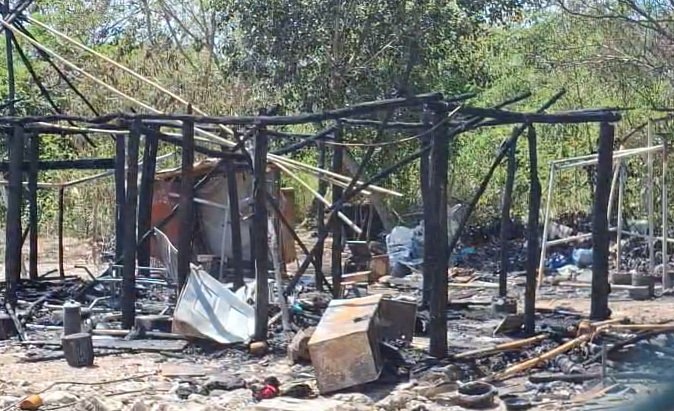
Playa del Carmen, Quintana Roo — A fire that destroyed several security huts near the entrance to Playa 72 has raised new concerns among activists and environmentalists, who fear it may have been deliberately set amid a long-running dispute over the future of Chen Zuluub, one of the last remaining coastal forest areas in Playa del Carmen.
The blaze broke out at the end of Avenida Colosio, where it meets Quinta Avenida, and spread across approximately 100 meters. The fire was contained to the area where the huts—used by private security guards—were located. No damage was reported to the surrounding jungle or access roads.
Witnesses reported seeing a man fleeing the area, and a second fire igniting nearby around the same time, though authorities have not confirmed any connection.
The incident comes against the backdrop of a years-long conflict over Chen Zuluub, a stretch of coastal jungle widely regarded by local groups as the city’s last significant undeveloped beachfront ecosystem. The land sits just north of Playa 72 and has become a flashpoint between environmental advocates, residents, and private interests seeking to develop the property.
Ownership of the land has long been disputed, with overlapping claims involving private entities such as Derimaya and historical ties to ejido land. That legal ambiguity has also opened the door to a more troubling pattern: over the years, individuals—both Mexican buyers and foreign investors—have reportedly been sold or promised parcels in the area that are not clearly titled, not legally subdivided, or tied up in ongoing litigation.
Local activists say this has created a cycle where unsuspecting buyers are drawn in by the promise of prime beachfront land, only to discover later that development is blocked or ownership is contested. In some cases, these informal or questionable sales have been used to justify attempts to clear, secure, or “activate” the land.
Sergio Beristain, president of Dog Beach Playa del Carmen, visited the site after the fire and confirmed that the surrounding vegetation remains intact—for now.
“There is a legal dispute and many interests in the area,” he said. “There is always the fear that an eviction could be triggered, or that development could begin in the zone.”
For more than a decade, Chen Zuluub has been at the center of recurring tensions. Community groups have organized cleanups, protests, and legal actions to keep the area accessible and protected, while also pushing back against privatization of beach access—an issue that has become increasingly sensitive along the Riviera Maya coastline.
Environmentalists say the stakes go beyond access. The forest plays a critical role in stabilizing dunes, protecting against erosion, and maintaining the health of the adjacent beach. Nearby examples, such as Playa Pelícanos, are frequently cited as cautionary tales—where construction too close to the shoreline has contributed to severe erosion and loss of sand.
Chen Zuluub is also part of a fragile coastal and underground ecosystem connected to the region’s cenote and aquifer systems. Disturbance of this terrain can have long-term environmental impacts, including groundwater contamination and habitat loss.
Despite its ecological importance, the area has remained vulnerable due to legal ambiguity, overlapping claims, and strong economic pressure tied to beachfront development in one of Mexico’s fastest-growing tourism corridors.
Beristain emphasized that the recent fire—whether accidental or intentional—underscores the urgency of protecting the site.
“This is one of the last spaces we have left,” he said, calling for greater unity among civil society groups to defend Chen Zuluub against ongoing development pressures.
For now, the forest still stands. But as the legal battle continues—and as questionable land sales and competing interests persist—many see the situation as a race between preservation and development, with the future of one of Playa del Carmen’s last wild coastal spaces hanging in the balance.
More Local News
- Sargassum Barrier Reaches Puerto Aventuras as Navy Support Takes Shape
- Who Takes Tulum’s First Councilor Seat During Tah Balam’s Leave?
- Cobá Arrest Turns Violent: Officer Injured, Shots Fired
- El 19, 3 Others Arrested in Puerto Morelos Extortion Case
- Isla Mujeres Mayor Steps Aside for Morena District 3 Role
