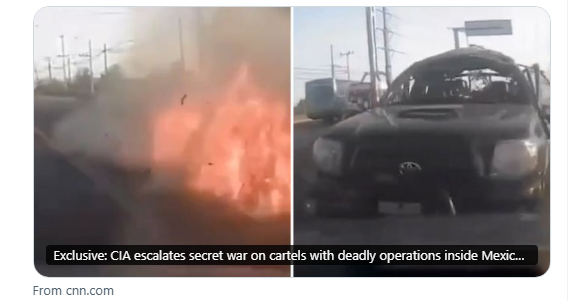
Mexico City — The explosion of a pickup truck traveling on the Mexico-Pachuca highway in the municipality of Tecámac, State of Mexico, in late March, which killed Francisco Efraín Beltrán, "El Payín," an operator for the Sinaloa Cartel, and his driver, was a targeted assassination facilitated by operatives of the Central Intelligence Agency (CIA), CNN revealed Tuesday. This version was rejected by both Mexican Security Secretary Omar García Harfuch and CIA spokeswoman Liz Lyons.
"This is false and sensationalist information that serves no purpose other than as a public relations campaign for the cartels and puts the lives of Americans at risk," the spokeswoman for the U.S. agency wrote on her X account.
According to multiple sources and two other people familiar with this campaign consulted by the U.S. media outlet, the explosive device had been hidden inside the vehicle as part of a previously unreported, expanded CIA campaign in Mexico, led by the agency's Ground Branch, to dismantle entrenched cartel networks.
The report, authored by journalists Natasha Bertrand, Zachary Cohen, Evan Perez, and Mauricio Torres, states that since last year, CIA agents have been directly involved in lethal attacks against several cartel members, mostly mid-level.
"The lethality of their operations has seriously increased. It's a significant expansion of the kind of things the CIA has been willing to do inside Mexico," one of the people briefed told the news network.
But the bombing of "El Payín's" truck, very close to the Felipe Ángeles International Airport (AIFA), has not been the only one, according to the media outlet, as the agency has undertaken a series of covert activities to dismantle entire cartel networks, targeting both leaders and lower-ranking members who function as key players.
"The exact number of CIA officers operating inside Mexico has fluctuated in recent months, but it has typically been a small force," they revealed.
One of the sources also pointed out that these operations might not be authorized by the Mexican government, and therefore would be illegal. Despite this, the source indicated that the agency's presence could grow, as the full ecosystem of assets for the Land Branch has not yet been deployed and only a few agents remain in Mexico.
The official consulted by CNN, who maintains contact with his colleagues, affirms that the U.S. Ambassador to Mexico and former agency official, Ron Johnson, would be fundamental in these operations that intensified last year after President Trump formally updated and expanded the agency's powers to carry out lethal actions and conduct covert operations in Latin America.
The revelation by the U.S. network comes amid a scandal involving two CIA agents who participated in the dismantling of a drug lab in Chihuahua, governed by opposition leader Maru Campos, and who died in a car accident after the operation. The case has been taken over by the Attorney General's Office (FGR) for the alleged crime of treason.
Harfuch Rejects Interference in Mexico
The head of the Secretariat of Security and Citizen Protection, Omar García Harfuch, also rejected the information presented in the report by the U.S. media outlet.
"The Mexican government categorically rejects any version that attempts to normalize, justify, or suggest the existence of lethal, covert, or unilateral operations by foreign agencies on national territory. Cooperation with the United States exists, is important, and has yielded significant results for both countries; however, it is carried out under clear principles: respect for sovereignty, shared responsibility, mutual trust, and cooperation without subordination," the Mexican official stated.
At the same time, he reiterated that under these principles, both governments have made significant progress in combating transnational organized crime, including arrests of key targets, seizures of drugs, weapons, chemical precursors, clandestine laboratories, financial resources and assets linked to criminal structures.
"These results demonstrate that bilateral collaboration can be effective when conducted through institutional channels, with information exchange and full respect for each country's legal framework," he said.
Furthermore, he made it clear that in Mexico, operational actions correspond exclusively to the competent Mexican authorities and reiterated that "any international cooperation is limited to the exchange of information, institutional coordination and formal mechanisms established by the Government of Mexico."
More Politics
- New Quintana Roo Press Group Leader Calls for Consensus Journalist Protection Law
- UQRoo Cancún Union Workers Allege Rigged Election, Demand Full Rerun
- Isla Mujeres Approves Updated Development Plan With 185 Action Items
- Mexico Seeks Tariff Cuts on Steel and Autos in US Trade Talks
- No Date Set for Supreme Court Ruling in Quintana Roo Border Dispute