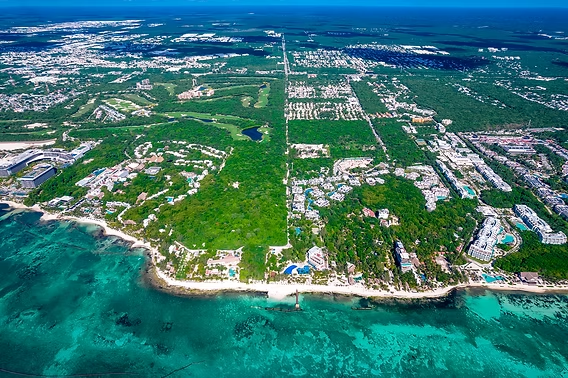
Playa del Carmen, Quintana Roo — A heated confrontation at Xcalacoco has spread across social media under claims that a foreign resident believed she had “bought” part of the beach for nearly 28,000 pesos.
The video is certainly provocative. But the dispute behind it is more complicated than its increasingly sensational headlines suggest.
The confrontation involves neighboring property owners, operators offering personal-watercraft excursions and a contested passage leading to the coastline. It also raises a familiar question in Playa del Carmen: If Mexico’s beaches are public, what happens when the route used to reach one crosses land claimed as private property?
What the woman actually said
During the recorded argument, a woman says she pays approximately 28,000 pesos as a “general-use user” and another 9,500 pesos under a “protection and beautification” concession. The payments appear to refer to fees associated with the use of the Federal Maritime-Terrestrial Zone, commonly known as Zofemat.
They do not amount to purchasing a beach.
Mexico’s beaches are federal public property. A Zofemat concession may authorize a person or business to use an adjoining section of the federal coastal zone for purposes such as operating a business, installing permitted facilities or maintaining the area. It does not transfer ownership of the beach or give the concession holder the right to exclude the public.
Mexico amended its General Law of National Assets in 2020 to state explicitly that access to maritime beaches and the adjoining federal zone cannot be restricted, obstructed or conditioned except in circumstances established by regulation. A fence brought the dispute into the open
The confrontation followed a separate altercation in early September involving a passage used to reach Xcalacoco beach.
Property owners placed fencing across the route, reportedly to stop personal-watercraft operators from moving through the area. Municipal Zofemat personnel intervened, removed the barrier and took three personal watercraft and two boats into custody while their legal and operating status was reviewed.
Miguel Ricardo Novelo Cárdenas, who identified himself as one of the property owners, said the disputed route has never been formally designated as a public street. He described it as private property functioning as an easement and said neighboring families hold documents dating back several decades.
According to Novelo Cárdenas, part of the land has been maintained as a “window to the sea” that could eventually become a formally recognized public access. He also alleged that some tourism operators were using the site without the necessary authorization, a claim that authorities would need to verify.
The people involved were called to appear before Playa del Carmen’s Zofemat office to clarify the legal status of the passage and the watercraft operations.
Public beach does not always mean a clearly defined public road
The law is clear that the beach itself is public. The route to it may be where the legal problem begins.
Where no established public road reaches the coast, federal law allows authorities to create access across adjoining land, with compensation determined under applicable rules. That process requires a formal government decision. Members of the public cannot automatically cross any private lot simply because it leads to the sea, but landowners also cannot use their property or a concession to claim ownership of the beach.
That distinction has repeatedly caused disputes along the Riviera Maya, where older property boundaries, resort construction and rapid coastal development have left relatively few obvious public entrances between large beachfront properties.
It is also why the Xcalacoco case cannot be reduced to a woman attempting to purchase the shoreline. The unresolved issues include whether the contested route is private property, a legally recognized easement or a public access; whether it can be fenced; and whether the tourism operators using it have permission to transport and launch their equipment there.
Viral claims are running ahead of the evidence
Social-media posts have identified the woman as an American resident and made additional accusations about her conduct. Those details have not been confirmed by authorities and should not be treated as established facts.
Nor is there evidence that she paid an unidentified person 28,000 pesos to “own” the beach. Her own words indicate that she was describing recurring federal-zone fees connected to authorized use, although the precise concession and its holder have not been publicly documented.
The video may have made one person the face of the controversy, but the real story is a long-running conflict over coastal access, private land and commercial activity.
Whatever authorities ultimately decide about the passage and the personal-watercraft businesses, one point is not in dispute: paying Zofemat fees may grant limited rights to use part of the federal zone. It does not make anyone the owner of a Mexican beach.
More Law Enforcement
- Two Drivers Hurt in Playa del Carmen Crash at Wet Zazil-Há Intersection
- Trump Escalates Pressure on Mexico, Demands Action Against Cartel-Allied Officials
- Alleged Owner of Cancún Home Rented by Puerto Morelos Mayor Linked to Ultramar Fraud Case
- Chetumal Traffic Officer Shoots Two Dead, Then Kills Himself
- Canine Unit Finds 10 Kilos of Cocaine Hidden in Suitcase at Cancún Airport
More Playa del Carmen
- Playa del Carmen Taps HR Directors to Boost Local Hiring
- Influencer Discards 2,500-Peso SpongeBob Cake at Nickelodeon Riviera Maya, Citing Bad Taste
- Quintana Roo Tops 152,000 Metric Tons of Sargassum as Playa del Carmen and Cancún Lead
- Playa del Carmen Opens Registration for Audiovisual Workshops
- Playa del Carmen Businesses Seek Later Closing Hours for Bars and Restaurants