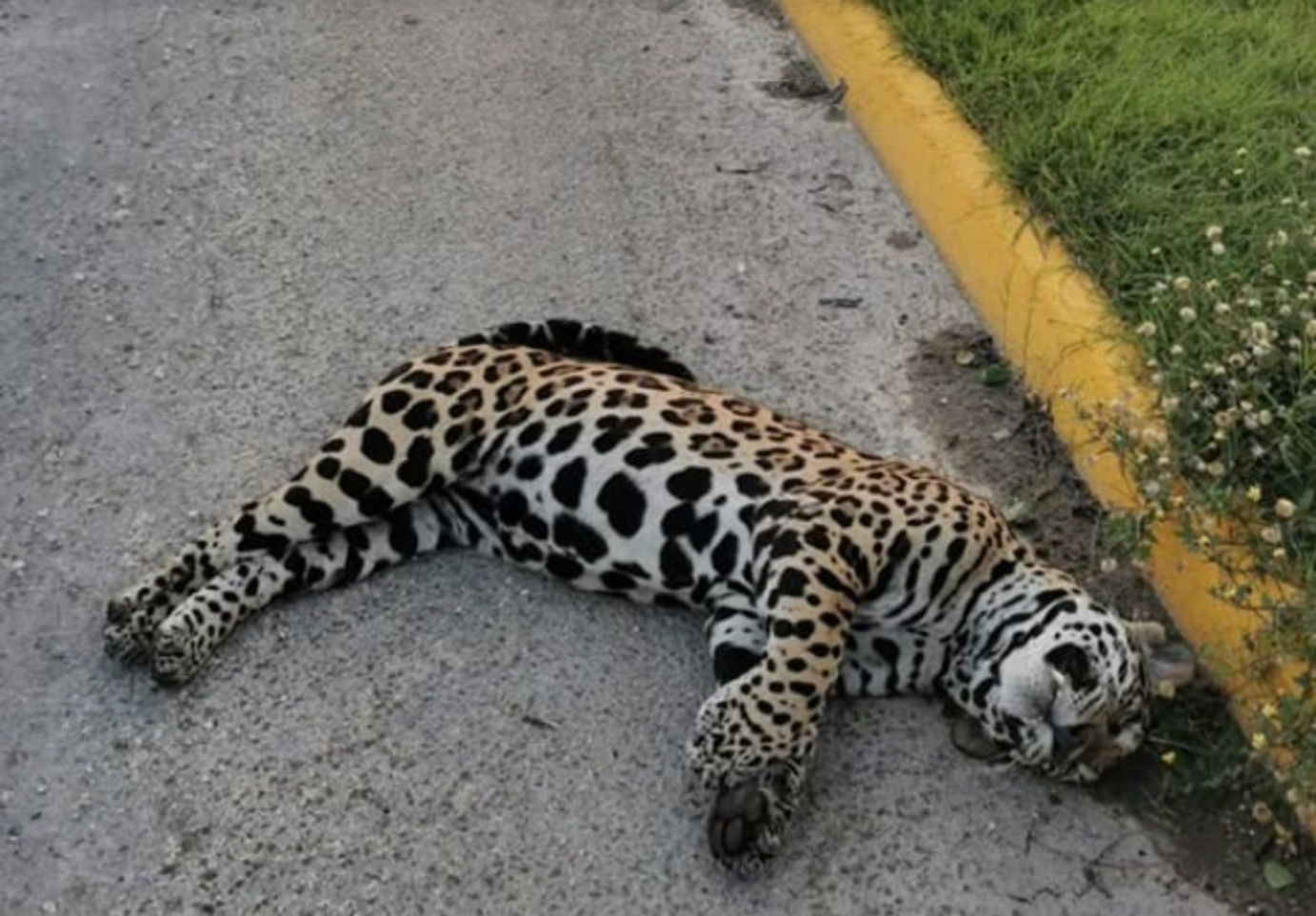
Puerto Aventuras, Quintana Roo — Two wild cats have reportedly been killed within days of one another along Highway 307 near Paamul, drawing renewed attention to a section of road that researchers previously identified as a regular crossing point for large felines.
An ocelot was found dead near the highway following an apparent collision during the night of Sept. 8. Community reports indicate that a puma was killed several days earlier in approximately the same area, between Playa del Carmen and Puerto Aventuras.
Photographs of the animals have circulated locally, but as of Wednesday morning, environmental authorities had not released reports confirming the precise locations, times or circumstances of either collision. The drivers involved have not been identified.
Even without those details, the deaths fit a well-documented and troubling pattern. Highway 307 cuts through habitat used by all five wild-cat species found in the Yucatán Peninsula: jaguars, pumas, ocelots, margays and jaguarundis.
A known wildlife crossing zone
The reported deaths occurred in an area already identified by researchers as an important crossing point for large cats.
In a study published in 2021, scientists used a GPS collar to track a female puma living around Punta Venado, just north of Paamul. They documented the animal crossing Highway 307 twelve times within the same three-kilometer section. On average, she crossed approximately once every four days.
The research showed that the highway does more than run beside wildlife habitat. It divides it. Coastal mangroves, forest and resort properties lie to the east, while larger areas of jungle and development extend to the west. Tracking studies and camera traps have shown that jaguars and pumas use habitat on both sides.
The four-lane highway carried approximately 40,000 vehicles per day in 2019, according to transportation data cited in the study. The researchers recommended wildlife crossings designed for that section of road, along with fencing to direct animals toward them.
Jaguar Wildlife Center drew renewed attention to those findings this week, noting that repeated roadkill reports and camera-trap records confirm that large cats continue moving across the corridor.
“Both jaguars and pumas use both sides of the road,” the Playa del Carmen conservation organization said in its Sept. 8 explanation of wildlife movement around Highway 307.
The two reported deaths now raise a difficult question: years after researchers identified this section of Highway 307 as a regular crossing point for large cats, what measures have been installed to protect them?
Paamul has seen this before
The area around Paamul, Punta Venado, Calica and Xpu-Ha has repeatedly appeared in reports of wild animals killed on the highway.
On July 13, 2023, an ocelot was struck and killed near Paamul at approximately 6 a.m. Just one day earlier, a male jaguar had been killed farther south along the Playa del Carmen-Tulum corridor. Both animals were species classified as endangered under Mexican law.
Earlier that year, a pregnant jaguar known as Naku was killed between Playa del Secreto and the Nickelodeon resort. Conservationists said she was only days away from giving birth. The collision occurred shortly before a roadside sign warning drivers that jaguars cross in the area.
Another adult female puma was killed near Xpu-Ha on July 10, 2024. The collision occurred at about 4:30 a.m. near the Catalonia Royal Tulum resort. Municipal environmental personnel, firefighters and the Federal Attorney for Environmental Protection responded, and the animal’s body was transferred to federal authorities.
The timing is notable. Several of the documented collisions occurred before dawn, when visibility is limited and nocturnal wildlife is still moving through its territory.
The loss of an ocelot carries added weight
The ocelot, Leopardus pardalis, is classified as endangered under Mexico’s NOM-059 list of at-risk native species. It is also included in Appendix I of the Convention on International Trade in Endangered Species, the highest level of international protection against commercial trade.
Pumas are more widely distributed, but their survival still depends on large, connected territories. As predators, pumas and ocelots help regulate prey populations and maintain the ecological balance of the remaining forest.
Their presence close to Paamul does not mean the animals are wandering somewhere they do not belong. It confirms that the forest surrounding the highway remains active wildlife habitat, even where hotels, communities and construction projects have divided it into smaller areas.
Drivers can reduce the danger
Wildlife collisions are more likely at night and around dawn, particularly where vegetation grows close to the highway. Drivers should reduce their speed along the Paamul-Xpu-Ha section, use high beams when it is safe to do so and watch the shoulders for reflected eyes or sudden movement.
Anyone who sees a wild animal should slow down without swerving into another lane. If a collision occurs, the safest response is to stop at a secure distance, activate the vehicle’s hazard lights and call 911. An injured wild cat should never be approached or handled.
Road signs alone have not stopped the deaths. Conservation groups continue to call for scientifically located overpasses or underpasses, fencing, lower speeds in known crossing zones and consistent monitoring to determine where animals are attempting to cross.
The deaths reported near Paamul this week underline the cost of waiting. Highway 307 is the Riviera Maya’s main transportation artery, but for the animals moving between the jungle and the coast, it has become a barrier they must risk their lives to cross.
More Environment
- Greenpeace Finds Contamination at 17 Yucatán Wells and Cenotes as Maya Communities Demand Action
- Quintana Roo Tops 152,000 Metric Tons of Sargassum as Playa del Carmen and Cancún Lead
- Profepa Shuts Down Los Rápidos Swimming Spot in Xul-Ha Over Missing Environmental Permit
- Court Gives Profepa 72 Hours to Clarify Tren Maya Closure Order
- National Geographic Names Maya Ka’an Among Top Destinations to Visit in 2027
More Playa del Carmen
- Playa del Carmen Taps HR Directors to Boost Local Hiring
- Two Drivers Hurt in Playa del Carmen Crash at Wet Zazil-Há Intersection
- Influencer Discards 2,500-Peso SpongeBob Cake at Nickelodeon Riviera Maya, Citing Bad Taste
- Playa del Carmen Opens Registration for Audiovisual Workshops
- Playa del Carmen Businesses Seek Later Closing Hours for Bars and Restaurants