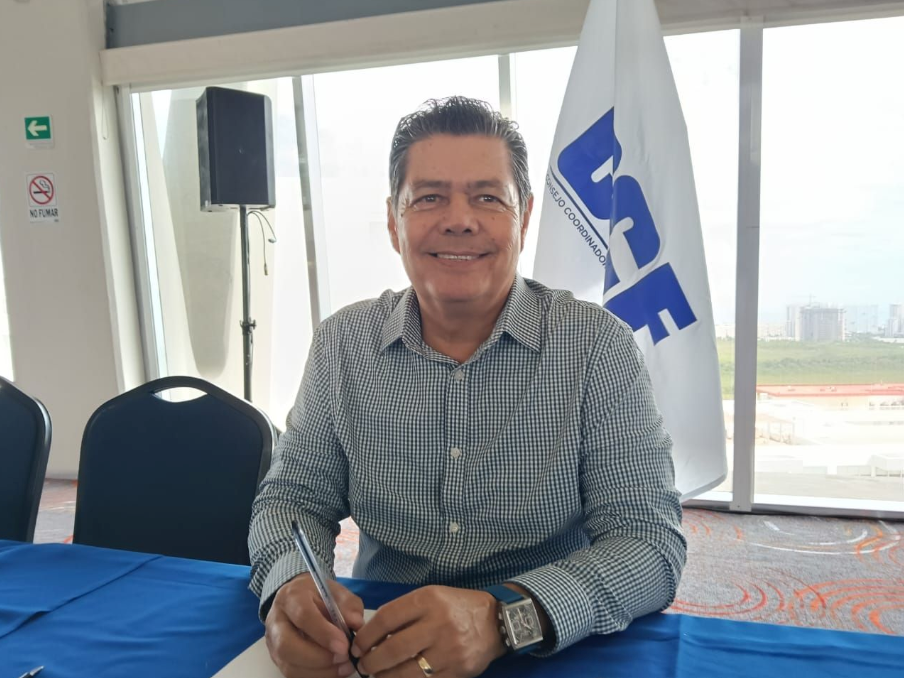
Cancún, Quintana Roo — The Caribbean Business Coordinating Council (CCE) will press for administrative simplification in Quintana Roo’s state budgets as a way to protect the local business economy, according to the group’s president, Alejandro Arvizu Contreras.
Arvizu said the council is currently reviewing the Revenue Law and hopes to reduce the number of permits required to open a business. “There are 40 permits, for example, to open a restaurant or any business,” he said. “We need to make that much more efficient—often the same permits are duplicated.”
He acknowledged that permitting procedures have improved at both state and federal levels in recent years. At the state level, he said the priority is avoiding tax increases in next year’s budget, working in coordination with the local College of Public Accountants and the state treasury.
The federal budget, he said, does not currently present any particular concerns for the group, but the CCE will back requests made by other employer organizations, including the Mexican Employers’ Confederation (Coparmex).
On Monday, Jovita Portillo Navarro, president of Coparmex Cancún, said the federal budget must support national growth and family well-being rather than simply balancing figures. She noted that the economy grew 1.4% in the second quarter of 2026 but continued to face structural challenges.
“When the government invests well, companies invest. When companies invest, jobs are created, and when there is formal, productive employment, growth reaches families,” Portillo said. “Mexico needs a budget that not only covers spending but also serves to generate growth.”
The CCE’s immediate request, Arvizu said, is for municipalities to align their permit requirements with state rules and eliminate duplicate procedures—a need made more urgent by the current low tourism season, which is affecting the entire country.
The main challenge, he stressed, is stemming job losses caused by weak business activity, which has already forced some companies to implement solidarity days—temporary unpaid leave intended to avoid layoffs.
“Without a doubt, we are living through a complex moment,” Arvizu said. “There has been a drop in employment linked to low occupancy, and companies are granting solidarity days. For now, it is a matter of holding on and hoping conditions improve.”
More Economy
- Playa del Carmen Taps HR Directors to Boost Local Hiring
- Mexico Hoteliers Warn of 1.1 Million Air Tourist Loss as U.S. Arrivals Slump
- Cancún’s Route 17 Leona Vicario Draws More Than 16,000 Riders on First Free Day
- FIRA Issues Mexico’s First Biodiversity Bond Worth Over 1.6 Billion Pesos
- Aeromexico Eyes New U.S. Routes After Mexico City Limits End
More Cancun
- Moderna COVID-19 Vaccine to Be Offered to Children in Cancún
- Paraguayan Tourists Challenge Asur Over $30 Exit Fee at Cancún Airport
- Caribbean Poker Tour Closes 2026 Season in Sint Maarten With $125,000 Main Event
- Canine Unit Finds 10 Kilos of Cocaine Hidden in Suitcase at Cancún Airport
- Hanal Pixán 2026 in Puerto Juárez: Four Days of Maya Day of the Dead Traditions