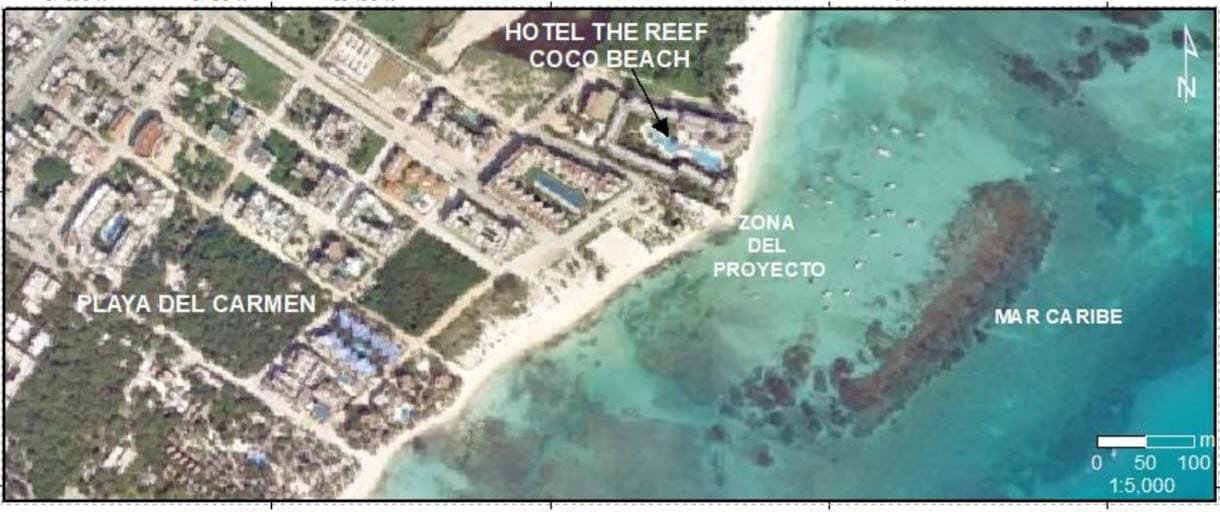
Playa del Carmen, Quintana Roo — Mexico’s Secretariat of Environment and Natural Resources (Semarnat) has rejected a proposal by Inmobiliaria Coco Beach to install a wave attenuator and carry out beach restoration work in front of the south corner of The Reef Coco Beach hotel, citing unauthorized work already done at the site.
The project, submitted for environmental review in April 2024, involved interventions in the federal maritime-terrestrial zone and in the marine area adjacent to the property, located on Costera Norte, lot 1, block 007. Semarnat delivered its ruling last week.
Project Proposed Breakwater and Sand Replenishment
The company planned to build a 50-meter-long, 2.4-meter-wide wave attenuator to act as a breakwater and help stabilize the beach. It would be connected to the shore by a perpendicular wooden pier section measuring 45 meters long and 2.4 meters wide, built on stilts and supported by pilings to avoid affecting nearshore currents.
The second component called for redistributing sand on the beach to accelerate its recovery.
Unauthorized Works Blocked Approval
During the environmental review, Semarnat’s General Directorate of Environmental Impact and Risk (DGIRA) determined the company had already carried out work without the required environmental impact authorization. The agency also said the developer had not supplied a resolution from the Federal Attorney’s Office for Environmental Protection (Profepa), and that procedures referenced by the company may have concerned activities different from those examined in the project.
Authorities therefore concluded the project violated the General Law of Ecological Balance and Environmental Protection (LGEEPA).
“Because activities were carried out without prior environmental impact authorization, it was not possible to establish or anticipate measures to ensure they would be compatible with the policy of protection and sustainable use,” the ruling states.
Semarnat said it also could not determine in advance what adjustments to the project’s components and intervention zones would be needed to protect the environment, particularly coastal ecosystems.
Possible Sanctions for Unauthorized Work
The agency warned Inmobiliaria Coco Beach that it cannot carry out any construction or activity related to the project until it obtains the corresponding environmental impact authorization. If work proceeds without the permit, the company could face penalties under LGEEPA and other applicable laws.
The ruling adds that any work already done, in progress, or continuing without prior environmental impact authorization could constitute potential environmental damage.
As a result, the project remains without environmental approval until the developer complies with the requirements and procedures established under federal environmental law.
More Environment
- Greenpeace Finds Contamination at 17 Yucatán Wells and Cenotes as Maya Communities Demand Action
- Quintana Roo Tops 152,000 Metric Tons of Sargassum as Playa del Carmen and Cancún Lead
- Profepa Shuts Down Los Rápidos Swimming Spot in Xul-Ha Over Missing Environmental Permit
- Court Gives Profepa 72 Hours to Clarify Tren Maya Closure Order
- National Geographic Names Maya Ka’an Among Top Destinations to Visit in 2027
More Playa del Carmen
- Playa del Carmen Taps HR Directors to Boost Local Hiring
- Two Drivers Hurt in Playa del Carmen Crash at Wet Zazil-Há Intersection
- Influencer Discards 2,500-Peso SpongeBob Cake at Nickelodeon Riviera Maya, Citing Bad Taste
- Playa del Carmen Opens Registration for Audiovisual Workshops
- Playa del Carmen Businesses Seek Later Closing Hours for Bars and Restaurants