
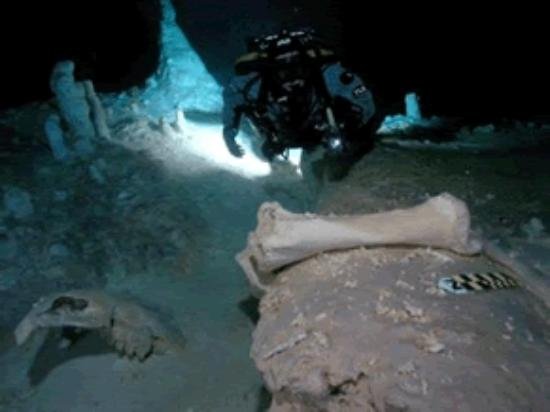
Tulum, Quintana Roo — A growing controversy over damage inside a cenote on the Yucatán Peninsula has intensified after underwater specialists confirmed that one of the region’s most important archaeological sites, Hoyo Negro, has been disturbed by unauthorized divers.
The incident has sparked outrage among archaeologists, conservationists, and local residents, who warn that the damage could represent an irreversible loss to a fragile underground archive that has taken thousands of years to form.
Cenotes are not simply natural sinkholes. Formed through karst geology, they are part of an extensive network of flooded caves that have preserved human remains, ritual offerings, and extinct animal fossils in extraordinary condition. In Maya belief systems, these spaces were sacred portals to Xibalba, adding cultural significance to their scientific value.
The latest reports center on Hoyo Negro, a deep cenote system near Tulum considered one of the most important paleoanthropological sites in the Americas. The site gained international attention following the 2007 discovery of “Naia,” one of the oldest and most complete human skeletons ever found on the continent.
According to cave divers Alejandro Álvarez and Alberto Nava of the Tulum Speleological Project—both involved in that discovery—the damage occurred when at least five foreign divers entered the site without authorization during ongoing research coordinated with Instituto Nacional de Antropología e Historia (INAH).
“They ignored official signage prohibiting access and descended to the bottom of the sinkhole without control or supervision,” Nava said.
Specialists report that the divers disturbed sediment layers that are critical to understanding early human migration and Pleistocene-era fauna. Even more concerning, Álvarez stated that some remains were physically handled or removed.
Among the documented impacts was damage to prehistoric animal bones, including a puma skeleton whose fangs were fractured, along with disturbance to other specimens that form part of the site’s scientific record.
Experts stress that in environments like Hoyo Negro, context is everything. The position of bones, sediments, and artifacts provides essential clues about timelines, climate conditions, and human activity. Once disturbed, that context cannot be restored.
“This type of irregular access is not an isolated incident,” Álvarez added, noting that similar unauthorized incursions have been detected in other cave systems across the region. The divers involved are believed to be linked to unregulated tourism activity, raising concerns about gaps in enforcement and site protection.
Hoyo Negro is officially restricted due to its importance, with clear signage and strict access protocols in place. Any entry requires permits, trained supervision, and adherence to conservation standards—not only to protect the site, but also for diver safety in what is a technically demanding and potentially hazardous environment.
The case has reignited broader concerns about the pressure cenotes face across Quintana Roo. Increased tourism, cave diving, and nearby development projects have all contributed to growing risks for these ecosystems. While cenotes attract visitors for their natural beauty, they are also among the most sensitive archaeological environments in the region.
Environmental groups and researchers are now calling for stronger oversight, increased surveillance, and stricter enforcement of existing regulations. There are also renewed demands for better control of tour operators and diving activities, particularly in sites known to contain archaeological or paleontological material.
Beyond the scientific loss, the damage carries cultural weight. Cenotes are part of the region’s living heritage, tied to both ancient traditions and modern identity. What has been disturbed at Hoyo Negro is not just a collection of bones or artifacts, but a record of human history that cannot be replaced.
As development and tourism continue to expand across the Riviera Maya, the challenge remains clear: how to protect these irreplaceable sites before more of them are permanently altered or lost.
More Crime
- Cancún Airport Transporters Blame ASUR for Steep Fees
- Five to Face Trial in Tulum Funeral Home Equipment Theft
- Quintana Roo Civil Protection Warns Against Fireworks Ahead of Independence Day
- Rising Crime Reports in Quintana Roo Signal Greater Trust, Official Says
- Armed Men Try to Abduct Woman on Cozumel; She Escapes on Her Motorcycle
More Tulum
- Mexican Army Nears Completion of 16-Kilometer Jungle Road Over Tulum’s Sac Actún Cave System
- Advocates Urge Quintana Roo Governor to Expand Xcacel-Xcacelito Turtle Sanctuary
- Three Arrested in Tulum After Taxi Driver Beaten and Robbed for Refusing Extra Passengers
- Tren Maya Archaeological Finds Won’t Be Displayed in Chetumal, INAH Says
- Tulum Hotels Stay Open Through Renovations Ahead of High Season, Union Says
