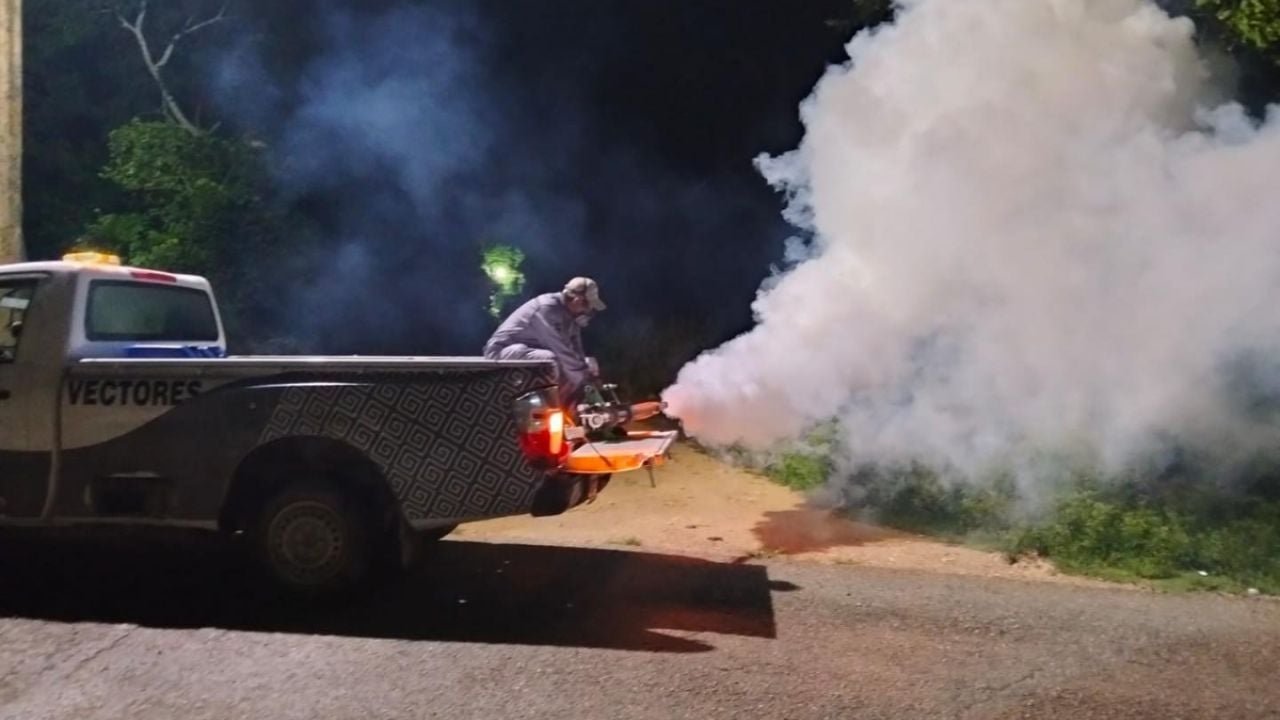
Cancun, Quintana Roo — With the rainy season creating ideal breeding conditions for the Aedes aegypti mosquito, health authorities in Quintana Roo announced a large-scale fogging operation from June 8 to 12 across multiple municipalities to curb the spread of dengue, zika and chikungunya.
The campaign, coordinated by the State Health Secretariat (SESA) and specialized vector control brigades, will target neighborhoods, subdivisions and urban areas considered high priority due to population density or risk factors for mosquito proliferation.
Officials noted that routes may be adjusted depending on weather conditions or changes in epidemiological indicators in each municipality.
Cancun, Playa del Carmen and Chetumal Focus
In Benito Juarez municipality, brigades will cover strategic sectors of Cancun, including the Hotel Zone, the International Airport, Prado Norte, Lombardo Toledano and regions 71, 91, 92, 93, 94, 201, 210, 217, 218, 219, 220 and 228. Fogging will also take place in superblocks 231, 508, 509, 510, 511, 512, 513, 516 and 517, where preventive actions will be reinforced due to high housing density.
In Playa del Carmen, the operation will include neighborhoods such as Colosio, Gonzalo Guerrero, Ejido, Bella Vista, Aviacion, Forjadores, Mision del Carmen, Real del Sol, Villas Maya, Xaman-Ha and Zazil-Ha, among others.
In Chetumal, efforts will focus on Bicentenario, Proterritorio, Nuevo Progreso, Nueva Generacion, Residencial Chetumal, Sian Kaan, Mario Villanueva, Esperanza and Felix Gonzalez Canto neighborhoods.
Coverage Across Northern, Central and Southern Municipalities
The campaign also includes fogging in other Quintana Roo municipalities. In Isla Mujeres, brigades will work both on the mainland and the island, covering dozens of neighborhoods and urban sectors for comprehensive coverage.
In Cozumel, neighborhoods such as Emiliano Zapata, 10 de Abril, Flores Magon, San Miguel II, Miraflores and Nueva Creacion will be treated.
In Jose Maria Morelos, actions will reach traditional neighborhoods including Centro, Guadalupe, San Juan, Vicente Guerrero and Santa Lucia.
Brigades will also visit sectors of Kantunilkin, the municipal seat of Lazaro Cardenas; neighborhoods in Tulum such as Tumben Kah, Kukulkan, Nassin and Carlos Joaquin; and various residential areas of Puerto Morelos.
Authorities Urge Home Prevention
SESA specialists emphasized that fogging is effective for killing adult mosquitoes but warned that dengue control cannot rely solely on fumigation. They called on the public to maintain the preventive strategy known as “Lava, Tapa, Voltea y Tira” (Wash, Cover, Turn Over and Throw Away), which involves eliminating containers that collect water and can become mosquito breeding sites.
They also recommended that families open doors and windows when fogging vehicles pass by to allow the insecticide cloud to enter homes and increase treatment effectiveness.
The preventive campaign is especially important as the rainy season and tropical cyclone period begin in the Mexican Caribbean, a time when mosquito breeding sites typically increase due to water accumulation in patios, roofs and public spaces.
Health authorities reiterated that citizen participation is essential to reduce the incidence of dengue, zika and chikungunya, particularly in densely populated urban areas. SESA maintains official channels for reporting potential infection sources, requesting brigade visits and checking updated fogging routes across the state.
More Lifestyle
- AI Could Leave Indigenous Communities Behind, Mexico Warns
- Mexico City’s 32-Meter Catrina Aims for Guinness World Record
- Quintana Roo Expands Free Mental Health Care Network Across the State
- Quintana Roo to Bar Cellphones for Teachers as Well as Students Starting Nov. 3
- Playa del Carmen Councilwoman Proposes Reviving Under-Bridge Spaces Along Boulevard