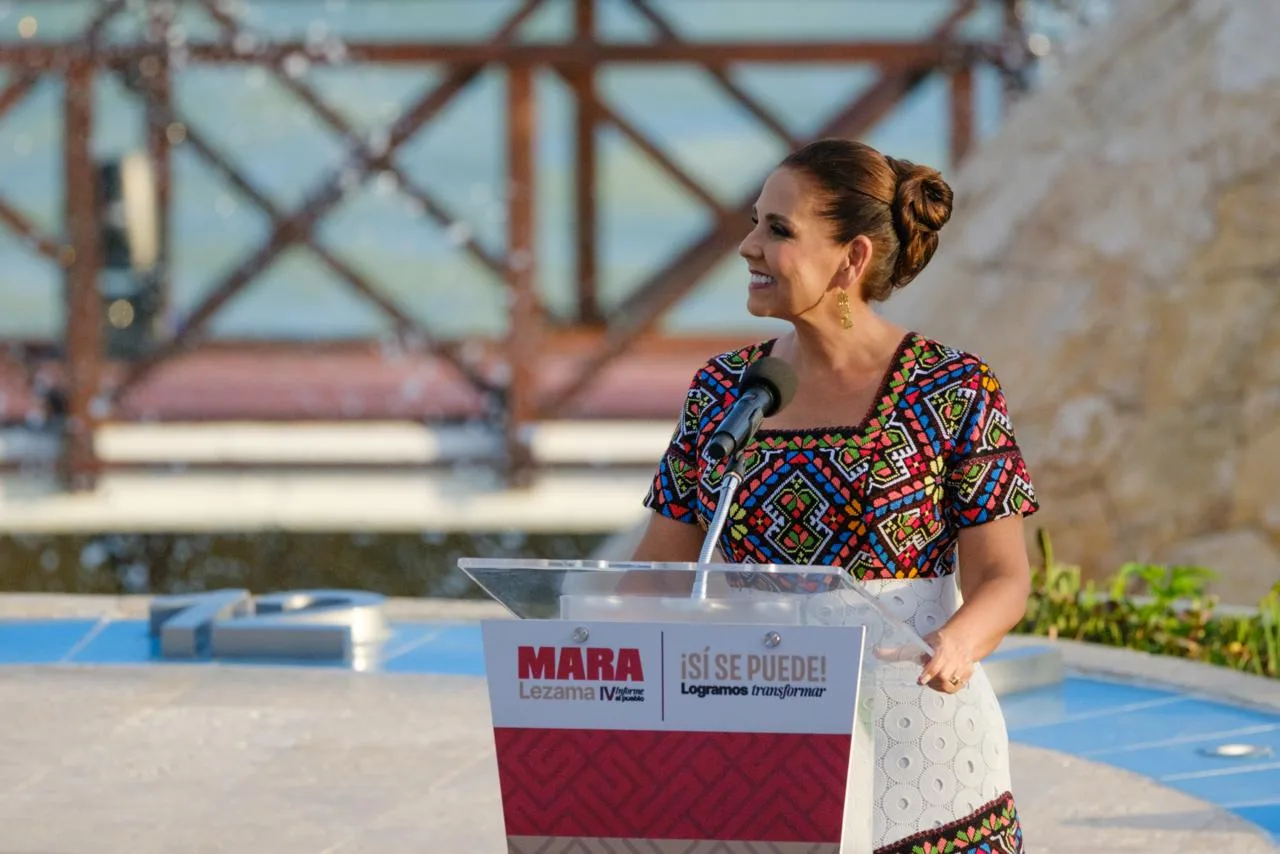
Chetumal, Quintana Roo — Gov. Mara Lezama delivered a defiant fourth government report Sunday, telling opponents they will not stop her administration’s push to transform Quintana Roo.
“Our eternal adversaries and the occasional pretenders will not stop us or defeat us,” Lezama said during the event at the Fuente del Pescador, attended by Federal Tourism Secretary Josefina Rodríguez Zamora as President Claudia Sheinbaum’s representative.
The address came as Morena, the ruling party, prepares its internal candidate selection process for the next gubernatorial race. Lezama said her administration has faced “a coordinated political war” aimed at discrediting her government, fueled by conservative sectors and, she added, by people inside the movement pursuing personal ambitions.
“They try to weaken the popular foundations of this transformative project,” she said. “What we are building in Quintana Roo is a different way of exercising power: it is there to serve, not to be served.”
Lezama insisted that the transformation project belongs not to factions or individuals but to the people, and she called for unity within the Fourth Transformation movement.
Poverty, Transparency and Housing
In her formal report, Lezama said more than 200,000 Quintana Roo residents have emerged from poverty during her term, a drop of more than 38 percent. She attributed the reduction to public spending on infrastructure, housing, education, health, security, and social programs.
She also said the state’s public accounts received zero observations from the federal Superior Audit Office for the second straight year, and that Quintana Roo had climbed from 29th to second place nationally in transparency and anti-corruption rankings.
Lezama reported that more than 491,000 people receive state welfare benefits, while about half a million receive federal social programs. In housing, she said 13,000 homes are under construction under the “Vivienda para el Bienestar” program, which aims to complete more than 80,000 housing actions during the five-year administration. She also cited progress regularizing land tenure, including in the Luis Donaldo Colosio neighborhood in Playa del Carmen.
On women’s policy, Lezama said state programs have reached more than 261,000 women, including 50,000 beneficiaries of the “Mujer es Poder” program. She also reported delivering 2,600 property titles to rural and Indigenous women landowners and highlighted four Women’s Justice Centers that have served nearly 13,000 users with more than 62,000 free services.
Health Infrastructure
The governor announced that 11 hospital projects are underway, five of them in development, with investment exceeding 5.5 billion pesos. Hospital expansion projects are planned in Chetumal, Cancún, Felipe Carrillo Puerto and José María Morelos. The new IMSS-Bienestar general hospital in Chetumal will grow from 90 to 120 beds, and the ISSSTE hospital there will increase from 30 to 90 beds.
Lezama also highlighted the introduction of hemodynamics services in Cancún and Chetumal and said more than 1.6 million free medical services have been provided through mobile units and the state’s public health network.
Infrastructure and Mobility
In sports infrastructure, she reported investment of more than 720 million pesos in rehabilitation and modernization projects in Chetumal, Cancún and Cozumel.
She celebrated the completion of the 11.2-kilometer Nichupté vehicular bridge, eight kilometers of which cross the Nichupté lagoon, and the launch of the MOBI public transit system. A new Cancún route connecting outlying neighborhoods to the Hotel Zone, she said, will cut travel times by up to 50 minutes; the system is expected to expand to 15 routes with 582 buses.
Chetumal, meanwhile, has added electric TARUK buses manufactured in Mexico, part of a plan involving up to 10 routes and 66 vehicles.
Customs, Tourism and Economy
Among the announcements for southern Quintana Roo, Lezama highlighted the activation of the customs section at Chetumal’s international airport, which allows air imports and exports and is expected to connect the terminal with the Maya Train cargo service, the Strategic Fiscal Zone, the Free Zone and the regional economic development hub.
The state has three strategic development poles, she said: Chetumal, Cancún’s financial and technology district, and the circular economy hub in Puerto Morelos.
On tourism, Lezama reported that Quintana Roo received more than 28 million visitors in 2025, generating more than $18 billion in revenue. The state recorded more than 31 million passenger movements, more than 66 percent of them foreign travelers, along with 1,870 cruise ship arrivals and nearly eight million cruise passengers.
She described the restoration of free access to Tulum’s beaches and a new fee system for the archaeological zone and natural protected area as key achievements. Lezama also noted an agreement with the cruise industry and the FCCA to create a trust fund benefiting port communities in Mahahual and Cozumel, and said the state secured a global fund of 2.6 billion pesos for sargassum collection and management.
Public Safety
On security, Lezama said intentional homicides in Quintana Roo fell more than 60 percent during her tenure, while the number of police officers grew 54 percent. Video surveillance centers, or C2, now operate in all 11 municipalities, up from just two at the start of her term.
‘They Will Not Stop Us’
Lezama closed by reaffirming the political message that ran throughout the address.
“What lies ahead is not simply a continuation; it is the consolidation of the future,” she concluded. “This work does not end tonight. The true transformation of Quintana Roo will continue to open paths, build schools, protect lives and communities, and bring well-being to every household.”
More Politics
- Trump Escalates Pressure on Mexico, Demands Action Against Cartel-Allied Officials
- Mexico Files New Complaint Over Migrant Death in ICE Custody
- Puerto Morelos Mayor Denies Detention After Federal Search of Rented Home
- Mexico’s Federal Prosecutor Charges Former Chihuahua Attorney General With Treason Over CIA Role in Drug Lab Raid
- Quintana Roo Health Secretary Flavio Rosado Resigns to Seek Morena’s Isla Mujeres Candidacy
More Quintana Roo
- Quintana Roo Tops 152,000 Metric Tons of Sargassum as Playa del Carmen and Cancún Lead
- Court Gives Profepa 72 Hours to Clarify Tren Maya Closure Order
- Quintana Roo Beaches Lose Up to 14 Meters of Sand a Year as Restoration Plan Advances
- Quintana Roo Youth Sailors Join Mexico’s Team for Optimist Championship in Uruguay
- Mara Lezama Hands Out 100 Sewing Machines in Chetumal to Boost Women’s Self-Employment