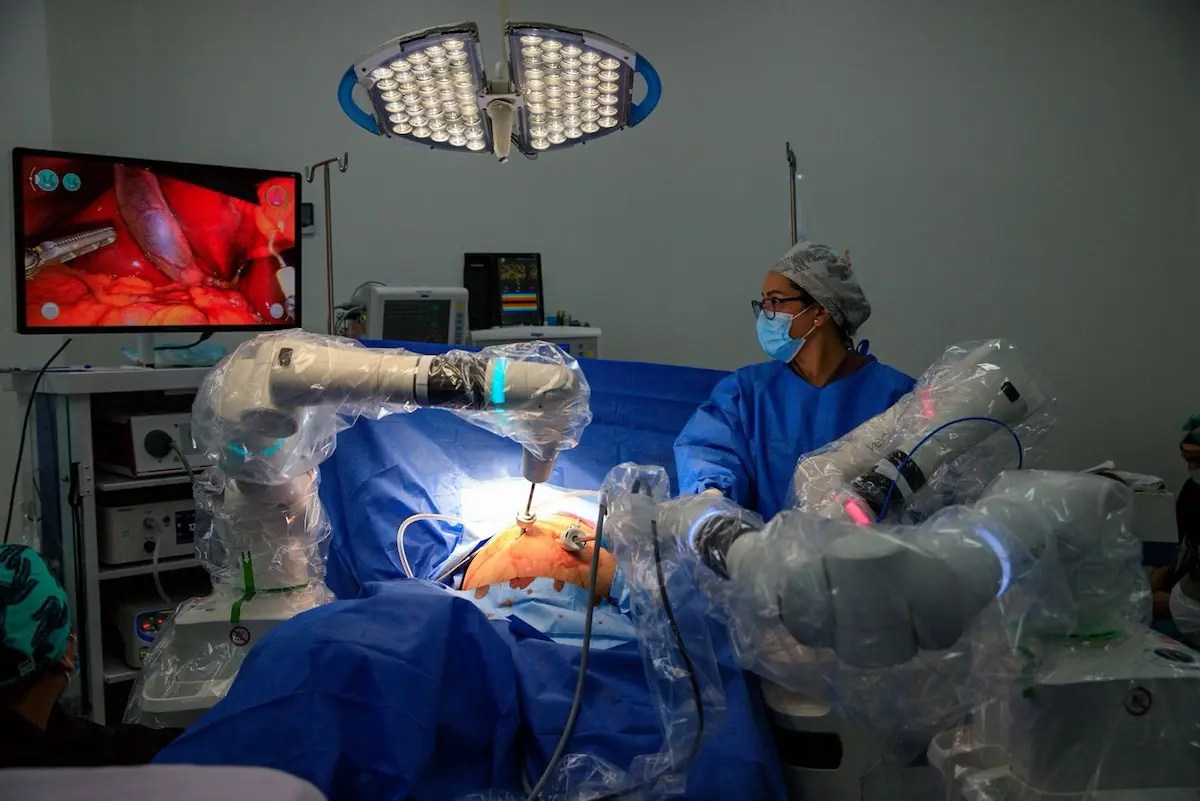
Cancún, Quintana Roo — Quintana Roo has introduced robot-assisted surgery into its public healthcare system, completing its first two procedures at the Hospital General de Cancún “Dr. Jesús Kumate Rodríguez.”
The milestone could eventually give residents access to complex, minimally invasive operations closer to home, reducing the need for patients and their families to travel to Mérida, Mexico City or other medical centers for certain specialized procedures.
The first surgical session involved two cholecystectomies, or gallbladder removals, performed on adult patients using the VERSIUS surgical system. Both operations were reported as successful.
The first patient was a 48-year-old man with chronic cholecystitis, a condition generally caused by repeated inflammation of the gallbladder and frequently associated with gallstones. State health officials said the procedure ended without complications and the patient was recovering well. A second gallbladder removal was completed during the same session.
The operations formally launched the hospital’s Robotic Surgery Program, inaugurated August 31.
“We successfully performed the first robotic surgeries at the Hospital General de Cancún ‘Dr. Jesús Kumate Rodríguez,’ making us a benchmark across the country,” Gov. Mara Lezama Espinosa said after visiting the operating room.
The robot does not perform the operation by itself
Despite the name, robot-assisted surgery is not automated. The system does not make medical decisions or move independently.
A surgeon remains in control throughout the procedure, operating from an open console with joystick-like controls. The VERSIUS system translates the surgeon’s hand movements into smaller, highly controlled movements by instruments attached to robotic arms beside the operating table.
A high-definition, three-dimensional image gives the surgeon a magnified view inside the patient’s body. The articulated instruments can also reach and move within tight spaces that may be difficult to navigate with conventional laparoscopic equipment.
VERSIUS was developed by the British medical-technology company CMR Surgical. Unlike systems built around one large fixed unit, it uses independent modular arms that can be positioned according to the operation and the layout of the operating room. The manufacturer says this compact design allows hospitals to use only the number of arms required for each procedure.
Quintana Roo officials said the technology is currently installed in only five hospitals in Mexico.
A local surgeon reaches a national milestone
One of the first operations was led by Dr. María de los Ángeles Martínez Ferretiz, a surgeon at the Cancún hospital and head professor of its General Surgery postgraduate program.
According to state officials, Martínez Ferretiz is the second woman in Mexico certified to operate the VERSIUS system and the first on the Yucatán Peninsula.
Her certification is particularly important because purchasing surgical technology is only the first step. A hospital also needs surgeons, nurses, anesthesiologists and technical personnel trained to prepare, operate and troubleshoot the equipment.
The Cancún program plans to certify as many as 16 surgeons already working at the hospital. Training will cover general surgery, gynecology, urology and thoracic surgery.
As that training progresses, officials plan to introduce more complex procedures, including hysterectomies and operations related to prostate cancer.
What could change for patients
Robot-assisted surgery is a form of minimally invasive surgery. Instead of making one large incision, the surgical team normally works through several smaller openings used for a camera and instruments.
For suitable patients and procedures, minimally invasive techniques can mean less blood loss, less postoperative pain, smaller scars and shorter hospital stays than open surgery. They may also allow patients to return to ordinary activities sooner.
Those benefits are possible rather than guaranteed. Recovery still depends on the type of operation, the patient’s health, the surgeon’s experience and whether complications arise.
A review of early VERSIUS studies found the system feasible for a range of minimally invasive procedures but cautioned that the available evidence varied considerably and that more comparative, long-term research was needed.
Robot assistance is also not necessarily superior to conventional laparoscopy in every case. Gallbladder removal, for example, is already commonly performed through small incisions using standard laparoscopic instruments. The greater potential value of the new system may emerge as Cancún surgeons begin using it for operations in confined or difficult-to-reach areas.
Not every patient will qualify
The arrival of the equipment does not mean every surgery at the hospital will now be robotic.
Doctors must consider the diagnosis, the complexity of the operation, previous surgeries and the patient’s general condition. In some cases, conventional laparoscopy or open surgery may remain the safer or more appropriate choice.
The program will also expand gradually as surgeons complete their certification and the hospital builds experience with the equipment. No separate public application process has been announced. Patients are expected to be selected through medical evaluation and the hospital’s existing specialist-care system.
There is always a possibility that a minimally invasive operation will need to be converted to conventional laparoscopy or open surgery if the medical team encounters bleeding, difficult anatomy or another complication.
Specialized care closer to home
For Quintana Roo families, the importance of the program extends beyond surgical technology.
Patients referred outside the state may face transportation, lodging and food expenses in addition to the stress of receiving treatment far from home. Relatives may also need to miss work or arrange childcare while accompanying them.
Providing more high-specialty procedures in Cancún could reduce that burden, particularly for patients who depend on public healthcare and cannot easily pay for treatment at a private hospital.
The first two gallbladder operations demonstrate that the equipment is functioning and that certified medical personnel are in place. The larger test will come next: training the remaining surgical teams, expanding the range of procedures and ensuring the technology is used often enough to improve access rather than becoming an occasional showcase.
If the program develops as planned, Cancún’s public hospital could become an important regional surgical center for patients throughout Quintana Roo and the wider Yucatán Peninsula.
More Community
- Supreme Court Reopens Mahahual Case Against Royal Caribbean
- Quintana Roo Governor Invites Families to First Janal Pixán Festival in Calderitas
- Senate to Review Legality of IMSS Changes to Modality 40 Pension Scheme
- Quintana Roo Seeks Geographic Indication to Protect Melipona Honey
- Quintana Roo Prosecutor’s Office Releases Seized Playa del Carmen Property, Leaving Two Dogs Locked Inside for Three Days
More Cancun
- Hells Angels Leader Arrested in Cancun Over Cartel Drug Trade
- Tourist Boat Traffic Slumps Across Quintana Roo Ports in September
- Cancún Waives 100% of Fines and Surcharges to Help Businesses Get Licensed
- Puerto Morelos Mayor Says Cancún Mansion Raided by Federal Agents Was ‘Lent’ to Her
- Mothers Keep Up Protest at Cancún Middle School Over Alleged Attack on Student