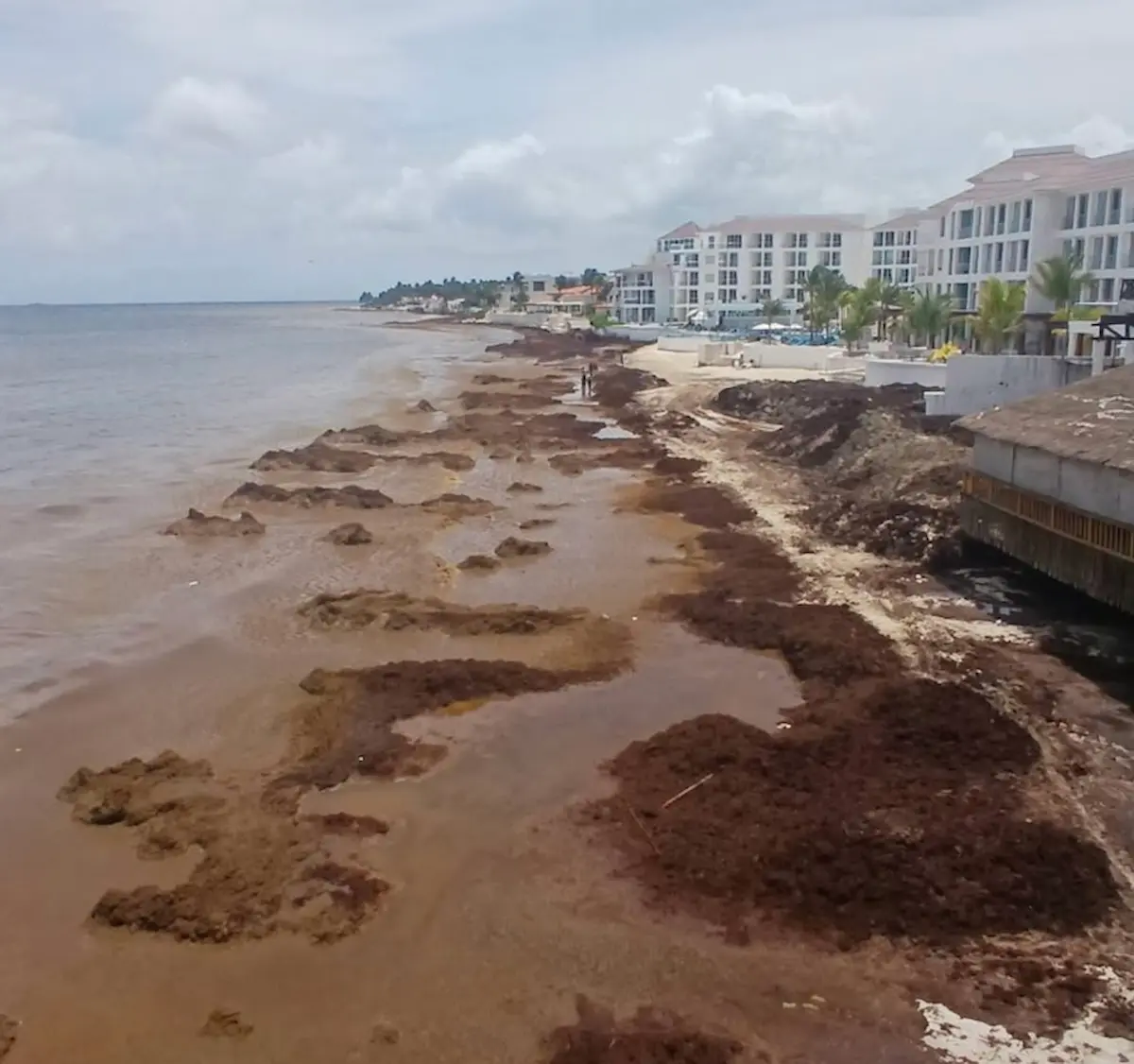
Playa del Carmen, Quintana Roo — Quintana Roo is facing one of its most difficult sargassum seasons in recent years, with heavy landings affecting beaches across the Mexican Caribbean, but the state government says the situation has not been formally classified as an environmental contingency.
Large accumulations of sargassum have disrupted beach activity, fishing, swimming, tourism services, and coastal access in several areas. In the worst-hit zones, decomposing seaweed has created foul odors, blocked nearshore water activities, and forced crews to intensify removal efforts. Playa del Carmen, Tulum, and Mahahual have been among the most affected points, although other stretches of coastline have also reported steady arrivals.
Cristina Torres Gómez, Quintana Roo’s interior secretary, said any formal environmental contingency declaration would have to come from the federal government. She added that state and federal agencies continue to work in coordination with the Mexican Navy, which has led much of the offshore and coastal sargassum response in recent years.
“For an environmental contingency, the federal government would have to declare it,” Torres said. “We continue working in coordination with the Navy, exploring alternatives.”
According to Torres, the inter-institutional sargassum task force is reviewing additional offshore strategies beyond the use of containment barriers. Those efforts remain complicated by shifting currents, wind patterns, wave activity, and changing landing points along the coast.
The state official acknowledged that conditions are particularly serious in Playa del Carmen, Tulum, and Mahahual, where large quantities of sargassum have exceeded the capacity of some containment measures. In some areas, barriers have been overwhelmed, allowing seaweed to reach the beach in heavy volumes.
“Playa del Carmen and Tulum have a lot of sargassum concentration, Mahahual too,” Torres said. She added that weather conditions had shifted some landings, while authorities were also monitoring a large sargassum mass moving toward the region.
The Mexican Navy has reported that approximately 63,000 metric tons of sargassum have been removed and collected so far this season. Even with that effort, authorities remain on alert as new patches continue moving through the Caribbean toward Quintana Roo’s coastline.
The refusal to declare an environmental contingency may seem contradictory to residents, hotel operators, fishermen, and tourism workers who see the accumulation on the beaches firsthand. But there are several reasons why officials may be cautious about using that label.
First, the legal authority matters. Much of the coastline, maritime zone, and offshore response involves federal jurisdiction. A formal emergency or contingency declaration could require action from federal agencies, not only the state. That would likely involve additional funding, operational commitments, and formal procedures that go beyond routine cleanup and containment.
Second, an emergency declaration can carry economic and political weight. Quintana Roo’s economy depends heavily on tourism, and officially labeling the situation an environmental emergency could reinforce negative perceptions of the destination at a time when hotels, beach clubs, tour operators, and restaurants are already dealing with sargassum-related cancellations, complaints, and reduced beach activity.
Third, a declaration may raise expectations for extraordinary resources. In previous sargassum crises, emergency language has been tied to calls for federal relief funding, expanded cleanup crews, equipment, containment infrastructure, and disposal solutions. Once an emergency is declared, the public and private sector may expect a larger and faster response than government agencies are prepared to deliver.
Fourth, authorities may prefer to frame the issue as a permanent management challenge rather than a temporary crisis. Sargassum is no longer seen as an occasional seasonal nuisance. In Quintana Roo, it has become a recurring environmental and economic problem requiring year-round monitoring, offshore detection, beach cleanup, disposal planning, and possible industrial reuse.
That shift is already visible in federal policy. Mexico has moved toward treating sargassum not only as waste, but also as a potential resource, including its use in emerging industries. That approach supports long-term management, research, and investment, but it can also conflict with the language of emergency response.
The environmental risks remain serious. When sargassum decomposes in large quantities, it can affect water quality, damage seagrasses and nearshore ecosystems, smother marine life, and release gases such as hydrogen sulfide and ammonia. Those gases create the familiar rotten-egg smell and may cause discomfort or health concerns, especially for people with respiratory conditions, children, older adults, and workers exposed for long periods.
Disposal is another challenge. Sargassum cannot simply be piled anywhere. If handled poorly, it can leach salt, nutrients, organic matter, and possible heavy metals into soil or groundwater. For a region dependent on a fragile karst aquifer, the long-term storage and processing of sargassum matters as much as the beach cleanup itself.
For now, Quintana Roo remains in response mode rather than emergency mode. Crews continue removing sargassum from beaches, the Navy continues monitoring and containment work, and officials are studying offshore intervention before the seaweed reaches shore.
The practical reality, however, is clear. Whether or not the government calls it an environmental contingency, the sargassum crisis is already affecting beaches, tourism, fishing, local businesses, public health, and coastal ecosystems across the Mexican Caribbean.
More Environment
- Mexican Army Nears Completion of 16-Kilometer Jungle Road Over Tulum’s Sac Actún Cave System
- Akumal Halts Turtle Swim Tours Through September
- Mexico Assigns $110 Million Navy Budget to Fight Sargassum in Quintana Roo
- Mérida Opens First Green Corridor to Fight Climate Change
- El Niño Keeps Atlantic Hurricane-Free, Setting Record for Latest First Storm in Decades
More Quintana Roo
- Quintana Roo Civil Protection Warns Against Fireworks Ahead of Independence Day
- Quintana Roo to Pilot Child Protection Protocol for Tourism Sector in October
- Sheinbaum Announces 187 Primary Care Clinics and Major Projects in Quintana Roo
- Quintana Roo Records 29,413 Sea Turtle Nests at Season’s Midpoint
- Quintana Roo Reports 1,200 Screwworm Cases as Officials Await Sterile Fly Release