
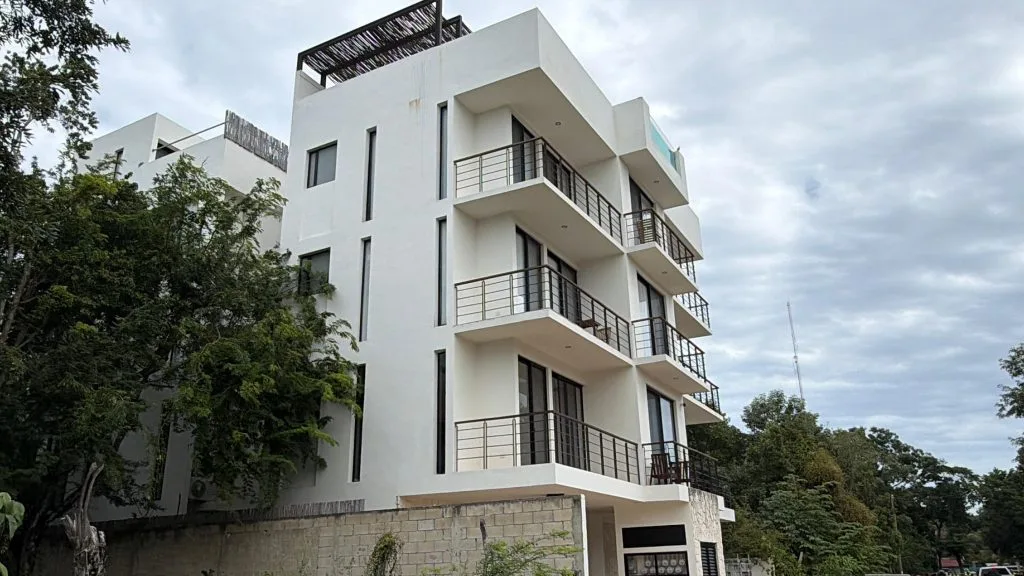
Tulum’s Housing Imbalance Deepens as Tourism Slowdown Exposes Structural Problems
Tulum, Quintana Roo— Two and a half years after the opening of Tulum International Airport, expectations of a major boom in foreign tourism, real estate investment, and digital nomad migration have collided with a more complicated reality. Tulum is facing a slowdown in tourism, an oversupplied real estate market, and a shortage of housing for the workers and residents needed to sustain the local economy.
The airport, inaugurated in December 2023 and later expanded to international service, was promoted as a catalyst for growth in southern Quintana Roo. But instead of delivering uninterrupted expansion, Tulum has entered a difficult adjustment period marked by lower hotel occupancy, reduced air connectivity, high prices, beach access complaints, rising transportation costs, sargassum, and sporadic security concerns.
Behind those immediate problems, real estate analysts say, is a deeper structural issue: Tulum has built largely for visitors and investors, not for the people who live and work there.
“The main problem in Tulum is the lack of social and middle-income housing,” said Gene Towle, managing partner of real estate consultancy Softec.
According to Towle, the contrast with nearby Cancún and Playa del Carmen is significant. In those cities, around 80% of housing is social or middle-income, while only a small percentage is aimed at vacation use. In Tulum, he said, the model is almost reversed, with roughly 80% of housing oriented toward tourists, short-term rental platforms, second-home buyers, and beach property investors.
That imbalance matters most when tourism slows. In Cancún and Playa del Carmen, a large local population keeps supermarkets, restaurants, veterinarians, salons, schools, and neighborhood businesses operating even during low season. Tulum, by contrast, has fewer full-time residents relative to the amount of tourism-oriented housing and commercial space.
“When tourist activity drops, there’s no one to go to the supermarket or restaurants,” Towle said, describing the issue as a structural imbalance in the destination.
Tulum’s rise from backpacker enclave to global luxury brand accelerated between 2015 and 2024, attracting boutique hotels, beach clubs, investors, remote workers, wellness tourism, and short-term rental developments. The formula worked while demand was strong. But when visitors and digital nomads began pulling back, the absence of a broader resident base became more visible.
Tulum’s hotel model also differs from Cancún’s. Many of its properties are independent or boutique-style rather than large chain resorts with established convention, group travel, or wholesaler networks. That leaves the destination more exposed when leisure demand softens.
Towle compared the situation to Cancún before Hurricane Gilbert in 1988, when many hoteliers believed the destination would remain full without needing to diversify into conventions or wholesaler-backed occupancy. After the hurricane disrupted tourism, he said, the industry better understood the value of guaranteed group and business demand.
For Tulum, some problems may be easier to address than others. Insecurity, beach access, sargassum management, pricing complaints, and transportation costs can be improved through policy, enforcement, and market correction. Housing, however, is a longer-term issue because the existing inventory was built around a specific kind of buyer.
Juan Vega, CEO of real estate firm Habitaria, said Tulum’s challenge is partly the result of a young market growing too quickly. Cancún has had six decades to develop. Tulum’s modern real estate boom is barely a decade old.
“The narrative of Tulum’s infinite growth has been broken,” Vega said.
According to Habitaria, Tulum’s real estate inventory, including lots, houses, and apartments, totals 11,889 units. The municipality has a population of roughly 65,000, meaning much of the available product is not designed for local residents.
The issue, Vega said, is not only the number of units but the type. Developers found strong margins in compact studios, lofts, and investor-friendly units aimed at vacation rentals. On a lot worth several million pesos, a developer could build multiple small apartments and sell them as short-term rental investments. As more developers followed the same formula, the market became saturated.
Habitaria estimates that 4,874 homes are currently available for sale in Tulum, a level that could take up to five years to absorb. Another 608 active projects may face delays, cancellations, or financing problems.
“The problem is that real estate supply grew as if tourist demand were infinite,” Vega said. “But the market must compete not only for tourists, but also for buyers, guests, and operators.”
The slowdown is creating financial risk for developers. Some projects were financed with a mix of bank loans and buyer pre-sales, a model that depends on steady absorption. When sales slow, cash flow tightens. Construction can stall, buyers may become nervous, and unfinished projects can add further pressure to the market.
“When you start developing in a market with strong demand, you grow excessively,” Vega said. Developers that planned one project at a time began launching three or four at once, expecting the same level of demand to continue. “Initially it works, but when demand falls, resources are limited and construction stops.”
Tourism officials and business leaders have pushed back against the idea that Tulum is collapsing, arguing that the destination remains globally recognized and that downturns are part of market cycles. But even if tourism rebounds, analysts say the housing imbalance will remain unless the development model changes.
Tulum’s next challenge may not be attracting attention. It already has that. The harder task will be building a more stable destination, one that can support not only tourists and investors, but also the workers, families, and year-round residents who keep a city functioning when the beach clubs are quiet.
More Economy
- Hotel and Business Groups Warn 35.8% Non-Resident Fee Hike Threatens Quintana Roo Tourism
- Trump Says US Will Not Exit USMCA and Promises ‘Great Relationship With Mexico’
- Tulum Hotels Stay Open Through Renovations Ahead of High Season, Union Says
- Southern Quintana Roo Lacks Banks and Internet to Ditch Cash, Accountants Warn
- Playa del Carmen Sets September 30 Deadline to Join El Buen Fin 2026
More Tulum
- Three Arrested in Tulum After Taxi Driver Beaten and Robbed for Refusing Extra Passengers
- Tren Maya Archaeological Finds Won’t Be Displayed in Chetumal, INAH Says
- Quintana Roo Records 29,413 Sea Turtle Nests at Season’s Midpoint
- Quintana Roo Seeks to Curb Unfair Competition Among Transporters
- Tulum Tourism Slump Spreads to Inland Maya Communities as Businesses Close Along Cobá Route