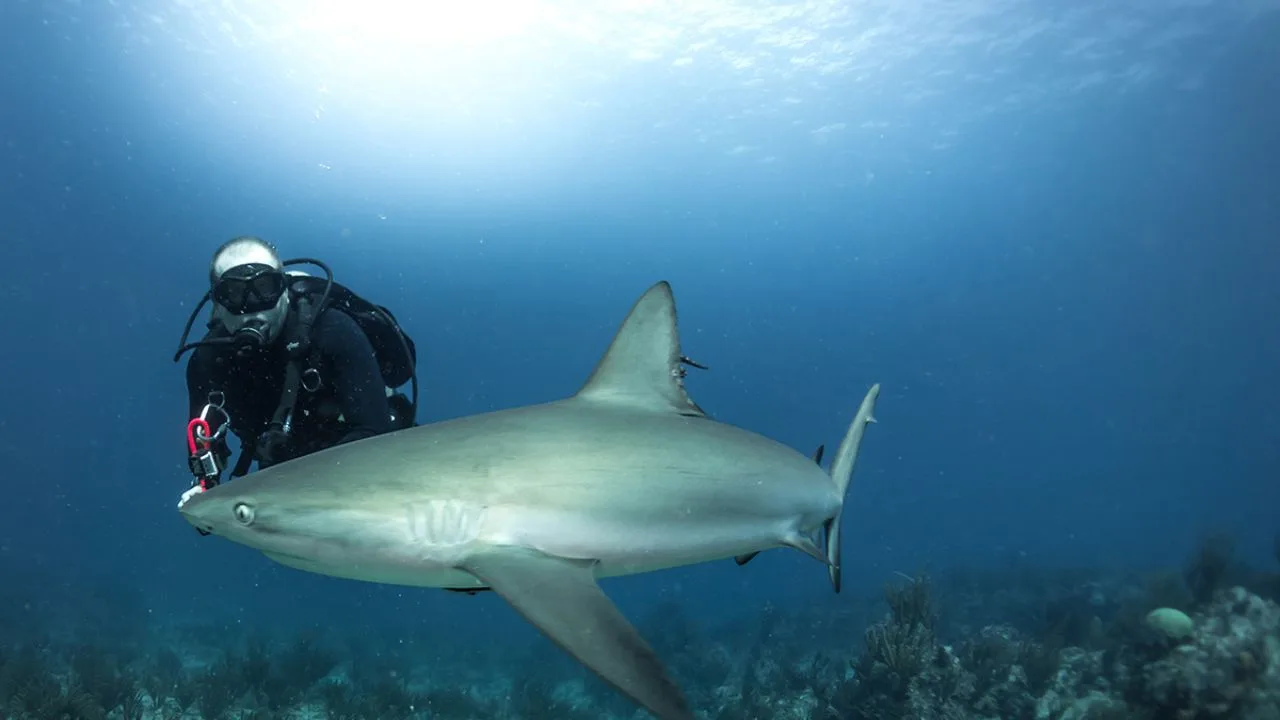
Playa del Carmen, Quintana Roo — Playa del Carmen is approaching the final stages of a federal process that could give its seasonal bull shark diving activity Mexico’s first Geographical Indication connected to nature tourism.
The proposed designation, “Tiburón Toro de Playa del Carmen, Quintana Roo,” would protect the name used for regulated bull shark observation and attraction dives conducted in a designated marine area off the city’s coast.
The application was submitted to the Mexican Institute of Industrial Property, or IMPI, by the Quintana Roo government on May 25, 2026. It was published for public review in the Official Gazette of the Federation on May 29.
That publication opened a mandatory two-month period during which interested parties may submit objections or observations. The period is scheduled to expire July 29. IMPI must then evaluate the application and any challenges before issuing a final declaration of protection.
The May publication did not itself grant the designation. It explicitly stated that publication of the application did not represent a decision on whether the request would be approved. As of July 26, a final declaration had not appeared in the federal gazette.
If approved, however, the designation would be unusual. Mexico’s Geographical Indications have traditionally been associated with agricultural products, foods, beverages and handicrafts whose characteristics or reputation are tied to a particular region. The Playa del Carmen application instead covers a tourism activity based on the seasonal presence of bull sharks and the local practices developed for observing them.
Under Mexican law, a Geographical Indication identifies a product or activity associated with a defined place when its reputation or distinguishing qualities are linked to its geographical origin. Protected indications are considered public assets of the Mexican federation, while authorized users must comply with the applicable conditions and technical rules.
A Defined Diving Area And Season
The proposed geographical area is the Bull Shark Public Use Subzone within the Mexican Caribbean Biosphere Reserve. The designated polygon covers 10.337 hectares of coastal and reef waters off Playa del Carmen, approximately between latitude 20°36′ and 20°39′ north and longitude 87°04′ and 87°06′ west.
The federal application defines the formal diving season as November 1 through March 31, although sharks may be observed in the region from approximately November through April.
Most of the animals encountered off Playa del Carmen are females, including pregnant sharks. Bull sharks can move between saltwater and freshwater and are known to use coastal lagoons, estuaries and mangrove systems as nursery habitat.
The application recognizes two forms of diving. Observation dives depend on sharks appearing naturally within the designated area. Attraction dives allow specially trained and equipped personnel to use a limited amount of bait as an olfactory attractant.
Both methods have been practiced locally, although baited shark diving has generated debate within the diving and scientific communities. Supporters say regulated attraction dives can concentrate the activity in a controlled area, support research and give live sharks greater economic value than animals landed by fisheries. Critics have raised questions about whether repeated feeding can alter shark behavior, making clear operating standards and scientific monitoring important parts of the proposed designation.
Local conservation organizers report that 42 individual bull sharks have been identified in the area. Photo identification generally relies on visible characteristics such as fin shapes, scars, pigmentation and other markings that allow researchers to distinguish one animal from another. The count represents identified individuals, rather than a complete population census, because sharks move through the region seasonally.
More Than A Tourism Brand
A Geographical Indication would do more than market Playa del Carmen as a shark-diving destination. It would reserve the protected name for operators authorized to use it and establish a connection between that name, the defined marine area and the operating practices contained in the technical application.
The designation would not replace environmental permits, protected-area rules or federal wildlife regulations. Dive operators would still need the authorizations required to work inside the Mexican Caribbean Biosphere Reserve, which is administered by the National Commission of Natural Protected Areas.
The reserve’s management framework already recognizes bull shark diving as an activity requiring regulation and supervision. Federal conservation reports have described responsible shark tourism as a possible tool for conservation, while documenting coordination among authorized operators, protected-area personnel, the Mexican Navy, the harbor authority and Saving Our Sharks.
The bull shark, scientifically known as Carcharhinus leucas, is classified as vulnerable, with a decreasing global population, on the International Union for Conservation of Nature’s Red List. Major threats include commercial and small-scale fishing, accidental capture, habitat degradation and the loss of coastal nursery areas.
The technical study supporting the application was prepared by the University of the Caribbean. Quintana Roo’s Economic Development Secretariat coordinated the institutional process, which included municipal, state and federal authorities, researchers, dive operators, fishing cooperatives and civil organizations.
Saving Our Sharks has worked with shark conservation, fishing communities and tourism operators in the Mexican Caribbean since 2010. Its participation has included research, photo identification, education and efforts to reduce the capture of sharks by creating alternative sources of income.
The protected area involved in the application is part of the Mexican Caribbean Biosphere Reserve, not the Sian Ka’an Biosphere Reserve. The federal government created the Mexican Caribbean reserve in 2016, and its regulated bull shark zone lies directly off Playa del Carmen.
The application’s opposition period ends July 29. After that, IMPI must consider any filings and decide whether the requested protection meets the requirements of Mexico’s industrial-property law. A final Geographical Indication will exist only after IMPI approves it and publishes the declaration in the Official Gazette.
More Environment
- Puerto Morelos launches weekly sargassum watch until 2026
- Quintana Roo Seeks Geographic Indication to Protect Melipona Honey
- Dengue Cases in Quintana Roo Jump 152 Percent
- Quintana Roo Hoteliers Push Regenerative Tourism Amid Beach Access Disputes
- Greenpeace Finds Contamination at 17 Yucatán Wells and Cenotes as Maya Communities Demand Action
More Playa del Carmen
- Judge Orders Five to Stand Trial for Drug Dealing in Playa del Carmen
- Quintana Roo Prosecutor’s Office Releases Seized Playa del Carmen Property, Leaving Two Dogs Locked Inside for Three Days
- Playa del Carmen Prepares Third Janal Pixán Festival With 300 Artists and Two Parades
- Playa del Carmen Parking Meter Operator Playaparq Ignores City Notices Over Broken Machines
- Playa del Carmen Cuts Administrative Offenses 8.5% as Peace and Civic Justice Council Convenes