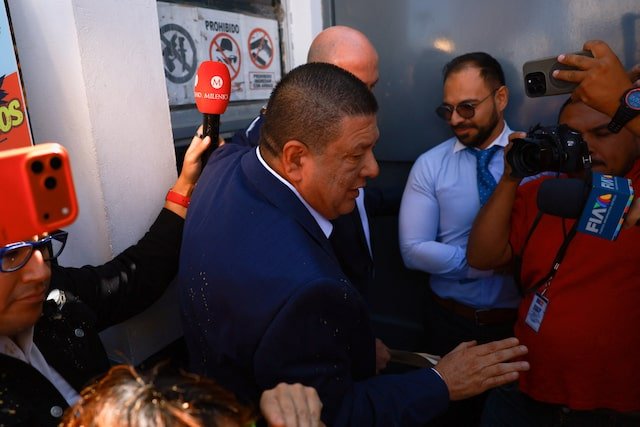
Mexico City — Mexican federal prosecutors charged former Chihuahua Attorney General Cesar Jauregui with treason on Wednesday, accusing him of allowing U.S. personnel to take part in a drug operation in northern Mexico without the federal government’s approval.
The charge revives one of Mexico’s most serious and least-used criminal offenses. The case could reshape how Mexican officials work with U.S. security forces.
Prosecutors allege Jauregui allowed U.S. agents to participate in an April raid on a suspected drug lab in Chihuahua, a border state long central to Mexico’s fight against organized crime. The raid became public only after two U.S. agents were killed in a car crash while returning from the scene. The incident drew scrutiny from President Claudia Sheinbaum and set her against opposition Governor Maru Campos.
A judge ordered Jauregui held in pretrial detention while the court decides whether there is enough evidence to formally proceed with a criminal case. A follow-up hearing is scheduled for Saturday, according to a statement from the Attorney General’s Office.
Attorney General Ernestina Godoy said Jauregui allowed foreign agents to carry out activities reserved for Mexican authorities and failed to share information with federal officials as required.
Federal Control Over U.S. Ties
Analysts said the case could have consequences beyond Chihuahua as the federal government moves to tighten control over security cooperation with the United States.
“The treason charge … seeks to set a precedent and prevent cooperation between [Mexican] states and the U.S. government without the federal government’s coordination and approval,” said Matias Gomez Leautaud, an analyst at Eurasia Group.
He said the case fits a broader push by the federal Security Ministry to centralize information-sharing with the United States, curb unilateral actions by U.S. agencies and bring state-level initiatives under federal control.
Gomez Leautaud said there was also a clear political dimension, given that Chihuahua is governed by the opposition and could become a key battleground ahead of Mexico’s 2027 midterm elections.
Treason Law Rarely Tested
Treason cases are extremely rare in Mexico. No widely recognized conviction has been recorded since 1867, when Emperor Maximilian was executed after the government of Benito Juarez found that his French-backed rule violated Mexico’s sovereignty.
Mexican law does not spell out treason in a single definition, but it broadly covers acts against the country’s sovereignty, independence or territorial integrity carried out for the benefit of a foreign power.
In 2024, prosecutors also sought to bring treason charges against Joaquin Guzman Lopez, one of the sons of jailed drug lord Joaquin “El Chapo” Guzman. That case has not led to a conviction, with Guzman Lopez currently detained in the United States.
More Politics
- Mexico’s Lower House Approves ‘Anti-Meme’ Law as Opposition Warns Over Free Speech
- Puerto Morelos Mayor Says Cancún Mansion Raided by Federal Agents Was ‘Lent’ to Her
- Trump Escalates Pressure on Mexico, Demands Action Against Cartel-Allied Officials
- Mexico Files New Complaint Over Migrant Death in ICE Custody
- Puerto Morelos Mayor Denies Detention After Federal Search of Rented Home