
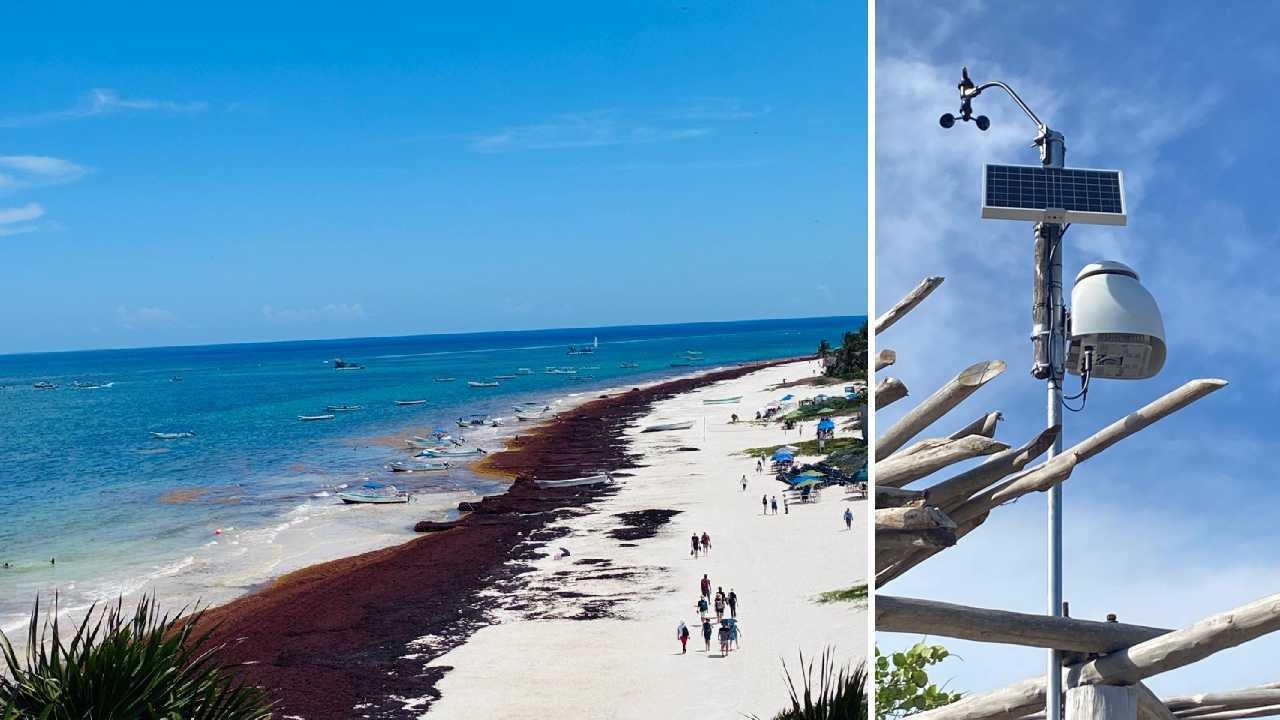
Playa del Carmen, Quintana Roo — Authorities have installed a specialized monitoring station to track gases released by decomposing sargassum along the coast, adding a new scientific tool to address the environmental challenge.
The equipment, placed by researchers from the Scientific Research Center of Yucatan (CICY) at the main entrance of Oasis Maya and Pulmon Verde — an area promoted as a protected natural reserve — is part of a state-wide environmental surveillance network. It aims to generate technical data to inform public decision-making.
The station measures emissions of carbon dioxide, methane, ammonia, and compounds related to sulfuric acid, substances that can be released when sargassum begins to rot on the beach. Scientists said the data will allow for a more precise assessment of the phenomenon’s impact on coastal ecosystems and the population exposed daily.
Special attention is focused on beach cleanup workers, who spend hours under the sun in direct contact with the biomass. Researchers are analyzing potential health effects, including eye and respiratory irritation and chronic lung conditions from prolonged exposure to the gases.
The new station joins an international network present in Caribbean countries, aimed at strengthening early warning systems for massive sargassum arrivals.
Authorities estimate that more than 25,000 metric tons of sargassum have already been collected in Quintana Roo this year, exceeding the amount recorded during the same period in 2025. Researchers also warned that some algae may contain arsenic, recommending limited industrial use and prioritizing controlled applications such as biogas generation.
More Environment
- Mexican Army Nears Completion of 16-Kilometer Jungle Road Over Tulum’s Sac Actún Cave System
- Akumal Halts Turtle Swim Tours Through September
- Mexico Assigns $110 Million Navy Budget to Fight Sargassum in Quintana Roo
- Mérida Opens First Green Corridor to Fight Climate Change
- El Niño Keeps Atlantic Hurricane-Free, Setting Record for Latest First Storm in Decades
More Playa del Carmen
- Business Leaders Urge Playa del Carmen to Diversify Economy as Tourism Slumps
- Playa del Carmen Inaugurates Plaza Punto Sur Under Public-Private Alliance
- Mayakoba Resorts Accused of Illegally Withholding Up to 35% of Worker Tips
- Cenotes in Playa del Carmen Face Contamination Risk From Poor Sanitary Infrastructure
- GPS Leads Police to Rental Car Reported Stolen in Cancún; Two Arrested in Playa del Carmen
