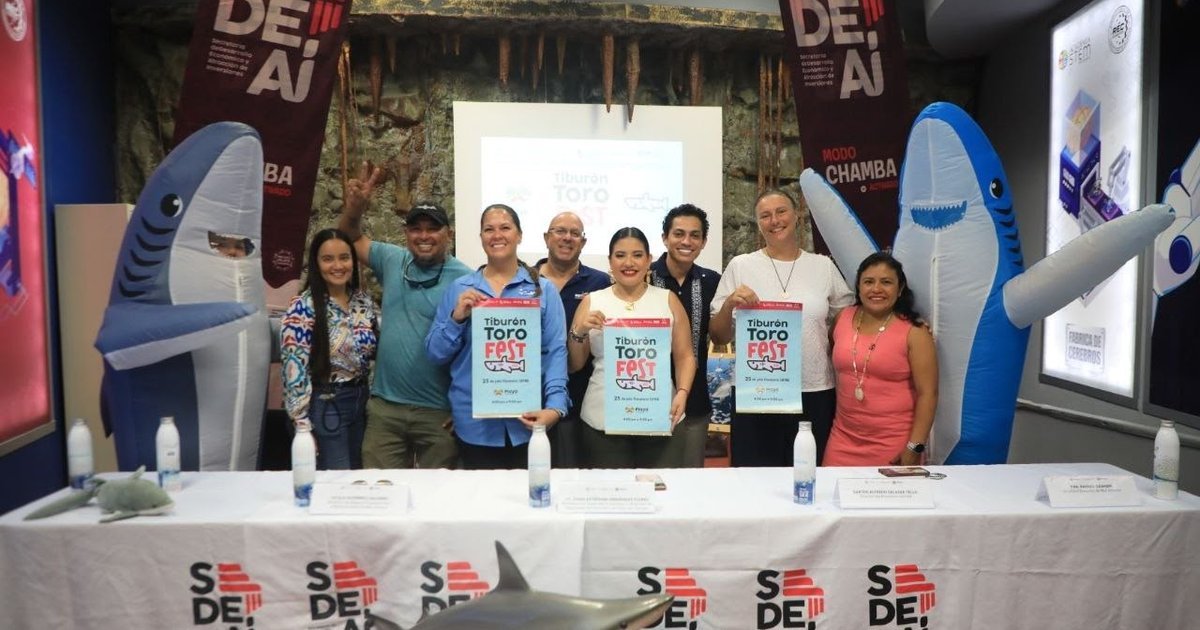
PLAYA DEL CARMEN, Quintana Roo — Playa del Carmen will host the second edition of Tiburón Toro Fest 2026 on Saturday, July 25, bringing together scientists, conservation groups, divers, tourism providers and families for a public event focused on one of the city’s most iconic marine species.
The festival will take place at the Sayab Planetarium, beginning at 4 p.m., with free educational activities, workshops, exhibits, documentary screenings and panel discussions centered on the bull shark and its role in the marine ecosystem. The municipal government said the event is part of a broader effort to strengthen environmental education, support species conservation and promote responsible nature-based tourism.
Estefanía Hernández Flores, Playa del Carmen’s Secretary of Economic Development and Investment Attraction, said the festival is intended to recognize the work already being carried out by scientists, civil organizations, divers and local service providers.
“Conserving the bull shark means conserving the future of Playa del Carmen and part of our identity,” Hernández Flores said.
The 2026 program will include environmental education workshops, family activities, documentary screenings, expert panels and exhibits from more than 21 conservation projects, according to the municipal announcement. Cecilia Gutiérrez Navarro, director of Proyecto Azul Balché, said one of the goals is to counter myths about sharks and encourage a stronger culture of marine conservation.
Why Bull Sharks Matter in Playa del Carmen
Playa del Carmen is one of the best-known bull shark observation sites in the Mexican Caribbean. During the winter season, bull sharks are seen offshore by recreational divers, creating a specialized tourism activity that has become part of the city’s marine identity.
MarAlliance, an international marine conservation organization, describes Playa del Carmen as an important research site for bull sharks, where female sharks arrive seasonally in local waters. The organization has led research expeditions in the area and promotes citizen-science participation to better understand and protect the species.
Rachel Graham, founder and executive director of MarAlliance, said during the festival presentation that Playa del Carmen is among the important global sites for bull shark research. She also noted the economic value of shark encounter tourism worldwide when conducted under sustainability criteria.
That point is central to the festival’s message. Sharks are often treated as either a danger or a spectacle, but conservation groups argue that they should also be understood as wildlife with ecological and economic value when tourism is properly managed.
A Species That Needs Better Understanding
Bull sharks are powerful coastal predators capable of living in both saltwater and freshwater environments. Their presence close to shore has contributed to their reputation, but scientists and conservation groups emphasize that sharks play an important role in marine food webs.
NOAA Fisheries notes that sharks are among the ocean’s top predators and help maintain balance in marine ecosystems. The agency also warns that sharks are particularly vulnerable compared with many other fish because they tend to grow slowly, mature late and produce relatively few young.
That biological reality makes conservation work especially important. When shark populations are reduced by fishing pressure, habitat loss or unregulated exploitation, recovery can be slow.
Globally, sharks and rays face serious conservation pressure. A landmark global assessment of more than 1,000 shark, ray and chimaera species found that about one-quarter were threatened under IUCN Red List criteria, with overfishing identified as the main threat.
Tourism Under Rules
Playa del Carmen’s bull shark tourism is not an open free-for-all. Francisco Chan, a representative of the local divers’ union, said the destination currently has 26 authorized permit holders for bull shark tourism operating under guidelines established by the National Commission of Natural Protected Areas, CONANP. Local officials say those rules have helped position Playa del Carmen as a reference point for responsible shark tourism.
CONANP identifies the bull shark, Carcharhinus leucas, among the species present in the Mexican Caribbean region, which includes the coastal zone around Cancún, Puerto Morelos, Playa del Carmen, Akumal, Tulum and Mahahual.
For local dive operators, the challenge is balancing the economic value of shark encounters with the need to protect the animals and the marine environment that supports them. That includes following authorized practices, respecting seasonal conditions and reinforcing education for visitors who may arrive with fear or misconceptions about sharks.
From Fear to Conservation
The first edition of Tiburón Toro Fest was held in 2025 under the theme “Identidad y Conservación,” or “Identity and Conservation.” That event included a mini-documentary screening, photography exhibition and educational activities, and involved groups such as CONANP, MarAlliance, EcoCaribe MX, We Love the Sea and Centinelas del Agua A.C.
The second edition continues that approach, presenting the bull shark not only as a tourism attraction, but as a species tied to local identity, marine science and responsible economic activity.
The festival’s broader message is simple: protecting bull sharks also means protecting the health of the marine ecosystem that supports Playa del Carmen’s tourism, diving industry and coastal way of life.
For a city built around the sea, that makes the bull shark more than an occasional winter visitor. It is part of the natural system that helped make Playa del Carmen valuable in the first place.
More Events
- Cancún Looks to Promote Its Cultural Heritage to Tourists
- Anyma Brings ÆDEN to Zamna Tulum for 10th Anniversary Show on January 4
- AI and New Travel Trends to Headline AFEET Trends 2026 Summit in Cancún
- Playa del Carmen Opens Nominations for Elvia Carrillo Puerto Award Honoring Outstanding Women
- Cancún Businesswomen Organize Charity Walk for Breast Cancer Survivors
More Playa del Carmen
- Car With Two Children Overturns at Paamul Curve on Highway 307
- CFE and Playa del Carmen to Review Plan for Submarine Power Line to Cozumel
- American Says Stolen Truck Was Resold in Playa del Carmen With Forged Paperwork
- State Adult Education Institute to Open Branch in Villas del Sol
- Playa del Carmen Council Adds 66.5 Million Pesos to 2026 Public Works Budget