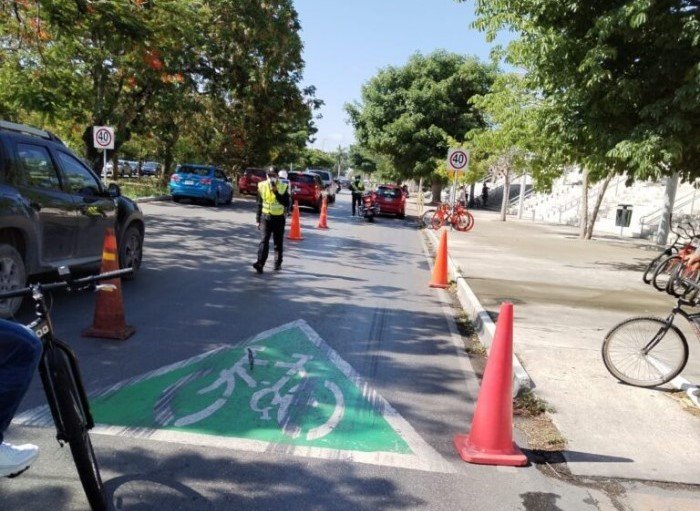
Mérida, Yucatán — Citizen groups and civic organizations in Yucatán are pushing back against the Metropolitan Well-Being Plan (Plan Bienestar Metropolitano), saying the proposed upgrades to Mérida and its Periférico ring road are designed to move cars faster rather than make streets safer for pedestrians, cyclists, and transit riders.
In a joint statement, the groups said the plan contradicts the mobility hierarchy set out in Mexico’s General Law of Mobility and Road Safety and in the federal accessibility standard NOM-004-SEDATU-2023.
The groups singled out five pedestrian infrastructure projects planned for high-risk points along the Periférico, warning they would likely be built as pedestrian bridges. Such structures, they argued, increase walking distances and travel times, require more physical effort, and can become barriers for people with disabilities, older adults, and other pedestrians. They proposed at-grade crossings with pedestrian signals, or grade-separated interchanges that include sidewalks and cycle lanes.
They also raised concerns about the modernization of eight underpasses on the Periférico and the planned 300-meter extension of the underpass at the Periférico-Canek junction. The groups said the Canek project focuses on improving traffic flow but does not adequately address the dangers people face crossing the old Caucel highway and Canek Avenue. They called for sidewalks, ramps, at-grade crossings, cycle lanes, and priority space for public transit as part of the work.
Another point of contention is the pedestrian bridge planned in front of the former O’Horan Hospital in downtown Mérida. The groups argued the bridge would fail accessibility standards and would once again put motorized traffic first. They estimated the bridge would cost more than 7 million pesos to build, plus over 500,000 pesos a year to operate and maintain. By contrast, they said an at-grade pedestrian priority crossing at sidewalk level could cost under 500,000 pesos, with annual maintenance below 20,000 pesos.
The organizations said the metropolitan projects can still be redesigned around redistributing street space to prioritize safety and accessibility for people. Their proposals include at-grade crossings, priority traffic signals, cycle lanes, rebuilt sidewalks, and exclusive or priority bus lanes. They said such measures would reduce crashes, emissions, and congestion over time, and urged the Metropolitan Well-Being Plan to move away from car-capacity projects and toward what they called “streets for people, not for cars.”
More Development
- Semarnat Approves Artificial Reefs and Sand Relocation for Akumal Hotel
- Chetumal Plans 836 Million Pesos in Stormwater Works to Curb Flooding
- Mara Lezama Delivers 288 Infonavit Homes in Puerto Aventuras as Quintana Roo Targets 76,000
- Fonatur Doubles Maya Ka’an Budget to 20 Million Pesos
- Study Finds Cancún’s Laguna Manatí Mangrove Could Qualify for Carbon Credits