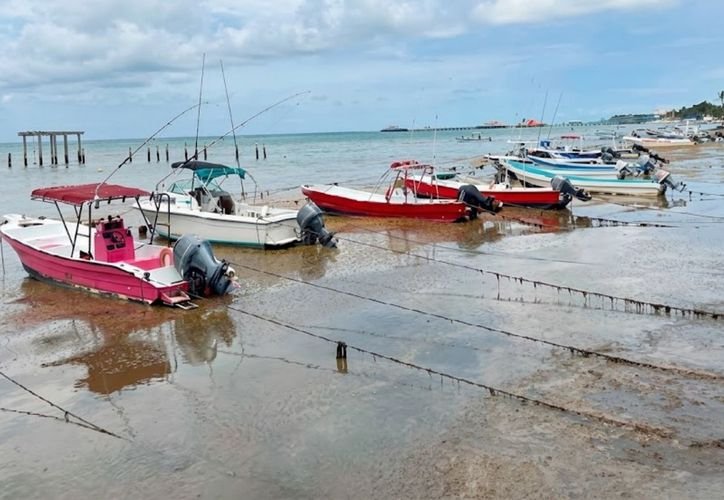
Playa del Carmen, Quintana Roo — Mexico’s environmental agency has approved a five-year permit for a private beach recovery project in Playa del Carmen that includes dredging sand from an offshore bank to rebuild a dune in front of Playa El Recodo, one of the most erosion-damaged stretches of coastline in the area.
The permit, granted by the Secretariat of Environment and Natural Resources (Semarnat), authorizes Mayan Monkey Holding, a company founded in Tijuana, Baja California, to carry out beach recovery work, build a 27-room hotel and construct a wooden pier. The total investment is reported at 115 million pesos.
The project — named Mayan Monkey Playa del Carmen — is planned for the site of the former Kool Beach club, next to Playa Mamitas. The club was shut down after an explosion on March 14, 2022, killed two people and left about twenty others injured.
The company submitted its environmental impact statement in November 2023, a little more than a year after the tragedy. An earlier request had been rejected by Semarnat, according to the document.
According to the Environmental Impact Statement (MIA), the goal of the authorized work is to expand tourist offerings at a point of high economic interest for Playa del Carmen. The roughly 2,000-square-meter property sits next to the Hyatt hotel, one of the largest in the municipal seat.
The most attention-grabbing element, and the one that has drawn criticism from environmental groups, is the creation of an artificial dune to recover the beach. To do this, the company plans to extract 360 cubic meters of sand from a bank located about 780 meters straight south, just off the eroded area of Playa El Recodo, which is also used as a shelter for boats.
The MIA states: “This sand bank is located in the protected natural area with the category of Biosphere Reserve called ‘Caribe Mexicano’, particularly in the ‘Public Use Subzone Playa del Carmen and Tulum-Sian Ka’an’. In that subzone, sand extraction is listed as an allowed activity under item 4.”
More Development
- Quintana Roo’s Beaches Are Disappearing Up to 14 Meters a Year
- Cancún Brings Electricity to Three Popular Neighborhoods With 358 New Meters
- Quintana Roo Identifies 780 Irregular Settlements, Prepares Regularization Strategy
- Cozumel’s Reefs Get a 3D Map Divers Can Explore Before Entering the Water
- Mexico’s Environment Agency Rejects Four Major Tourism Projects in Quintana Roo
More Playa del Carmen
- LIPU Bus Rear-Ends Van, Flipping It Off Highway 307 Near Playa del Carmen
- Woman Shot Dead on Motorcycle With Her Daughters in Playa del Carmen
- At Least Four Women Shot Dead Across Quintana Roo Over the Weekend
- Xcaret Says It Will Abide by Any Supreme Court Ruling on Use of Maya Culture
- Playa del Carmen Calls Volunteers to Clean More Than 7 Kilometers of Beach