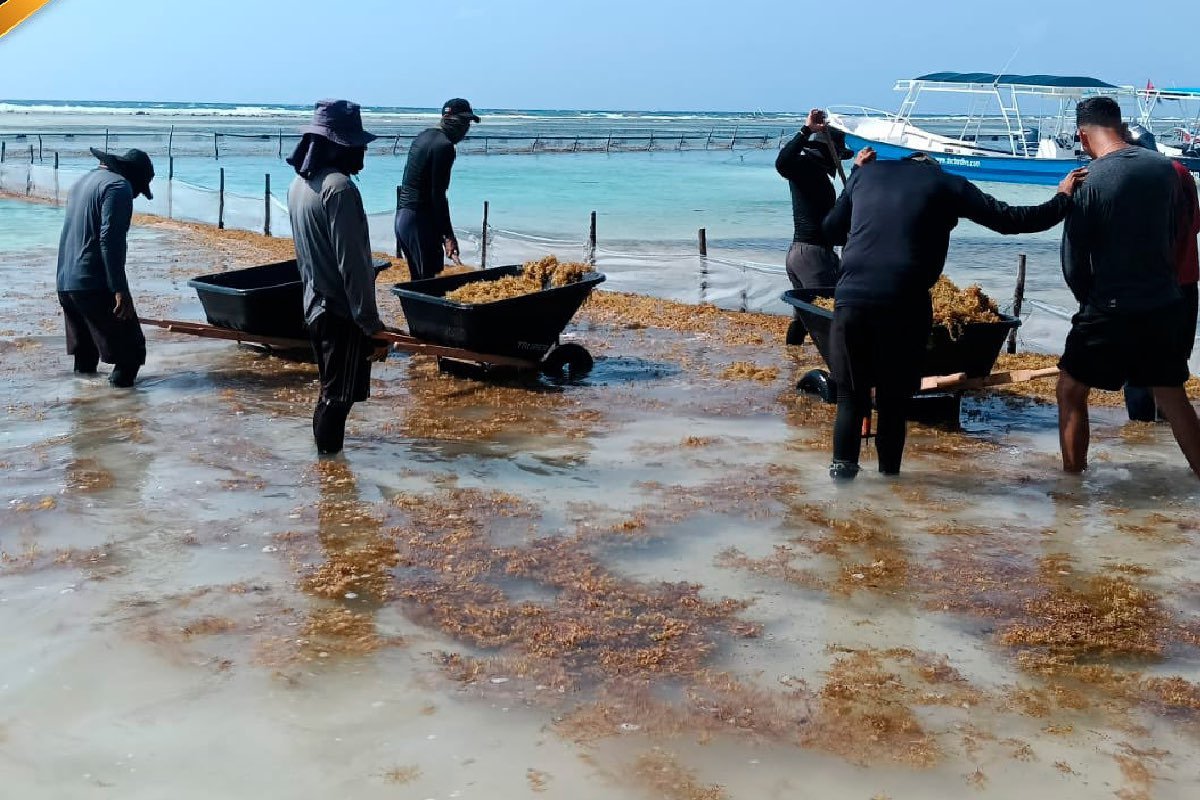
Playa del Carmen, Quintana Roo — Mexico is ramping up efforts to address the massive influx of sargassum, a brown macroalgae also known as the “golden tide,” that is inundating the Atlantic Ocean and threatening Caribbean beaches. The state of Quintana Roo is bearing the brunt, with the Mexican Navy (Semar) having collected 88,998 metric tons as of July 25.
The Navy expects an additional 179 metric tons to wash ashore on beaches south of Isla Mujeres, including Nizuc, Puerto Aventuras, Playa del Carmen, Akumal, Tulum, and Mahahual.
On May 17, Semar announced it would implement a sargassum response strategy to mitigate the algae’s negative effects. The strategy relies on satellite tools from the Oceanographic Institute of the Gulf and Caribbean Sea, which provide early warnings for containment and cleanup operations.
Record Arrivals in the Mexican Caribbean
According to the institute’s July 26 bulletin, 44,937 metric tons of sargassum were detected arriving in the Mexican Caribbean. The same monitoring detected 44,137 tons in the Central Caribbean, over 1.36 million tons in the Eastern Caribbean west of the Lesser Antilles, and 213,139 tons in the Central Western Atlantic — the highest report in that region.
The National Oceanic and Atmospheric Administration (NOAA) notes that sargassum naturally floats in the ocean, providing food and habitat for marine species, but becomes harmful when it inundates coastlines.
Arrivals typically increase from February, exceeding 20,000 tons, then gradually decline after October. Peak beach landings occur between May and August. In 2025 and so far in 2026, monthly arrivals have exceeded 80,000 tons. As of July 27, the Oceanographic Institute’s monitoring bulletin kept its “traffic light” at red, indicating “excessive” sargassum, based on images from the Federal Maritime Land Zone (Zofemat).
The citizen-reporting platform Sargazo.info counted 13 beaches in Cozumel, Mahahual, and Tulum with excessive sargassum on July 27.
Comprehensive Strategy Underway
The Navy has been collecting sargassum on beaches in Isla Mujeres, Benito Juárez, Puerto Morelos, Cozumel, Playa del Carmen, Tulum, and Mahahual. By mid-May 2026, it had gathered over 39,500 tons in collaboration with private initiatives and civil society.
Assets deployed include 13 surface units — one oceanic sargassum vessel, 11 coastal sargassum vessels, and one amphibious sargassum skimmer — along with 18 smaller support boats and more than 7,605 meters of containment barriers.
On Thursday, July 30, President Claudia Sheinbaum is expected to present a comprehensive strategy against sargassum, according to the Ministry of Environment and Natural Resources (Semarnat).
Ahead of the announcement, Quintana Roo Governor Mara Lezama said in social media posts after meeting with Sheinbaum that the plan will incorporate “science, technology, innovation, and circular economy.”
“Sargassum is a challenge that requires coordination, scientific knowledge, and long-term actions,” Lezama said. “In Quintana Roo we are grateful for all progress to protect our beaches, ecosystems, and the well-being of our people.”
Environment Secretary Alicia Bárcena visited the company CarbonWave in Puerto Morelos on June 4 to learn how they are using sargassum through circular economy principles. She emphasized the need for comprehensive solutions that create value chains, technological innovation, and productive alternatives with environmental, social, and economic benefits.
Semarnat stressed that sargassum management is part of the Puerto Morelos Circular Economy for Well-being Development Pole, focusing on sustainable development, environmental restoration, waste reduction, and job creation.
Bárcena also toured Ventana al Mar beach with Puerto Morelos Mayor Blanca Merari Tziu Muñoz to oversee monitoring, containment, cleanup, and collection operations by the Navy.
More Environment
- Cancún’s Benito Juárez Recycling Drive Recovers 6.8 Tons of Waste
- US Releases 1 Billion Sterile Flies to Stop Screwworm’s Return
- Delphinus Blue Planet Pulls Out of Deal to Buy The Dolphin Company, Leaving 101 Marine Animals in Limbo
- New Pemex Oil Spill in Gulf Won’t Reach Campeche Beaches, Company Says
- Cozumel Beach Club Kuzá Targets 4,000 Daily Visitors in Protected Area With CONANP Backing
More Quintana Roo
- No Long Weekend for Quintana Roo Students: Classes Held Sept. 14-15, Suspended Only Sept. 16
- Quintana Roo Bill Would Jail Pet Owners Who Abandon or Neglect Animals
- Quintana Roo Real Estate Market Matures Behind $1 Billion in Investment
- Illegal Trafficking Threatens Mexico’s Green Macaw, Expert Warns
- Least Tern Nests Under Watch in Sian Ka’an Reserve as Threats Mount