
Chetumal, Quintana Roo — Lawyers representing Maya dignitaries in a lawsuit against Grupo Xcaret have launched a series of informational assemblies across more than 1,000 Maya communities in the Yucatan Peninsula. With support from the federal government’s National Institute of Indigenous Peoples (INPI), they aim to explain a recent Supreme Court ruling and secure community agreements to join the legal action and prohibit unauthorized use of their cultural symbols.
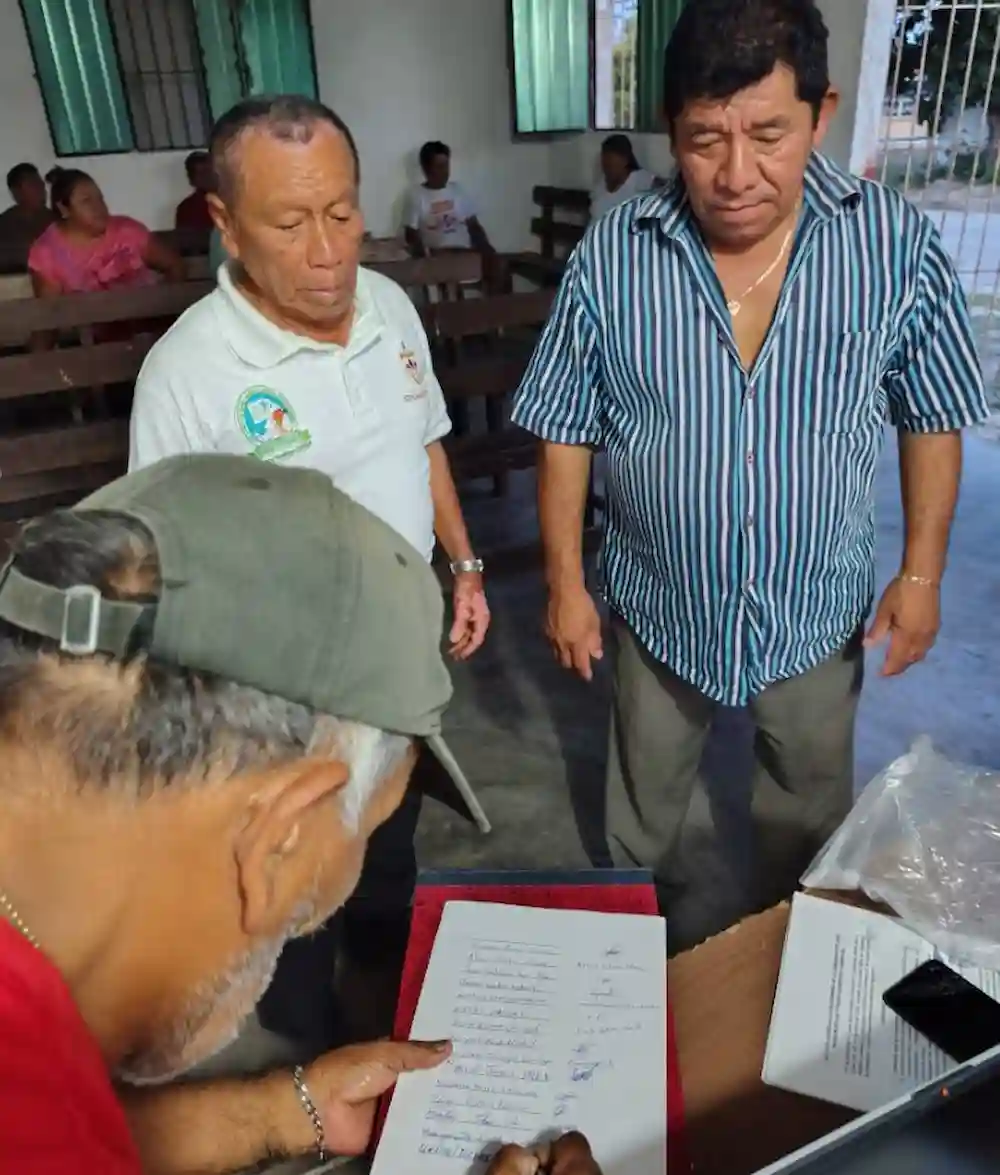
Alfredo Caamal Huchín, one of the organizing lawyers, announced on social media that the first assembly took place Saturday in the community of José María Morelos y Pavón in Champotón, Campeche. Approximately 120 of the community’s 200 adult residents attended, with INPI officials present to validate the proceedings.
The assemblies seek not only to inform communities and secure their adherence to the lawsuit but also to appoint the lawyers, including Caamal Huchín, as Maya-speaking legal advisors. These advisors would have authority to review any cultural exploitation contracts and serve as legal representatives before the INPI and third parties.
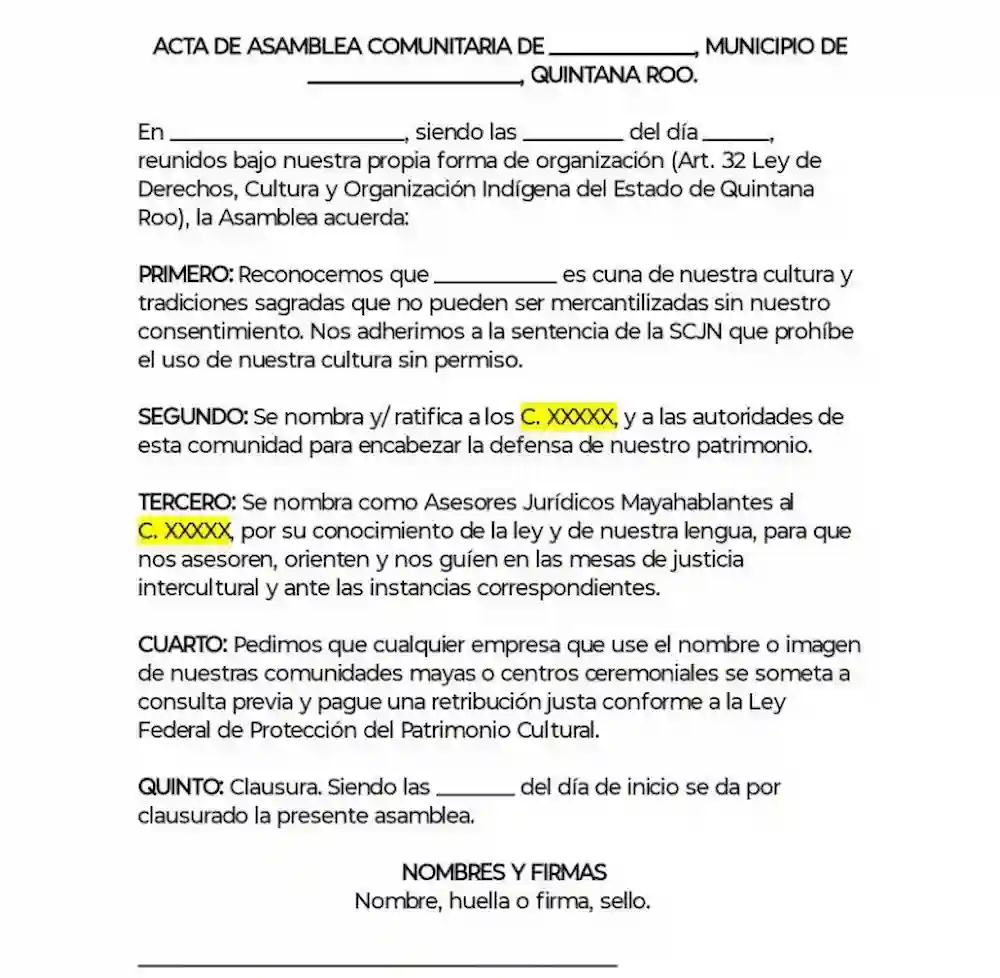
For Quintana Roo specifically, the proposal includes having assemblies in its 226 Maya communities demand that “any company using the name or image of our Maya communities or ceremonial centers must undergo prior consultation and pay fair compensation in accordance with the Federal Law for the Protection of Cultural Heritage.”
Caamal Huchín stated that the compensation Grupo Xcaret would need to provide for exploiting Maya culture will be submitted to a popular consultation among the peninsula’s communities. Only then will it be decided whether the consortium can use Maya symbols in its shows and decorations.
To achieve this, lawyers are pushing for Maya communities to become commercial partners of Grupo Xcaret, with direct participation in 2% to 10% of the consortium’s economic benefits, which would be allocated to social and development projects.
Assembly Agreements
On social media, Caamal Huchín explained that the goal is to hold informational assemblies in 1,021 Maya communities across Campeche, Yucatán, and Quintana Roo. The message emphasizes that the Supreme Court, in its ruling on protection of Maya dignity and heritage, “has given us reason: our cultural heritage cannot be touched without our consent.”
It should be clarified that the resolution is not a final judgment but rather revoked a suspension that protected Xcaret from restrictions imposed by the National Copyright Institute (Indautor) while it investigates the dignitaries’ complaint. The main litigation remains with Indautor, not the Supreme Court, meaning the case is ongoing.
The assembly agendas include:
- Legal installation of the assembly and roll call
- Analysis of the Supreme Court ruling on protection of Maya dignity and heritage
- Appointment or ratification of representatives for cultural heritage defense
- Designation of technical legal advisors with intercultural justice focus and Maya language proficiency
- Agreements on the “Peninsular Roadmap” for defense against companies and the state
Communities are asked to sign assembly minutes that include adherence to the Supreme Court ruling, appointment of representatives and advisors, and a statement that their culture is not merchandise and prohibits use of their symbolism without prior consultation.
Reviving Failed Consultation
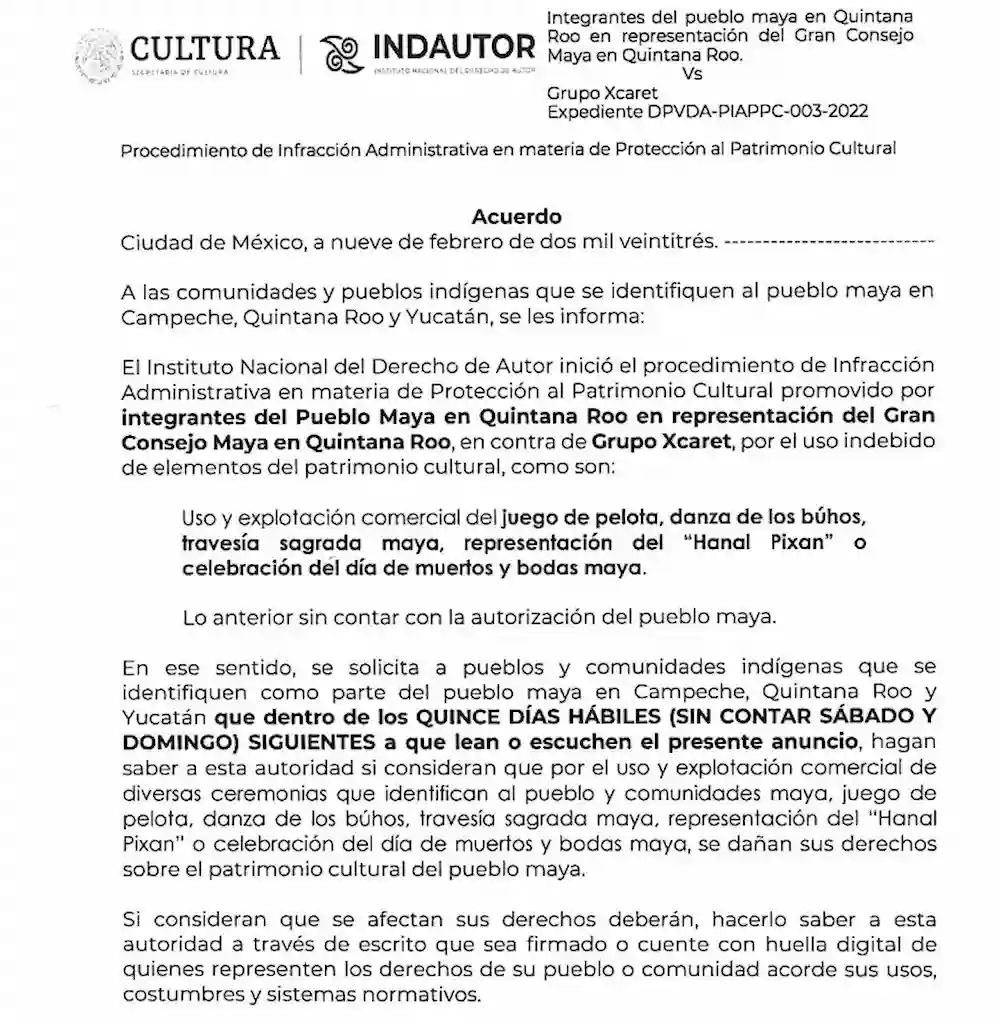
This strategy revives a failed consultation by Indautor in February 2023 that asked Maya communities in the Yucatan Peninsula to join the complaint against Xcaret. That consultation apparently remains open because its deadline runs from when communities learn of the summons, not from its publication date.
The original Indautor notice stated it had initiated administrative infringement proceedings regarding protection of cultural heritage, promoted by members of the Maya people against Grupo Xcaret for improper use of cultural heritage elements. These included commercial use and exploitation of the Ball Game, Dance of the Owls, Sacred Maya Journey, representation of “Hanal Pixán” or Day of the Dead celebration, and Maya weddings without Maya people’s authorization.
At the time, there was no registered interest from indigenous communities in participating in the complaint against Xcaret. This allowed the leadership of the Gran Consejo Maya to reach an economic agreement with the company and withdraw the complaint, not anticipating that opposing Maya dignitaries would reactivate it with federal government support.
Quintana Roo Assemblies
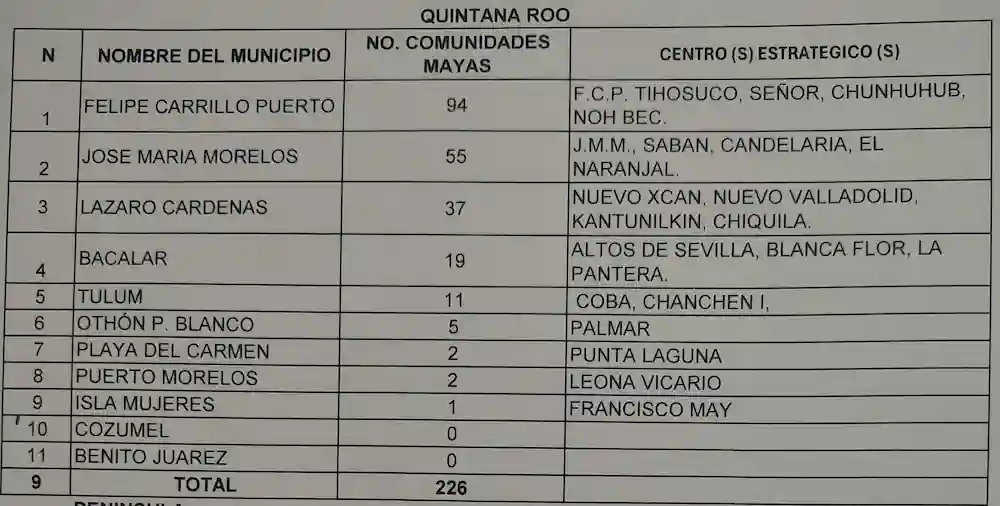
Caamal Huchín announced that, at the request of community authorities interested in learning about the Supreme Court ruling and litigation, informational assemblies have been proposed for Quintana Roo communities including Tihosuco, Señor, Chunhuhub, Noc Bec, Sabán, Candelaria, El Naranjal, Nuevo Xcan, Nuevo Valladolid, Kantunilkin, Chiquilá, Altos de Sevilla, Blanca Flor, La Pantera, Cobá, Chanchen I, El Palmar, Punta Laguna, Leona Vicario, and Francisco May.
No assemblies are planned for Benito Juárez and Cozumel municipalities because they have no communities cataloged as indigenous, though thousands of Maya indigenous people from the peninsula live and work there.
The locations were chosen as strategic centers to concentrate nearby communities. According to a published chart, Maya communities in Quintana Roo are distributed as follows: 94 in Felipe Carrillo Puerto, 55 in José María Morelos, 37 in Lázaro Cárdenas, 19 in Bacalar, 11 in Tulum, 5 in Othón P. Blanco, 2 in Playa del Carmen, 2 in Puerto Morelos, and 1 in Isla Mujeres.
Adding 262 communities in Campeche and 533 in Yucatán brings the total to 1,021 communities that lawyers seek to inform about the ruling and enlist in the lawsuit against Xcaret.
Controversial Lawyer Background
Alfredo Caamal Huchín previously served as Quintana Roo delegate for the National Commission for the Development of Indigenous Peoples (CDI), INPI’s predecessor. He was removed from that position after being sued and found guilty of sexual harassment against eight workers in 2011, for which he received the negligible fine of 45 pesos, drawing national public criticism.
He was later disqualified from holding public office for two years for violating budget regulations, for which he also had to pay a 280,000-peso fine while serving as an official in the Othón P. Blanco municipal government.
Subsequently, he helped found the local political party Confianza por Quintana Roo, promoted by Governor Carlos Joaquín and nicknamed the “Joaquinista Party,” serving as its leader in Felipe Carrillo Puerto and running as a proportional representation congressional candidate in 2022.
Now presenting himself as an intercultural legal consultant, and through his INPI connections, he became involved in the litigation of Maya dignitaries associated with that federal agency against Xcaret.
Regarding the lawyers representing the dignitaries, during a Saturday protest in Playa del Carmen by canoeists against the cancellation of Xcaret’s 2026 Sacred Maya Journey, the Gran Consejo Maya leadership claimed they have misadvised these dignitaries in pursuit of personal interests rather than the Maya people’s welfare.
They also stated that “a couple of thieving lawyers” promoted the current conflict from Mexico City “for money and ambition interests,” seeking to damage Maya traditions and those who help maintain them with dignity.
More Business
- Quintana Roo to Add 10,000 Hotel Rooms by 2028
- Cancún’s Teatro de la Ciudad Nears 75% Capacity Ahead of Second Anniversary
- BBVA México and IMEF Warn Capping ISR Deductions Would Discourage Private Investment
- Mexico’s Customs Fines Jump 131% in First Half of 2026
- Former AMPI Playa del Carmen President Faces Fraud Case Over Undelivered Land
More Quintana Roo
- Drought Crisis Forces Quintana Roo Wildlife to Seek Water Near Roads and Towns
- Brain-Eating Amoeba Confirmed in Mérida Lake: What to Know in Quintana Roo
- Quintana Roo Graduates 244 New Police Officers and Debuts First Bomb Squad
- Morena Taps Gino Segura as Quintana Roo Governor Candidate
- Quintana Roo Marks 216th Anniversary of Mexico’s Independence With Statewide Celebrations
