
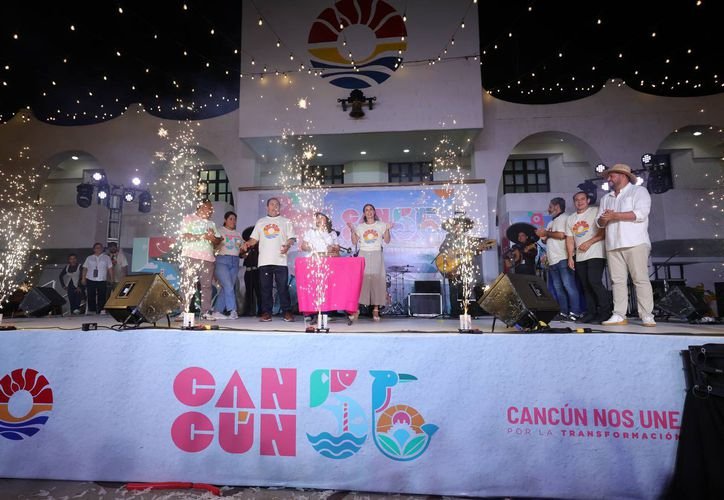
Cancún, Quintana Roo — Cancún celebrates its 56th anniversary this year, marking its evolution from a virgin Caribbean island into Mexico’s most important tourist destination, a transformation that has driven growth across the entire Yucatan Peninsula.
The city has been led by 19 elected mayors over more than five decades, including three women. Each administration faced unique challenges, often underestimating the scale of the project’s eventual impact.
Rafael Lara, a former mayor and pioneer who knew the area from its origins, acknowledges that Cancún’s growth not only boosted Quintana Roo but the entire peninsula. “I thought a lot of tourism would come, but I didn’t imagine we’d be where we are now,” Lara said. “We have everything—universities and hospitals—and the new bridge will bring even more life. I’m in love with Cancún.”
Political History and Key Milestones
Formal political history began with Alfonso Alarcón Morali, who arrived with engineers from Infratur and became the first defender of municipal autonomy, personally supervising progress from construction camps. He served as the first mayor of Benito Juárez from 1975 to 1978.
Felipe Amaro Santana (1978–1981) focused on basic public works for a population of immigrant workers, building the Beto Ávila and Jacinto Canek stadiums when the city barely extended beyond superblocks 2 and 22.
Under José Irabién (1981–1984), Cancún reached 45,000 residents and underwent a crucial financial transformation. A movement of mayors strengthened Constitutional Article 115, allowing the municipality to collect property taxes. The budget jumped from 470 million to 3.5 billion pesos, and construction began on López Portillo Avenue toward Puerto Juárez.
Joaquín González Castro (1984–1987) boosted social identity by founding the Pioneros soccer team and building the Andrés Quintana Roo and Cancún 86 stadiums. José González Zapata (1987–1990) continued this work, formally establishing April 20 as the city’s founding date.
Mario Villanueva (1990–1991) focused on ordering the rapid growth of the tourist zone. After interim mayor Jorge Arturo Contreras (1991–1993), Carlos Javier Cardín Pérez served from 1993 to 1996.
Rafael Lara (1996–1999) highlighted his administration’s lack of debt and crackdown on irregularities. “During my term, there were very few land invasions—we stopped them,” Lara recalled. “There was improvement in garbage collection, pothole repair, and streets.” His administration also protected the environment by decreeing Kabah Park as a natural protected area after convincing Governor Villanueva. “We convinced him to issue a decree declaring it a protected natural area, and I did the first works like trails and passed Armando Millet’s visitor house,” Lara said.
Transition to the New Millennium
Sonia Magaly Achach Solís (1999–2002) became the first woman mayor, prioritizing support for families in working-class neighborhoods. She passed away in April 2026. Juan Ignacio García Zalvidea served from 2002 to 2005.
After a series of administrations and interim periods, including those of Francisco Alor Quezada and Gregorio Sánchez Martínez—the latter leaving local coffers in debt—Julián Ricalde Magaña took office in 2011. He recognized that service deficits were the Achilles’ heel of a constantly expanding city. “It remains the great challenge because it’s a city that grows every day,” Ricalde said. “Many people come, and we have to give them space, attention, and public services. One thing people don’t understand is that while the municipality has 100 percent of the problems, it doesn’t have even 50 percent of the resources, and that complicates governance.”
Despite this, his administration achieved financial order, implemented social programs like school supply distribution, and resolved critical garbage crises. “There’s Siresol (Solid Waste Solution)… we solved a recurring problem with final waste disposal,” he said, ending his term in 2013.
Recent Developments and Modernization
In recent years, infrastructure and modernization have been pillars of administrations like Paul Carrillo’s, which achieved Blue Flag certification for beaches, and Remberto Estrada’s, which created sports spaces like outdoor gyms.
Under Mara Lezama (2018–2021), the second woman mayor, large-scale federal projects were managed, including repaving Colosio Boulevard and opening Tajamar Boardwalk, while simultaneously facing the Covid-19 pandemic challenge.
Current mayor Ana Paty Peralta has consolidated this vision with a historic investment of nearly 500 million pesos over three years to urbanize recently regularized neighborhoods. Under her leadership, 90 neighborhoods have entered the patrimonial welfare program, municipal medical units have been enabled, and the annual budget has increased by almost one billion pesos, ensuring that Cancún’s economic success finally translates into basic services and social justice for its residents.
At 56 years old, Cancún is no longer just an engineers’ camp or a tourist dream; it’s a vibrant metropolis that, in the words of its pioneers, continues overcoming every obstacle with the same unshakable faith that laid its first stone.
More Cancun
- Cancún Orders Removal of Grounded Boats From Nichupté Lagoon
- Mexico City, Cancún and Puerto Vallarta Top Searches for Independence Day Weekend
- Cancún Mayor Ana Paty Peralta Says She Will Finish Her Term and Skip ‘Gino’ Segura’s Campaign
- Father of Emma, Girl at Center of Cancún Abduction Case, Denies Being Violent
- Cancún Airport Posts Worst Day in Decades as Tourism Slump Deepens
