
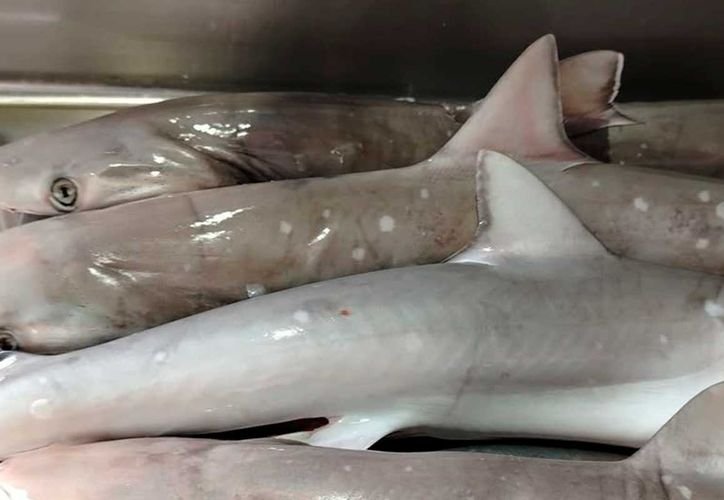
Quintana Roo, Mexico — Researchers are warning that shark meat sold in markets across Quintana Roo often comes from juvenile sharks and species at risk, and that the absence of clear labeling means many consumers do not know what they are buying.
At supply centers in the municipalities of Benito Juárez, Solidaridad and Cozumel, the lack of precise origin labels prevents buyers from identifying the exact species they purchase. The gap in traceability, from artisanal fishing docks to the final consumer, encourages the inadvertent substitution of seafood products.
Most shark marketed along the coast consists of juvenile specimens that have not reached reproductive maturity, accelerating the species’ population decline, researchers said.
The problems include:
- Lack of traceability: Transparent labeling is absent at sales points.
- Pressure on juveniles: Fishermen target and consumers prefer smaller cazones that have not reproduced.
- Product substitution: Most buyers do not know which species they are purchasing.
- Regional differences: Demand patterns vary even between nearby states such as Campeche and Quintana Roo.
- Invisible labor: Women’s work in cleaning fish and baiting hooks is not recognized.
Market demand drives shark fishing
Juan Carlos Pérez Jiménez, a researcher at Ecosur (El Colegio de la Frontera Sur) and a member of the International Union for Conservation of Nature’s (IUCN) Shark Specialist Group, said market demand directly shapes fishing practices through local traditions.
“Consumption and demand for shark meat or other products determine what is caught,” he said. “In Campeche, for example, there is a ray species known as ‘cachucha’ (Rhinoptera brasiliensis) that is not consumed despite the region’s strong seafood tradition. People don’t like it because the meat is too red. Fishermen avoid it and only catch it when other catches are very low.”
He stressed the need to raise public awareness about the preference for small specimens. “There are preferences, like the taste for small specimens or cazones, that can give us hints about what is being caught and how. But the main problem is that the average consumer does not know what they are eating. Many people do not realize they are eating shark. There is a long way to go in raising awareness; in an ideal world, we would have labeling systems so people know whether the species they consume are at risk.”
Multidisciplinary approach needed
Nadia Sandoval, a postdoctoral researcher at the Colegio de la Frontera Sur who specializes in conservation genetics, said biological and molecular characterization is essential to understanding commercial routes.
“Shark consumption is extremely complex and cannot be addressed only from a fisheries perspective,” she said. “Because it involves multiple species, we need to understand the biology of each species and how it interacts with its environment. Consumption also changes dramatically by region; the Pacific is not the same as the Gulf of Mexico. Even in areas as close as Campeche and Quintana Roo, consumption patterns are very different. That complexity forces us to approach conservation measures from a multidisciplinary angle.”
Social inclusion in the supply chain
Leonora Fernanda Mondragón Sánchez, a doctoral candidate at Ecosur specializing in the value chain of fishery resources, said all participants in the process must be recognized.
“It is crucial to identify every actor so that no one is left invisible, as happens with women’s participation in cleaning the product or baiting hooks,” she said. “We need to map everyone involved: researchers, civil organizations, regulators, inspectors, the fishermen themselves, and consumers. By recognizing each person’s role, we can make visible the responsibility we all carry — from the fisherman who must respect regulations to the consumer who should not buy products during closed seasons. To understand their needs, we must engage directly with the people who work on the coast every day.”
Shark and cazón fishing remains an economic and historical pillar for food security along Mexico’s coastlines, keeping alive the saying: “Sharks, food and work for everyone.”
More Environment
- Texas’ Big Bend Becomes Border Wall Battleground
- Contemporary Maya Sculpture Installed in Sacalaca Cenote to Draw Community Tourism
- Mexico to Review Private Events Held Inside Tulum National Park
- Cancún Sargassum Arrivals Ease in September, but Officials Watch the Winds
- Mexico Holds Second National Earthquake Drill; Alerts to Sound at Noon
More Quintana Roo
- Quintana Roo Tightens Rules for Scuba Divers Arriving With Specialized Gear
- Rafael Martínez Ruiz Named New Head of Mexico’s Migration Institute in Quintana Roo
- Quintana Roo Regulates Rental Golf Carts With New Inspection Rules
- Mexico Drill Saturday Will Sound Alerts on 80 Million Phones
- Cancun Hotels Look to 2027 for Rate and Occupancy Rebound
