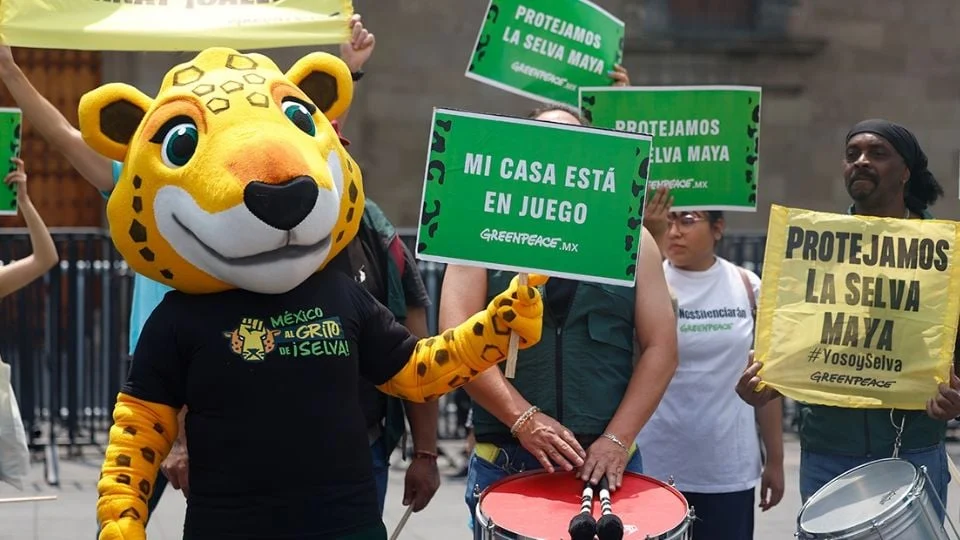
Mexico City — Greenpeace Mexico has launched the “Jaguar Route,” a campaign using the official mascot of Mexico’s 2026 World Cup team to draw global attention to the destruction of the Maya Forest in southeastern Mexico.
The environmental group unveiled “Kanan,” a symbolic jaguar figure, at a public event in Mexico City, marking the start of a nationwide tour that will also visit Cancún, Monterrey and Guadalajara — all host cities for the 2026 World Cup.
Activists said the campaign aims to “make visible the urgency of protecting the Maya Forest, a key ecosystem facing environmental threats.”
The 2026 World Cup, co-hosted by Mexico, the United States and Canada, kicks off June 11 at the Azteca Stadium in Mexico City. Greenpeace noted that the climate crisis is already disrupting life on the planet and pointed to extreme weather events such as heat waves and unusual rainfall linked to global warming that could alter the dynamics, dates or venues of the tournament.
For the first time in World Cup history, organizers will implement mandatory hydration breaks in all matches, the group said. “If we continue to allow the devastation of key ecosystems like the Maya Forest to curb climate change, it will not only change the game — it will change life itself,” Greenpeace warned.
The tour of Kanan is designed to raise awareness about the risks facing the jaguar’s habitat. The figure will travel to public spaces in several cities to bring citizens closer to the importance of conserving the Maya Forest, considered one of the region’s most important lungs and home to the jaguar, a keystone species for ecological balance.
Greenpeace recalled that the jaguar, an endangered species, and its habitat are being fragmented by tourism megaprojects, agro-industrial expansion and unprecedented rapid deforestation across the Yucatán Peninsula in southeastern Mexico.
More Environment
- Judge Halts Trump Border Barrier in Big Bend National Park
- US Coast Guard Seizes Cargo Ship Accused of Smuggling Fuel to Cuba
- Playa del Carmen to Renew Eight Blue Flag Beach Certifications, Eyes Two More
- Cancún Sets October Dates for Free Dog and Cat Sterilization Clinics
- Sargassum Influx Triggers Two Types of Wildlife Die-Offs in Quintana Roo
More Quintana Roo
- Quintana Roo Remains Far from Electronic Voting, INE Official Says
- Experts Highlight Social Memory as Key to Disaster Prevention in Quintana Roo
- Quintana Roo to Launch World’s First Formal Sargassum Fishery With 840 Fishermen
- INE Opens 2026-2027 Federal Electoral Process in Quintana Roo, Vows to Tackle Voter Apathy
- Quintana Roo High School System Aims to Install Cameras at All 44 Campuses