
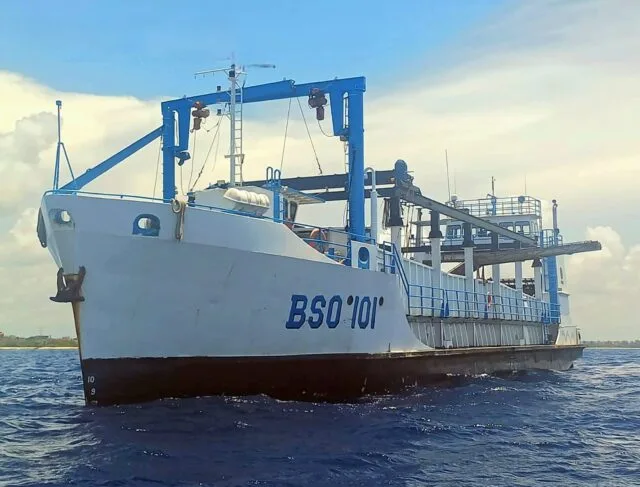
Cancún, Quintana Roo — The state government of Quintana Roo, in coordination with federal authorities, is preparing a new strategy to combat sargassum that includes deploying a much larger collection vessel and installing barriers at deeper, strategic points.
Governor Mara Lezama announced that she recently met with officials from the Mexican Navy to develop the plan, prompted by satellite imagery showing a massive sargassum bloom approaching the state’s coastline.
The strategy will be presented to President Claudia Sheinbaum next week for approval. Lezama declined to specify the investment amount, saying budget projections are still being finalized.
“A contingency like this, which is a natural phenomenon, requires reviewing year by year what works — whether barriers function in certain areas and how they operate in zones with higher waves,” Lezama said.
She emphasized that a vessel three times larger than the current Natans ship will soon arrive in Quintana Roo. Its primary mission will be to collect sargassum in open ocean, reducing the amount reaching the coast.
The governor noted that sargassum does not appear every day on every beach and urged the public to consult the daily sargassum traffic light reports for beach conditions.
As of May 11, authorities had collected 36,000 metric tons of sargassum, a figure Lezama said reflects the scale of the phenomenon and the need to reinforce the strategy. She added that the monitoring center allows real-time identification of sargassum masses and planning of collection routes farther offshore, though this presents greater logistical challenges.
Hoteliers in Playa del Carmen have been pressing for more resources. Offner Arjona, president of the Association of Small Hotels of Playa del Carmen, recently reiterated the need for additional vessels capable of collecting the algae in open water.
More Environment
- Nine Sick Dolphins Stranded in Abandoned Cancún Water Park
- Playa del Carmen Presses Federal Officials to Halt Wildlife Exploitation Permits
- Scientists Detect Early Signs of Groundwater Contamination in Quintana Roo
- 22 Hotels in Mexico’s Caribbean Join Dune Restoration Push
- Cancún Protesters Demand Answers on Fate of Big Cats Kept by ‘Pepe Tigre’
More Quintana Roo
- Measles Cases Surge 1,940% in Mexico’s Yucatan Peninsula
- Microplastics, Sunscreen Chemicals and Repellents Under Study in Quintana Roo Waters
- Quintana Roo to Present Mexican Caribbean Cenote Guide at DEMA Show 2026
- Quintana Roo Rethinks Tourism Model as Visitor Spending Falls
- Drainage Connection Gap Worsens Pollution of Cenotes and Beaches in Quintana Roo