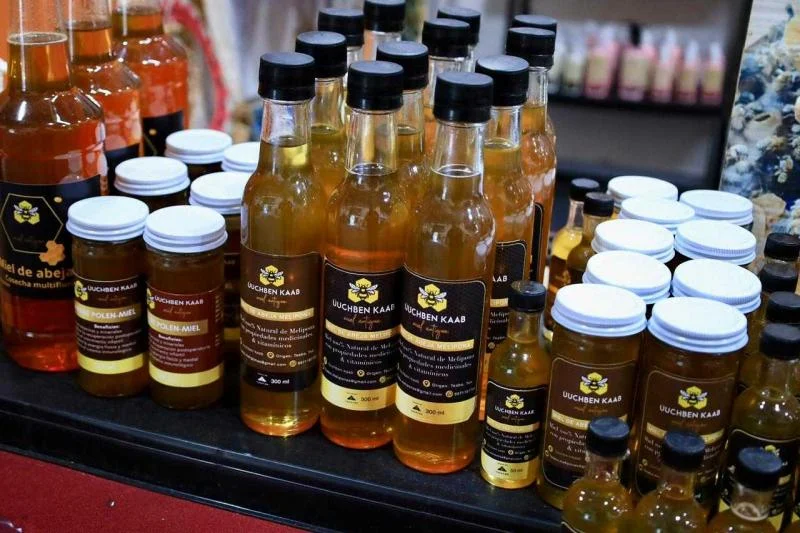
Mexico City — Yucatecan honey has taken center stage at the Semana Yucatán fair in Mexico City, where 12 exhibitors are showcasing why the region’s honey is considered among the world’s best. The event highlights unique varieties such as Apis honey from Dzidzilché and the legendary Melipona bee honey.
Chef Edwin Medina of the Abeja Gourmet brand, participating with support from the state’s Rural Development Secretariat (Seder), emphasized the technical superiority of Dzidzilché honey, a variety highly prized in European and U.S. markets for its natural chemical composition.
“Dzidzilché honey lacks fructose and sucrose, which means it crystallizes minimally or not at all. This gives it an exceptional, balanced flavor, unlike other honeys that are more resinous or saturated,” Medina explained.
Medina described his work as a bridge between professional technique and ancestral knowledge. “I’ve spent two years learning not just the academic side, but the wisdom of my relatives and my mother, who inherited a legacy of more than 40 years of beekeeping from my grandfather,” he said.
At the Semana Yucatán fair, organized by the state government led by Governor Joaquín Díaz Mena, 60% of exhibitors are women, reflecting their key role in the local economy and productive projects.
Medina acknowledged the female leadership behind his production. “My mother, Leticia de Jesús, is the queen bee, and I am the worker,” he said, noting that she holds the true beekeeping knowledge and land ownership, while he transforms that heritage into gastronomic innovation.
The fair also features the Melipona Beecheii bee. Anselma Chalé of Cuchil Kaab and Blanca Itzá May of Miel Melipona Úuchben Kaab explained that this stingless bee produces a sacred honey. “Per hive, we only get between 750 milliliters and one liter per year,” Itzá May said.
Semana Yucatán has demonstrated that Yucatecan beekeeping has evolved toward product transformation. Itzá May reported a 70% increase in sales of her natural cosmetics line compared to last year. “Here in Mexico City, people really value derivatives like royal jelly facial creams and melipona wax eye contour products,” she said.
Visitor response has exceeded expectations, with overall sales reaching 60,000 items totaling more than 11 million pesos (about $550,000) from May 8 to 12, according to the Yucatán Secretariat of Economy and Labor (SETY). The honey sector alone sold 750,000 pesos in the first four days.
Visitors can find a wide range of products: artisanal meads with wild fermentation (mixing Dzidzilché honey with hibiscus or pollen), honeys enriched with spices like ginger and turmeric (golden milk), honey with morita chili, and traditional sweets made without added sugar.
Cosmetic-grade offerings include honey shampoo with coconut oil, facial tonics, relaxing lavender body creams, and an eye contour product made with melipona beeswax and vitamin E. Soaps for different skin types feature ingredients like royal jelly, nacre shell, oatmeal, propolis, and rosemary, along with lip balms and creams with a “botox effect.” Also available are propolis syrups for respiratory health, pure honey droppers for eye care, and natural vitamin supplements.
Producers agreed that government support has been key to their presence in the capital. Medina noted that many beekeepers have benefited from inputs and programs from Seder and are now pursuing ambitious projects under the Renacimiento Maya model. “Events like this give us visibility and promotion. We come thanks to the state government’s support,” he said.
The Semana Yucatán fair runs through Sunday, May 17.
More Lifestyle
- Taco Social Run to Bring Recreation, Live Music and Street Tacos to Cancún’s Avenida Yaxchilán
- Playa del Carmen to Renew Eight Blue Flag Beach Certifications, Eyes Two More
- Cancún Sets October Dates for Free Dog and Cat Sterilization Clinics
- Quintana Roo Governor Urges Youth to Help Draft New Rights Law
- Playa del Carmen Reviews Parking Meter Concession Over Alleged Violations