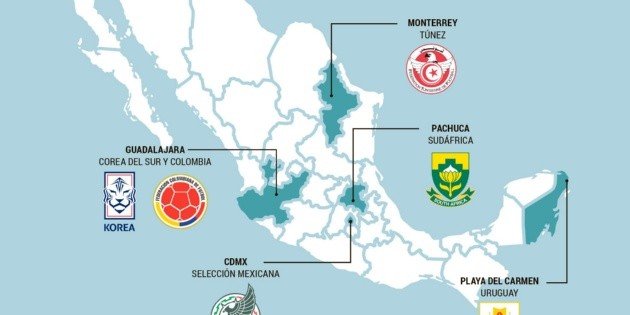
Guadalajara, Mexico — The logistical organization of the 2026 World Cup continues to reveal details about how national teams will approach the largest tournament in soccer history. Although Mexico is one of three host nations alongside the United States and Canada, not all teams playing matches on Mexican soil will establish permanent residence there during the competition.
Teams such as Spain, Japan, Sweden, Czech Republic, and Uzbekistan have matches scheduled in Mexico City, Guadalajara, and Monterrey, but that does not mean they will live in the country throughout the tournament.
FIFA has implemented a system of shared venues and “geographic clusters” for this edition, aiming to reduce long travel between matches and optimize player recovery. Under this model, most teams have decided to set up their base camps primarily in U.S. cities and, to a lesser extent, in Canada.
Of the 48 participating teams, around 40 will have their operational centers on U.S. soil, due to the extensive sports, hotel, and air connectivity infrastructure available. This makes the United States the main logistical hub of the tournament, even for teams that will play some of their matches in Mexico.
Federations playing in Mexican stadiums will operate under a so-called “Transit Venue” model. This means they will travel to Mexico only to fulfill official activities before each match. According to the planned protocol, delegations will arrive on private charter flights approximately 48 to 72 hours before the corresponding game.
During their brief stay, they will exclusively use facilities assigned by the Local Organizing Committee for light training, pitch recognition sessions, and media activities. Practices will generally take place at alternate fields designated around the World Cup stadiums, in evening slots before kickoff.
Once the match concludes, teams will return almost immediately to their camps in North America, where they will maintain their concentration routines, physical recovery, and tactical preparation. The intention is to avoid excessive travel and provide greater operational stability for teams during a tournament spanning vast geographic distances.
This format represents a significant change from previous World Cups, where teams used to stay for entire weeks in a single host country. In 2026, the magnitude of the competition forced the design of unprecedented logistical strategies to balance athletic performance, rest, and mobility.
Thus, while Mexican fans will be able to enjoy the presence of international powers in their cities, many of those teams will only be in the country for very brief periods before continuing their World Cup journey from bases in the United States or Canada.
Guadalajara: Latin and Asian capital
- Team: South Korea
Training venue: Club Deportivo Guadalajara (Verde Valle)
Accommodation: The Westin Guadalajara (or Hard Rock Hotel)
The “Tigers of Asia,” direct group rivals of Mexico, have opted for the traditional home of Chivas, ensuring natural grass pitches with optimal maintenance and FIFA-approved specifications for their pre-tournament World Cup preparation. - Team: Colombia
Training venue: Academia AGA (Atlas FC)
Accommodation: Grand Fiesta Americana Country Club
The Colombian squad will debut the state-of-the-art rojinegro complex in Nextipac. These cutting-edge facilities offer high-performance gyms, advanced medical areas, and the privacy needed to safeguard their international stars.
Mexico City: The host’s fortress
- Team: Mexico
Training venue: FMF High Performance Center (CAR)
Accommodation: Internal CAR facilities
True to tradition and seeking maximum logistical comfort, the national team led by Javier Aguirre has decided to fully bunker down in the south of the capital. The CAR has undergone a state-of-the-art technological renovation to mitigate the impact of Mexico City traffic by eliminating external transfers. The great competitive advantage of this headquarters is the scientific adaptation to 2,240 meters above sea level, a key factor ahead of the opening match on June 11 against South Africa at the Estadio Azteca.
Playa del Carmen: The Caribbean cloister bunker
- Team: Uruguay
Training venue: Fairmont Mayakoba Sports Complex
Accommodation: Fairmont Mayakoba (Playa del Carmen, Quintana Roo)
The Uruguayan Football Association (AUF) surprised by isolating itself in the Riviera Maya. Despite having matches scheduled in the United States (Miami) and closing their group stage in Guadalajara against Spain, the coaching staff of “La Celeste” prioritized the mental factor. The Mayakoba complex allows the delegation to walk from the lodging villas to the training fields integrated into the jungle and mangrove, guaranteeing a hermetic environment.
Monterrey: Northern resistance
- Team: Tunisia
Training venue: Rayados Training Center (El Barrial)
Accommodation: InterContinental Presidente Monterrey / Westin Monterrey Valle
The “Eagles of Carthage” will challenge the high temperatures of the Sultana del Norte by establishing their base of operations at the exclusive El Barrial complex in Santiago, Nuevo León. Owned by Club de Futbol Monterrey, this facility is surrounded by nature and offers perfect isolation in the mountains, ideal for tactical and physical work ahead of their group stage matches.
Pachuca: Altitude as a tactical weapon
- Team: South Africa
Training venue: Universidad del Futbol and Estadio Hidalgo (Grupo Pachuca)
Accommodation: Camino Real Pachuca
The Bafana Bafana chose the Bella Airosa as their base. As direct rivals of Mexico in the opening match, the South Africans will seek to counteract the advantage of Aztec home field by acclimatizing to an altitude of 2,400 meters above sea level (higher than Mexico City). Their training will be split between the cutting-edge academic fields of the Universidad del Futbol and the pitch of Estadio Hidalgo.
More Events
- Taco Social Run to Bring Recreation, Live Music and Street Tacos to Cancún’s Avenida Yaxchilán
- Playa del Carmen Takes Artisans to Guanajuato Day of the Dead Festival
- Xcaret Festival of Life and Death Returns for 20th Edition With Guanajuato as Guest State
- Cancún to Host First Claude Community Gathering for Hospitality in Latin America
- Cancún’s October 2026 Concert Lineup: Mijares, Enjambre and The Chainsmokers Headline a Packed Month